

The Idea of Space in Mathematics: A Philosophical Journey
The concept of space is one of the most fundamental and enduring ideas in human thought, deeply intertwined with our understanding of reality, perception, and the very structure of the universe. Within mathematics, this idea transcends mere physical emptiness, evolving into a rich tapestry of abstract structures and formal systems. This pillar page embarks on a philosophical journey through the history of mathematics, exploring how thinkers from antiquity to the modern era have grappled with, defined, and redefined space, transforming it from a simple container into a dynamic, multifaceted mathematical entity intimately linked with quantity and structure. We will trace this evolution, drawing insights from the Great Books of the Western World, to illuminate the profound philosophical underpinnings of mathematical space.
The Ancient Foundations: Euclid and the Geometry of Ideal Space
Our journey into the idea of space in mathematics invariably begins with the ancient Greeks, particularly Euclid. His monumental work, The Elements, published around 300 BCE, laid the bedrock for what would become classical geometry for over two millennia. For Euclid, space was an implied, absolute, and uniform container—an infinite expanse within which points, lines, and planes existed and interacted according to immutable laws.
Key Characteristics of Euclidean Space:
- Absolute and Homogeneous: Every point in space is identical, and the properties of space are the same everywhere. There is no preferred origin or direction.
- Infinite: Space extends indefinitely in all directions.
- Flat: Governed by the parallel postulate, which essentially states that through a point not on a given line, exactly one line parallel to the given line can be drawn.
- Geometric Primitives: Defined by fundamental ideas like points (having position but no quantity), lines (length but no width), and planes (length and width but no depth).
The quantity of objects and their relations—distances, areas, volumes—were central to Euclidean geometry. The idea of measurement and magnitude was inherently tied to this absolute space. While Euclid didn't explicitly define space as a philosophical entity, his axiomatic system implicitly presented space as a pre-existing, objective reality discoverable through reason. This mathematical framework was so compelling that it profoundly shaped Western thought, influencing philosophers from Plato to Kant.
From Abstract Space to Coordinate Systems: Descartes and Analytical Geometry
Centuries later, the 17th century brought a revolutionary shift in the idea of space with René Descartes' invention of analytical geometry. In his Discourse on Method and La Géométrie, Descartes introduced the concept of coordinate systems, effectively bridging the gap between geometry and algebra.
Prior to Descartes, geometry dealt with figures and their properties, while algebra dealt with quantity and equations. Descartes' brilliant insight was to assign numerical coordinates to points in space, allowing geometric shapes to be described by algebraic equations.
The Cartesian Revolution:
- Numerical Representation: Every point in a plane could be uniquely identified by an ordered pair of numbers (x, y), and in three dimensions by (x, y, z).
- Algebraic Description of Geometry: Lines, circles, and other curves could now be represented by equations. This transformed the study of space from drawing and measurement into calculation and manipulation of symbols.
- Unification of Disciplines: This idea effectively unified two previously separate branches of mathematics, opening up vast new avenues for inquiry.
This development profoundly altered the mathematical idea of space. While Euclidean geometry dealt with space as a container for ideal forms, Cartesian geometry provided a framework for quantifying and analyzing space through numbers. It laid the groundwork for modern calculus and physics, where space is often treated as a numerical manifold.
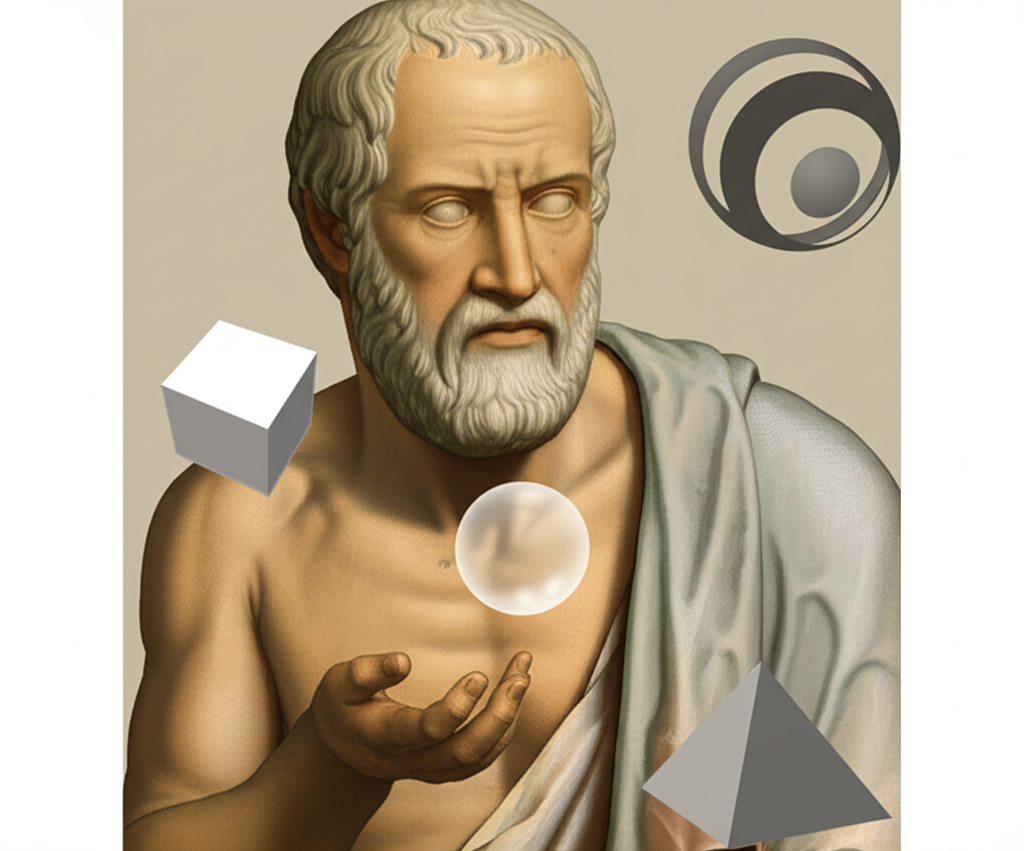 subtly outlined in the background, suggesting ideal forms. In the foreground, partially overlaid, are the faint lines of a Cartesian coordinate system, symbolizing the transition from ancient geometric ideals to modern analytical approaches to space.)
Newton's Absolute Space vs. Leibniz's Relational Space
The 17th and 18th centuries witnessed a profound philosophical debate regarding the nature of space itself, primarily between Isaac Newton and Gottfried Wilhelm Leibniz. This intellectual clash, recorded in their correspondence and various philosophical works, directly impacts the mathematical idea of space.
Newton's Absolute Space
In his Principia Mathematica, Newton posited the idea of absolute space:
- Space is an independent, eternal, and unchanging entity, existing prior to and independently of any objects within it.
- It is like an invisible, infinite container, providing a fixed reference frame against which motion can be measured.
- Space is not affected by physical events; it is merely the stage upon which they unfold.
- This absolute space provided the necessary framework for Newton's laws of motion and universal gravitation, allowing for an absolute quantity of velocity and acceleration.
Leibniz's Relational Space
Leibniz, in contrast, championed the idea of relational space:
- Space is not an independent substance but rather a system of relations among objects.
- It is merely the order of co-existence of things, just as time is the order of succession.
- If there were no objects, there would be no space.
- Leibniz argued that Newton's absolute space was superfluous and metaphysically problematic, as it implied the existence of something unobservable and undiscernible. For Leibniz, all quantity and position were relative.
This debate had profound implications for mathematics. Newton's view supported a mathematical space that was a fixed stage for geometry and physics, while Leibniz's perspective hinted at a more abstract mathematical space defined by its inherent structure and relations, a precursor to modern topological and abstract algebraic spaces.
Kant and the Transcendental Aesthetic: Space as an A Priori Intuition
Immanuel Kant, in his Critique of Pure Reason, offered a groundbreaking philosophical idea about space that profoundly influenced subsequent mathematics and philosophy. Kant argued that space is not an empirical concept derived from experience, nor is it an objective reality existing independently of us (like Newton's absolute space). Instead, space is an a priori intuition, a fundamental structure of the human mind.
Kant's Conception of Space:
- A Priori Intuition: Space is a necessary precondition for our experience of the external world. We cannot conceive of objects without locating them in space.
- Form of Outer Sense: It is the way our minds organize and perceive sensory data from the external world.
- Source of Synthetic A Priori Truths: Geometric truths (like those of Euclidean geometry) are not mere tautologies (analytic a priori) nor are they derived from experience (synthetic a posteriori). Instead, they are synthetic a priori judgments, universally true and necessarily applicable to our experience because space itself is a fundamental structure of our intuition.
- Foundation for Quantity: Our ability to perceive quantity and magnitude in the world is predicated on this inherent spatial intuition.
For Kant, Euclidean geometry was not just a description of physical space but a description of the space of our perception. This idea provided a powerful philosophical justification for the certainty and universality of mathematical truths about space, even as new mathematical concepts began to challenge the exclusivity of Euclidean geometry.
The Dawn of Non-Euclidean Geometries: Challenging the Absolute
The 19th century witnessed one of the most revolutionary developments in the mathematical idea of space: the emergence of non-Euclidean geometries. For centuries, Euclid's fifth postulate (the parallel postulate) had been a source of fascination and frustration for mathematicians. Attempts to prove it from the other axioms invariably failed.
Pioneers of Non-Euclidean Geometry:
- Carl Friedrich Gauss: Though he never published his findings, Gauss was among the first to explore geometries where the parallel postulate did not hold.
- János Bolyai and Nikolai Lobachevsky: Independently, they developed hyperbolic geometry (also known as Lobachevskian geometry) in the 1820s and 1830s. In this space, through a point not on a given line, infinitely many lines parallel to the given line can be drawn. This space can be visualized as having a constant negative curvature, like a saddle.
- Bernhard Riemann: In his seminal 1854 lecture "On the Hypotheses which lie at the Bases of Geometry," Riemann introduced elliptic geometry (also known as Riemannian geometry). In this space, no lines parallel to a given line can be drawn through a point not on it. This space can be visualized as having a constant positive curvature, like the surface of a sphere (where "lines" are great circles). Riemann also developed the general concept of a "manifold," a space that is locally Euclidean but can have a global curvature, opening the door to an infinite variety of possible geometries.
The idea that multiple, equally consistent geometries of space were possible was a profound shock to both mathematics and philosophy. It demonstrated that Euclidean space was not the only conceivable mathematical space, nor necessarily the space of the physical universe. This liberation of mathematics from a single, fixed idea of space paved the way for modern physics, particularly Einstein's theory of relativity, where spacetime itself can be curved.
| Type of Geometry | Parallel Postulate | Curvature | Example Visualization |
|---|---|---|---|
| Euclidean | Exactly one parallel | Zero | Flat plane |
| Hyperbolic | Infinitely many parallels | Negative | Saddle surface |
| Elliptic | No parallels | Positive | Surface of a sphere |
Space in Modern Mathematics and Physics
The 20th century further expanded the mathematical idea of space, moving far beyond the geometric and intuitive. Space in modern mathematics is often defined abstractly as a set of elements (points) endowed with a specific structure or properties.
Evolution of the Idea of Space:
- Vector Spaces: In linear algebra, a vector space is a collection of vectors that can be added together and multiplied by scalars, obeying certain axioms. This abstract space is fundamental to physics, engineering, and computer science. The quantity of dimensions can be finite or infinite.
- Metric Spaces: A metric space is a set with a defined "distance function" (metric) between any two points. This generalizes the idea of distance and allows for mathematical analysis on much more abstract sets.
- Topological Spaces: These are the most general spaces in mathematics, where the idea of "nearness" or "connectedness" is defined without necessarily having a metric. Topology studies properties of space that are preserved under continuous deformations (stretching, bending, but not tearing).
- Hilbert Spaces: Infinite-dimensional vector spaces with an inner product, crucial for quantum mechanics and functional analysis.
- Spacetime in Relativity: Einstein's theories revolutionized physics by merging space and time into a single four-dimensional continuum, spacetime, whose geometry is influenced by mass and energy. The quantity of matter dictates the curvature of spacetime.
These abstract spaces demonstrate how the mathematical idea of space has evolved from a concrete, physical container into a highly abstract and versatile concept, defined by its internal structure and the relationships between its elements. The quantity of dimensions, the properties of its points, and the operations that can be performed within it now define the space itself.
📹 Related Video: PLATO ON: The Allegory of the Cave
Video by: The School of Life
💡 Want different videos? Search YouTube for: ""History of Non-Euclidean Geometry Explained""
📹 Related Video: KANT ON: What is Enlightenment?
Video by: The School of Life
💡 Want different videos? Search YouTube for: ""What is a Vector Space? Linear Algebra Basics""
Conclusion: The Evolving Idea of Space
From Euclid's absolute and ideal geometry to Descartes' analytical coordinates, Newton's absolute container, Leibniz's relational framework, Kant's a priori intuition, and finally to the diverse, abstract spaces of modern mathematics and physics, the idea of space has undergone a profound transformation. What began as an intuitive understanding of our physical environment has blossomed into a sophisticated mathematical concept, capable of describing everything from the subatomic realm to the curvature of the cosmos.
This journey highlights that the mathematical idea of space is not static; it is a dynamic, evolving construct, continually refined and redefined by human inquiry. Each new conception has not only expanded our mathematical capabilities but has also deepened our philosophical understanding of reality itself, consistently challenging and enriching our perception of quantity, dimension, and the very fabric of existence. The philosophical quest to understand space remains a vibrant and essential endeavor, continually pushing the boundaries of what mathematics can describe and what the human mind can conceive.