

The Enduring Idea of Progress in Science
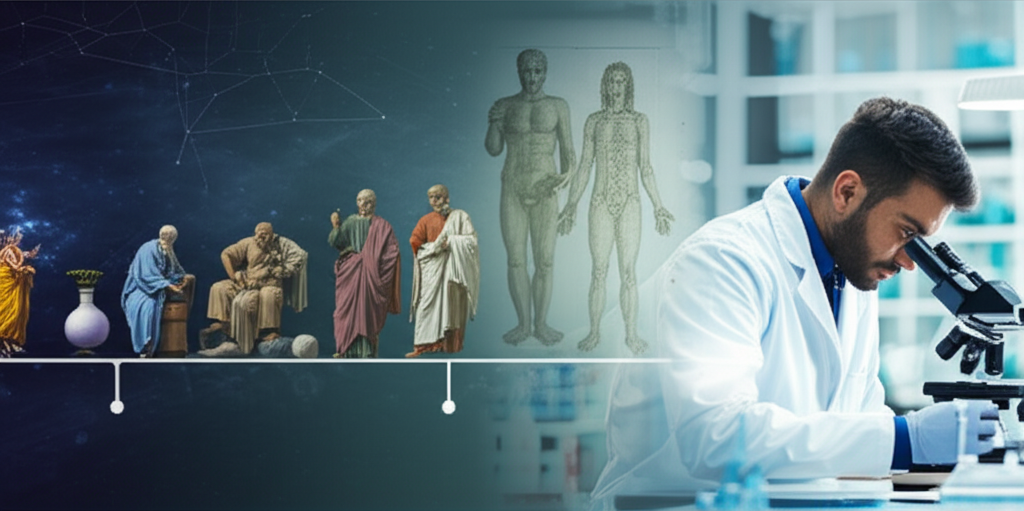
The concept of progress is deeply embedded in our understanding of science, shaping not only how we perceive scientific endeavors but also our broader hopes for humanity. This article delves into the multifaceted idea of progress within the scientific realm, exploring its historical roots, its pivotal role in shaping modern thought, and the nuanced ways in which scientific knowledge and methods evolve. Drawing insights from the rich tapestry of the Great Books of the Western World, we will examine how the pursuit of knowledge has been consistently viewed as a journey forward, even as we acknowledge its complexities and occasional detours.
Unpacking the Idea of Progress: From Cycles to Linear Ascent
The notion that humanity, particularly through its intellectual pursuits, is moving towards a better state is a relatively modern construct. Ancient philosophies, as explored in texts like Plato's Republic or Aristotle's Politics, often posited a cyclical view of history, where societies rise and fall, perpetually repeating patterns. Progress, in this context, was less about linear advancement and more about maintaining balance or returning to an ideal state.
However, with the dawn of the Enlightenment, a revolutionary idea took hold: that through reason and empirical observation, humanity could systematically improve its condition. This shift was profoundly influenced by the burgeoning field of science.
- Ancient View: Often cyclical, focusing on order, balance, and the return to an ideal.
- Enlightenment View: Predominantly linear, driven by reason, discovery, and the accumulation of knowledge.
Science as the Engine of Enlightenment Progress
The 17th and 18th centuries witnessed a profound transformation in human thought, largely propelled by figures who championed the scientific method. Thinkers like Francis Bacon, whose Novum Organum laid the groundwork for inductive reasoning, articulated a vision where systematic inquiry could unlock nature's secrets and, in doing so, alleviate human suffering.
Bacon’s emphasis on experimentation and observation was a direct challenge to scholastic traditions, proposing a new path to knowledge that promised tangible benefits. This was a powerful idea: that science was not merely an academic exercise but a practical tool for human betterment. René Descartes, in his Discourse on Method, further solidified the scientific approach, advocating for clear and distinct reasoning as the foundation for all knowledge.
The belief in scientific progress became a cornerstone of Enlightenment philosophy, fostering an optimistic outlook on humanity's capacity to overcome ignorance, disease, and social ills. This era saw the establishment of scientific academies and the widespread dissemination of scientific findings, reinforcing the collective idea that knowledge was accumulating, leading inevitably to a brighter future.
The Evolution of Understanding: Darwin and Beyond
Perhaps no single scientific theory epitomizes the idea of progress and evolution more profoundly than Charles Darwin's theory of natural selection. Published in On the Origin of Species, Darwin's work revolutionized biology, offering a mechanism for the gradual development and diversification of life forms over vast stretches of time. This wasn't just progress in understanding; it was a scientific articulation of progress itself within the natural world.
| Aspect of Evolution | Description | Impact on "Idea of Progress" |
|---|---|---|
| Biological Evolution | Gradual change in heritable traits of populations over generations. | Provided a scientific model for natural advancement and adaptation. |
| Evolution of Scientific Theories | The refinement, modification, or replacement of scientific paradigms. | Highlights that science itself is not static but progresses through critical revision. |
| Technological Evolution | The development and advancement of tools and methods. | Demonstrates the practical, cumulative nature of scientific application. |
The concept of evolution extends beyond biology. It can be seen in the evolution of scientific theories themselves. Think of the shift from Ptolemaic to Copernican cosmology, or Newtonian physics giving way to Einstein's relativity. These are not mere changes but represent a deeper, more accurate understanding of the universe, demonstrating a form of intellectual progress. Each new paradigm, while building on its predecessors, offers a more comprehensive or precise explanation, pushing the boundaries of human knowledge further.
Nuances and Challenges to Unfettered Progress
While the idea of progress in science has been a powerful motivator, it is not without its complexities and criticisms. The 20th century, with its world wars, environmental crises, and ethical dilemmas posed by advanced technologies, forced a re-evaluation of whether all scientific advancement truly constitutes "progress" in a universally beneficial sense.
- Ethical Considerations: The development of nuclear weapons, genetic engineering, or artificial intelligence raises profound questions about the moral implications of scientific capabilities. Is it progress if it carries the potential for widespread harm or existential risk?
- The Limits of Science: While science excels at explaining the natural world, it often struggles with questions of meaning, purpose, or ultimate values, areas traditionally explored by philosophy and religion.
- The Social Context of Science: Scientific progress is not isolated; it is influenced by societal values, funding priorities, and political agendas. What is deemed "progress" can vary significantly across different cultures and historical periods.
These challenges remind us that the idea of progress is not a simple, linear march forward but a dynamic, often contested, and ethically charged journey.
The Enduring Philosophical Quest for Progress
Despite these challenges, the fundamental idea of progress in science endures. From the earliest inquiries into the nature of reality to the cutting-edge research of today, humanity has consistently sought to understand, explain, and improve its world. The Great Books of the Western World are replete with examples of this quest – from Archimedes' mathematical innovations to Galileo's astronomical observations, from Newton's laws of motion to Darwin's theory of evolution. Each contribution, however incremental, pushed the boundaries of what was known and what was possible.
Ultimately, the idea of progress in science is more than just an accumulation of facts; it is a testament to the human spirit's insatiable curiosity, its capacity for rational inquiry, and its enduring hope for a better future. It is an ongoing evolution of understanding, a continuous dialogue between observation and theory, always striving for greater clarity and deeper insight into the universe and our place within it.
📹 Related Video: What is Philosophy?
Video by: The School of Life
💡 Want different videos? Search YouTube for: ""The Philosophy of Science - Karl Popper and Thomas Kuhn""
📹 Related Video: KANT ON: What is Enlightenment?
Video by: The School of Life
💡 Want different videos? Search YouTube for: ""History of the Idea of Progress - Enlightenment Thinkers""