

The Relentless Ascent? Unpacking the Idea of Progress in Science
A Philosophical Inquiry into Scientific Advancement
The concept of progress often feels self-evident when we consider science. From the ancient astronomers charting the heavens to the modern physicists unraveling the universe's fundamental forces, there appears to be an undeniable march forward, a continuous accumulation of knowledge and a refinement of understanding. Yet, for all its apparent clarity, the idea of progress in science is a deeply complex philosophical construct, riddled with nuances and subject to rigorous debate. This article delves into the historical evolution of this idea, examining how we define and measure scientific advancement, and exploring whether this progress is truly linear, inevitable, or even uniformly beneficial. We will consider how scientific evolution itself shapes our perception of progress, moving beyond a simplistic narrative to appreciate the profound philosophical questions at its core.
The Genesis of an Idea: From Cycles to Linear Advancement
For much of antiquity, the prevailing worldview, as reflected in many of the Great Books of the Western World, often embraced cyclical notions of time and history. Societies rose and fell, knowledge was rediscovered and lost, and the cosmos itself was seen as moving through repeating patterns. The idea of a continuous, upward progress was not a universal given. It was largely during the Enlightenment, fueled by the burgeoning successes of the scientific revolution, that this linear conception of progress truly took root. Thinkers like Francis Bacon championed empirical observation and systematic inquiry, laying the groundwork for a belief that through science, humanity could steadily improve its condition and understanding.
This shift marked a profound reorientation of human thought. Science became not just a method for understanding the world, but a primary engine for its betterment. The accumulation of verifiable facts, the development of predictive theories, and the subsequent technological innovations seemed to offer irrefutable proof that humanity was on an accelerating path toward enlightenment and mastery.
Science as the Engine of Progress: A Compelling Narrative
The history of science provides a compelling narrative for the idea of progress. Consider these transformative shifts:
- From Geocentric to Heliocentric: The profound leap from Ptolemy's Earth-centered universe to Copernicus's Sun-centered model, later refined by Kepler and validated by Galileo, was a monumental step in astronomical understanding. It wasn't just a change; it was a demonstrably more accurate and predictive model.
- Newtonian Mechanics: Isaac Newton's synthesis of celestial and terrestrial mechanics provided a universal framework that explained motion and gravity with unprecedented precision, leading to incredible technological advancements and a deeper understanding of the physical world.
- The Germ Theory of Disease: The work of Pasteur and Koch revolutionized medicine, replacing superstitious beliefs with empirical understanding, leading to dramatic improvements in public health and life expectancy.
These examples, among countless others, illustrate how science has consistently refined our understanding, corrected misconceptions, and empowered us with new capabilities. The very methodology of science – observation, hypothesis, experimentation, and peer review – seems inherently designed to foster this cumulative growth.
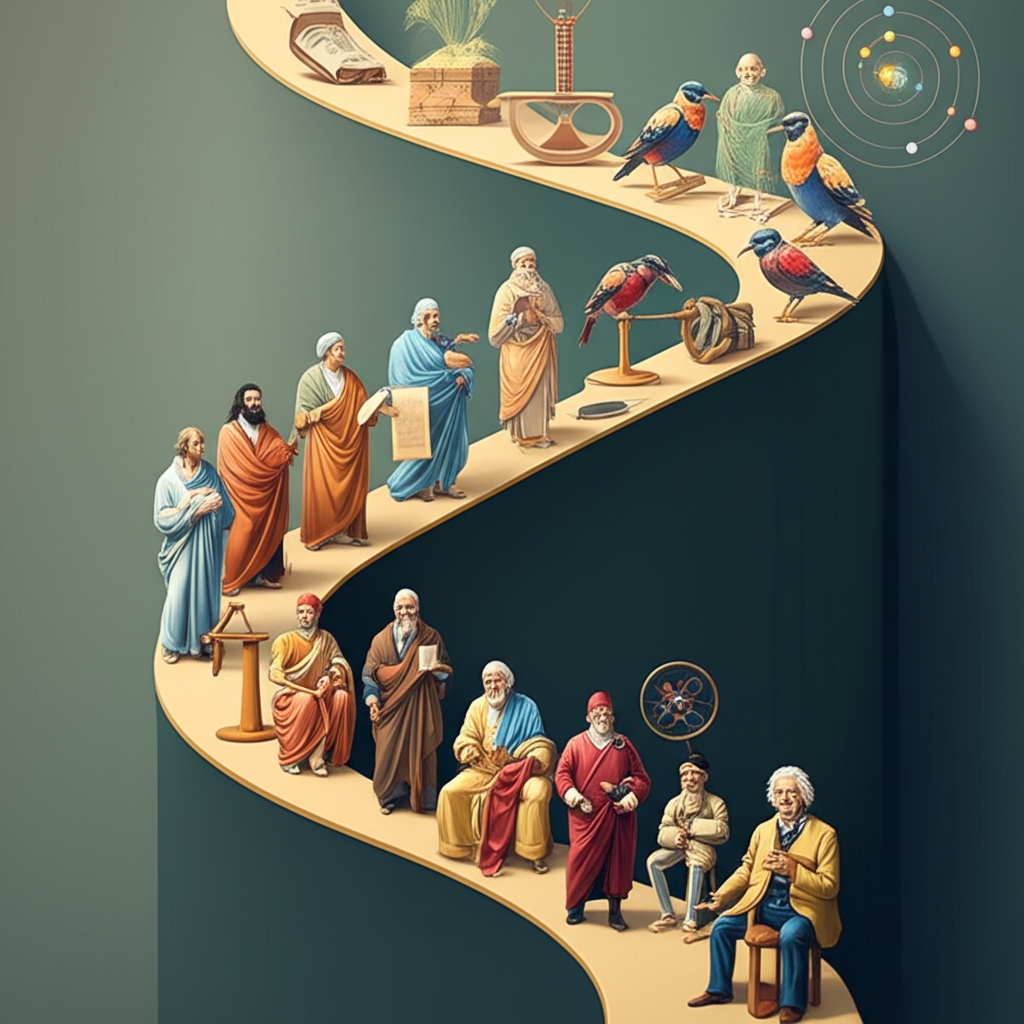
The Shadow of Evolution: Change vs. Improvement
The concept of evolution, particularly biological evolution as articulated by Charles Darwin, introduced another layer of complexity to the idea of progress. While often interpreted as a march from simpler to more complex, or "lower" to "higher" forms, Darwinian evolution fundamentally describes adaptation and change, not necessarily an inherent drive towards perfection. Organisms evolve to suit their environment; they don't necessarily "progress" in a universal sense.
This distinction is crucial when applied to scientific theories themselves. Does science evolve in the same way? When a scientific paradigm shifts, as Thomas Kuhn described, is it always a "progress" towards a more truthful or accurate representation of reality, or simply a different, perhaps more useful, way of organizing our understanding?
Consider the following perspectives on how scientific theories change:
- Popper's Falsification: Karl Popper argued that scientific progress occurs not by verifying theories, but by falsifying them. Each time a theory withstands attempts at refutation, or is replaced by a new theory that explains more and survives stricter tests, we make progress by getting closer to the truth, or at least eliminating falsehoods.
- Kuhn's Paradigm Shifts: Thomas Kuhn, in contrast, suggested that science progresses through periods of "normal science" within an accepted paradigm, punctuated by revolutionary "paradigm shifts." These shifts are not always purely rational, and the new paradigm is not necessarily "truer," but rather offers a different framework that resolves anomalies the old one could not. This perspective challenges a simple linear view of progress.
This intellectual evolution within the philosophy of science itself highlights that even our understanding of how science progresses is subject to change and refinement.
Nuances and Criticisms: Is Progress Always Good?
While the triumphs of science are undeniable, a critical philosophical stance requires us to question the unqualified embrace of progress. Is all scientific advancement inherently good? The development of nuclear physics led to both cleaner energy and weapons of mass destruction. Genetic engineering offers cures for diseases but also raises profound ethical dilemmas.
Furthermore, defining "progress" itself can be subjective. Is a more complex theory always better than a simpler one? Is a theory that offers greater predictive power always superior to one that provides deeper conceptual understanding? These questions challenge the simplistic notion of a straightforward, value-neutral ascent.
The idea of progress in science, therefore, is not a simple fact but a powerful narrative, a human interpretation imposed upon the dynamic, often messy, process of inquiry. It reflects our aspirations, our capacity for ingenuity, and our enduring quest for understanding, but it also demands constant philosophical scrutiny.
The idea of progress in science is a cornerstone of modern thought, deeply intertwined with our understanding of human potential and the advancement of civilization. While the empirical successes of scientific endeavor offer compelling evidence for a forward march, a deeper philosophical inquiry reveals its complexities. It is a journey marked by both revolutionary breakthroughs and subtle evolution, driven by human curiosity, and constantly challenging our definitions of "better" and "true." As we continue to push the boundaries of knowledge, the philosophical debate surrounding scientific progress will undoubtedly evolve alongside it.
📹 Related Video: What is Philosophy?
Video by: The School of Life
💡 Want different videos? Search YouTube for: "Philosophy of Science Progress - Kuhn vs Popper"
📹 Related Video: PLATO ON: The Allegory of the Cave
Video by: The School of Life
💡 Want different videos? Search YouTube for: "The Concept of Scientific Progress - History and Debates"