

The Unfolding Tapestry of Progress: Navigating the Idea in Science
The Idea of Progress in Science is a cornerstone of modern thought, painting a picture of humanity steadily advancing towards a more complete understanding of the universe. Yet, this seemingly straightforward notion is far from simple. It’s a complex, multifaceted idea deeply intertwined with our history, philosophy, and the very nature of discovery. This article will explore the historical roots of scientific Progress, delve into what we truly mean by progress in a scientific context, and consider how the concept of Evolution both exemplifies and complicates this powerful idea, drawing insights from the enduring wisdom of the Great Books of the Western World.
Introduction: The Allure and Ambiguity of Scientific Progress
It's a captivating notion, isn't it? The belief that Science is on an inexorable march forward, each discovery building upon the last, leading us to ever-greater truths. This Idea of Progress in Science is often taken for granted, a comforting narrative of human ingenuity and enlightenment. We see it in the incredible leaps from ancient astronomy to quantum physics, from rudimentary medicine to gene therapy. But as with many grand ideas, its surface simplicity belies profound philosophical depths. What constitutes progress in Science? Is it merely the accumulation of facts, or something more transformative? And how has this idea itself evolved over centuries of human inquiry?
From Antiquity to Enlightenment: Seeds of Scientific Advancement
The concept of linear Progress is not universal. Ancient Greek thought, as reflected in many texts within the Great Books of the Western World, often embraced cyclical views of history and knowledge. While there was certainly innovation and intellectual development, the idea of an endless, cumulative ascent towards perfect knowledge was not dominant. Aristotle, for instance, systematized vast amounts of knowledge, but his work was seen more as a comprehensive understanding of the natural world as it is, rather than a stepping stone in an infinite series of improvements.
It was with the Scientific Revolution and the Enlightenment that the Idea of Progress truly took root in the Western mind. Figures like Francis Bacon, with his emphasis on inductive reasoning and empirical observation, laid the groundwork for a Science that was not just contemplative but actively sought to expand human dominion over nature. René Descartes, advocating for systematic doubt and rational inquiry, further propelled the notion that through method, we could build knowledge on solid foundations. Isaac Newton's monumental synthesis of celestial and terrestrial mechanics became the ultimate testament to this new paradigm, demonstrating that rigorous scientific method could unlock universal laws. This era fostered the belief that Science was a cumulative enterprise, constantly refining and expanding our understanding, driving a seemingly inevitable Progress.
Defining Progress: More Than Just Accumulation
If we accept that Science progresses, how do we measure it? It's more than just gathering more data. Philosophers of Science have grappled with various metrics:
- Increased Predictive Power: A theory that can accurately predict future phenomena or previously unobserved events is often considered more progressive than one that cannot.
- Greater Explanatory Depth: Progress can mean moving from describing phenomena to understanding their underlying causes and mechanisms.
- Falsifiability and Testability: Karl Popper argued that scientific Progress comes through the rigorous testing and potential falsification of hypotheses, leading to stronger, more resilient theories.
- Problem-Solving Capacity: Imre Lakatos proposed that Progress occurs when a research program consistently makes novel predictions and solves problems more effectively than its rivals.
- Paradigm Shifts: Thomas Kuhn introduced the idea of scientific revolutions, where Progress isn't linear but involves radical shifts in fundamental assumptions and worldviews (paradigms).
| Criterion of Scientific Progress | Description | Example |
|---|---|---|
| Predictive Power | Ability to accurately forecast future observations or discover new phenomena. | Newtonian mechanics predicting planetary orbits. |
| Explanatory Depth | Moving beyond observation to understand underlying causes and mechanisms. | From observing disease symptoms to understanding microbial causes. |
| Falsifiability | Theories that can be rigorously tested and potentially disproven. | Einstein's theory of relativity being tested by observations during eclipses. |
| Problem-Solving | A theory's capacity to resolve anomalies or puzzles more effectively. | Quantum mechanics resolving issues unaddressed by classical physics. |
Evolution as a Paradigm of Progress (and its Ambiguities)
Perhaps no scientific idea better embodies the concept of Progress than Charles Darwin's theory of Evolution by natural selection. Darwin's work, a profound contribution to the Great Books of the Western World, revolutionized biology by providing a coherent, testable mechanism for the diversity and adaptation of life. It demonstrated how complex forms could arise from simpler ones, not through divine intervention, but through natural processes over vast stretches of time. This was a massive leap in explanatory depth and predictive power, allowing us to understand the relationships between species and even predict evolutionary trends.
Moreover, the very concept of Evolution can serve as a metaphor for Progress within Science itself. Scientific theories evolve. They are born, they compete, some thrive and adapt to new evidence, while others become obsolete. A good theory, like a successful species, is robust, adaptable, and capable of explaining a wide range of phenomena. When new data emerges that challenges an existing theory, the scientific community, much like a population facing environmental change, must adapt – either by refining the old theory or developing a new one that is better "fit" for the available evidence. This continuous process of refinement and replacement is, in essence, the Evolution of scientific knowledge, driving its Progress.
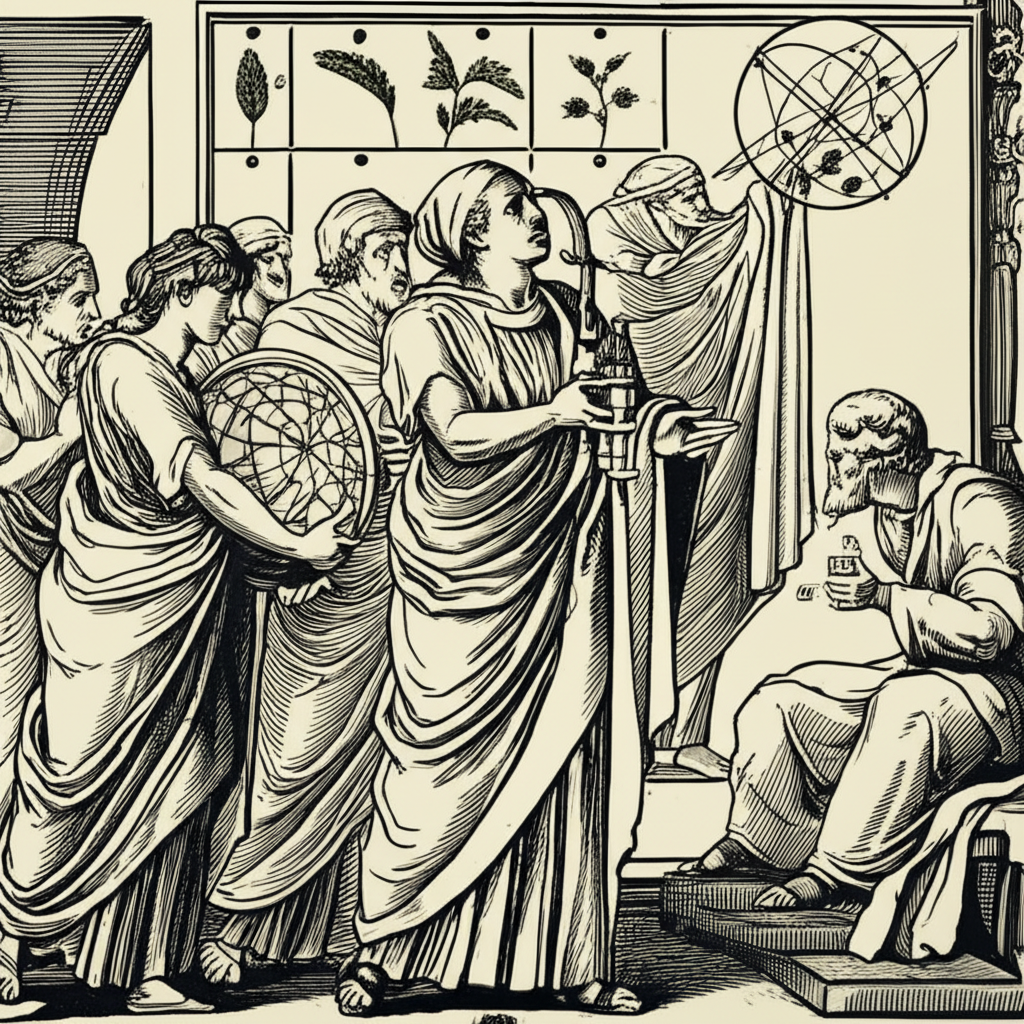 are collaboratively building a towering structure of knowledge. At the base, ancient Greek philosophers are laying foundational blocks, while at the top, modern scientists add intricate, glowing components, symbolizing the cumulative and progressive nature of scientific discovery across eras.)
The Shadows of Progress: Challenges and Critiques
Despite its undeniable appeal, the Idea of Progress in Science is not without its critics and complexities. Is all change Progress? Not necessarily. Sometimes, scientific paths lead to dead ends, or theories are discarded not because they are "wrong," but because they are less fruitful or elegant than alternatives. Furthermore, the notion of Progress can be anthropocentric, measuring advancement solely by human understanding or benefit.
The ethical implications of scientific Progress also demand scrutiny. Advances in nuclear physics led to devastating weapons, genetic engineering raises profound moral questions, and artificial intelligence presents both immense opportunities and potential existential risks. Can we truly call something Progress if its application leads to unforeseen harm or exacerbates societal inequalities? The Great Books remind us that wisdom must accompany knowledge.
Finally, the limits of scientific understanding itself pose a challenge. Are there fundamental questions that Science can never fully answer? Does the very act of observation alter the observed, as quantum mechanics suggests? These questions humble the idea of ultimate, linear Progress, reminding us that the universe may always hold mysteries beyond our grasp.
Conclusion: An Ever-Evolving Idea
The Idea of Progress in Science is a powerful engine of human curiosity and innovation. It has driven us to explore the cosmos, unravel the secrets of life, and transform our world in countless ways. From the foundational inquiries of ancient thinkers to the revolutionary insights of Darwin and beyond, Science has indeed demonstrated a remarkable capacity for advancement. However, as we reflect on this journey, it becomes clear that Progress is not a simple, linear ascent. It is a dynamic, sometimes circuitous, and often challenging process, deeply influenced by philosophical perspectives and societal values. Understanding this complex Idea — how it evolves, what it entails, and its profound implications — is crucial for navigating the future of scientific inquiry and ensuring that our pursuit of knowledge truly serves the betterment of humanity.
📹 Related Video: What is Philosophy?
Video by: The School of Life
💡 Want different videos? Search YouTube for: ""Philosophy of Science: Is Progress Real?""
📹 Related Video: PLATO ON: The Allegory of the Cave
Video by: The School of Life
💡 Want different videos? Search YouTube for: ""Thomas Kuhn and Scientific Revolutions Explained""