

The Idea of Good and Evil in Religion: A Journey Through Theological Foundations
Summary: This article explores the profound and multifaceted idea of Good and Evil as it has been conceptualized and debated within various religious traditions. Drawing upon foundational texts from the Great Books of the Western World, we delve into how theology grapples with defining morality, understanding the origins of malevolence, and the role of divine will and human agency in shaping ethical frameworks across diverse faiths.
Introduction: The Inescapable Dichotomy
From the earliest stirrings of human consciousness, the distinction between Good and Evil has been an inescapable dichotomy, a fundamental lens through which we interpret the world and our place within it. For millennia, this profound idea has found its most potent and systematic articulation within the realm of religion. Far from being mere abstract concepts, Good and Evil in theology are often woven into the very fabric of cosmic order, divine command, and the ultimate destiny of humanity. This exploration, drawing from the vast tapestry of thought preserved in the Great Books of the Western World, seeks to illuminate the diverse ways faiths have grappled with these enduring moral poles.
The Philosophical Genesis of the Good
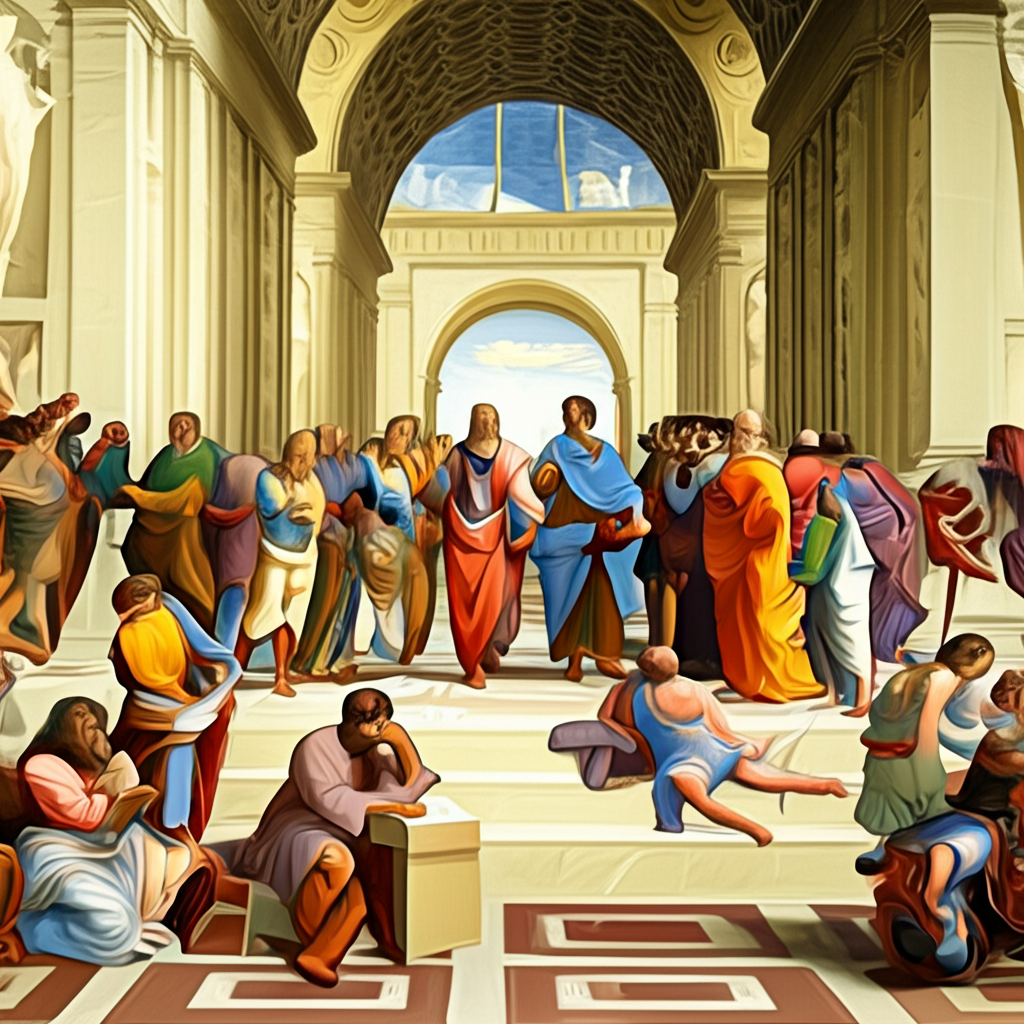
Before the intricate theologies fully blossomed, ancient philosophy laid crucial groundwork for understanding the Idea of the Good. Plato, for instance, in his Republic, posits the Form of the Good as the ultimate source of all being, knowledge, and value—a transcendent reality that illuminates all other forms, much like the sun illuminates the visible world. While not explicitly a religious doctrine in the modern sense, this philosophical quest for an ultimate, unifying principle of goodness deeply influenced subsequent theological thought, particularly within Christianity and Islam, which sought to identify this ultimate Good with God Himself. Aristotle, in his Nicomachean Ethics, approached the good from a more immanent perspective, defining it in terms of eudaimonia, or human flourishing, achieved through virtuous action. This focus on character and ethical conduct would similarly resonate through religious moral codes.
Religion's Defining Hand: Divine Command and Natural Law
The advent and development of organized religion significantly sharpened and codified the idea of Good and Evil. Here, morality is often not merely a matter of philosophical reasoning but a direct consequence of divine revelation or inherent in the divinely ordered cosmos.
- Monotheistic Perspectives on Moral Law
- Judaism: The covenant with God and the giving of the Torah (Law) at Sinai established a clear framework for Good and Evil. Actions are deemed good if they align with God's commandments, and evil if they transgress them. The idea of mitzvot (commandments) provides a practical guide for ethical living, emphasizing justice, righteousness, and mercy.
- Christianity: Building upon Jewish foundations, Christian theology introduces the concept of original sin, profoundly shaping the understanding of human propensity towards evil. The sacrifice of Christ offers a path to redemption and reconciliation with God, redefining goodness as not merely adherence to law but also faith, love, and grace. Augustine, in Confessions and City of God, wrestled intensely with the nature of evil, ultimately concluding it is not a substance but a privation of good, a turning away from God. Thomas Aquinas, integrating Aristotelian thought with Christian doctrine in his Summa Theologica, further developed the idea of natural law—the intrinsic moral order discoverable by human reason, reflecting God's eternal law.
- Islam: The idea of Good and Evil is inextricably linked to Tawhid (the oneness of God) and submission to His will. The Qur'an and the Sunnah (the teachings and practices of Prophet Muhammad) provide comprehensive guidance. Actions are good if they are in accordance with God's commands and lead to spiritual and societal well-being; evil actions are those that transgress divine limits and cause harm. The concept of fitra (innate disposition to good) suggests a natural inclination towards righteousness, though human free will allows for deviation.
The Problem of Evil: A Theological Conundrum
One of the most persistent and challenging questions within theology concerns the Problem of Evil: How can an all-powerful, all-knowing, and all-good God permit the existence of evil and suffering in the world? This question has spurred centuries of philosophical and religious debate, giving rise to various theodicies—attempts to reconcile God's attributes with the reality of evil.
Table: Major Theodicies in Religious Thought
| Theodicy Type | Core Argument | Key Proponents/Concepts |
|---|---|---|
| Free Will Theodicy | Evil arises from humanity's free choice to disobey God or misuse their freedom. God permits evil to preserve genuine moral agency and love. | Augustine, Alvin Plantinga |
| Soul-Making Theodicy | Evil and suffering are necessary challenges that allow humans to develop virtues, moral character, and grow spiritually. The world is a "vale of soul-making." | Irenaeus, John Hick |
| Best Possible World | God, being omnipotent and omnibenevolent, must have created the best possible world, even if it contains evil. Any alternative would be worse. | Gottfried Leibniz |
| Cognitive Limitation | Humans cannot fully comprehend God's ultimate plan or the reasons for evil; what appears evil from a limited human perspective may serve a greater, divine purpose. | Job, some mystical traditions |
Despite these sophisticated attempts, the tension between the idea of an omnibenevolent God and the undeniable reality of evil remains a profound area of inquiry, continually challenging and refining religious understanding.
The Enduring Idea: Good and Evil Beyond Dogma
Even in an increasingly secular age, the idea of Good and Evil persists, often retaining its religious echoes even when divested of explicit theological grounding. The moral frameworks developed within religion have profoundly shaped Western civilization's legal systems, ethical norms, and cultural values. While modern philosophy might seek secular justifications for morality (e.g., utilitarianism, deontology), the historical and psychological resonance of Good and Evil as categories of ultimate significance owes an immense debt to the centuries of religious thought that grappled with their origins, nature, and consequences. The quest to understand, define, and navigate the forces of Good and Evil remains a central human endeavor, continuously informed by the rich legacy of theology and philosophical inquiry.
Conclusion: A Continuing Dialogue
The idea of Good and Evil in religion is not a static dogma but a dynamic, evolving discourse. From Plato's transcendent Form to the nuanced theodicies of medieval scholars and beyond, religious traditions have offered profound insights into the nature of morality, the human condition, and the divine. They compel us to confront not only what we believe to be good or evil but also why we believe it, urging a continuous reflection on our actions, our character, and our place in the cosmic order. The dialogue between faith, reason, and experience in defining these ultimate poles continues, a testament to their enduring power over the human spirit.
📹 Related Video: PLATO ON: The Allegory of the Cave
Video by: The School of Life
💡 Want different videos? Search YouTube for: ""Plato Form of the Good Explained" "Problem of Evil Theodicy Debate""