

The Idea of Form in Poetry: An Exploration of Essence and Structure
Summary: In the realm of poetry, "Form" transcends mere structural convention; it is the tangible manifestation of an underlying "Idea," echoing the profound philosophical insights of classical thought. This article delves into how poetic form, from the strictures of a sonnet to the deliberate cadences of free verse, gives shape and meaning to abstract concepts, acting as both a vessel for and an integral part of the artistic expression. We will explore the philosophical lineage of this concept, drawing from the Great Books of the Western World, to understand how the idea of a poem finds its form, transforming language into enduring art.
The Enduring Question: What Gives Poetry Its Shape?
For centuries, thinkers have grappled with the essence of Art. What distinguishes a mere string of words from a profound poem? The answer, I contend, lies in the intricate relationship between the "Idea" a poet wishes to convey and the "Form" it ultimately assumes. This is not merely a question of meter or rhyme scheme, but a deeper philosophical inquiry into how structure itself imbues meaning, how the invisible becomes visible, and how transient inspiration is sculpted into timeless Poetry.
The Platonic Echo: From Ideal Idea to Poetic Form
To truly grasp the significance of form in poetry, we must first journey back to the wellsprings of Western philosophy, to the profound insights of Plato. For Plato, the world we perceive is but a shadow of a more perfect, eternal realm of "Forms" or "Ideas." These Forms are the ultimate reality, the perfect archetypes of which all earthly phenomena are imperfect copies.
How does this translate to Poetry? Consider the idea of beauty, justice, or love. A poet, inspired by these eternal Forms, seeks to capture their essence in language. The chosen poetic Form—be it a lyrical ode, a dramatic monologue, or an epic narrative—becomes the earthy vessel through which this higher Idea attempts to manifest. The poet, in a sense, is striving to create a poem that participates in the perfect Form of "Poem-ness," much like a craftsman tries to create a chair that embodies the ideal Form of "Chair." The very act of crafting lines, selecting words, and arranging stanzas is an attempt to give form to an idea that might otherwise remain ineffable.
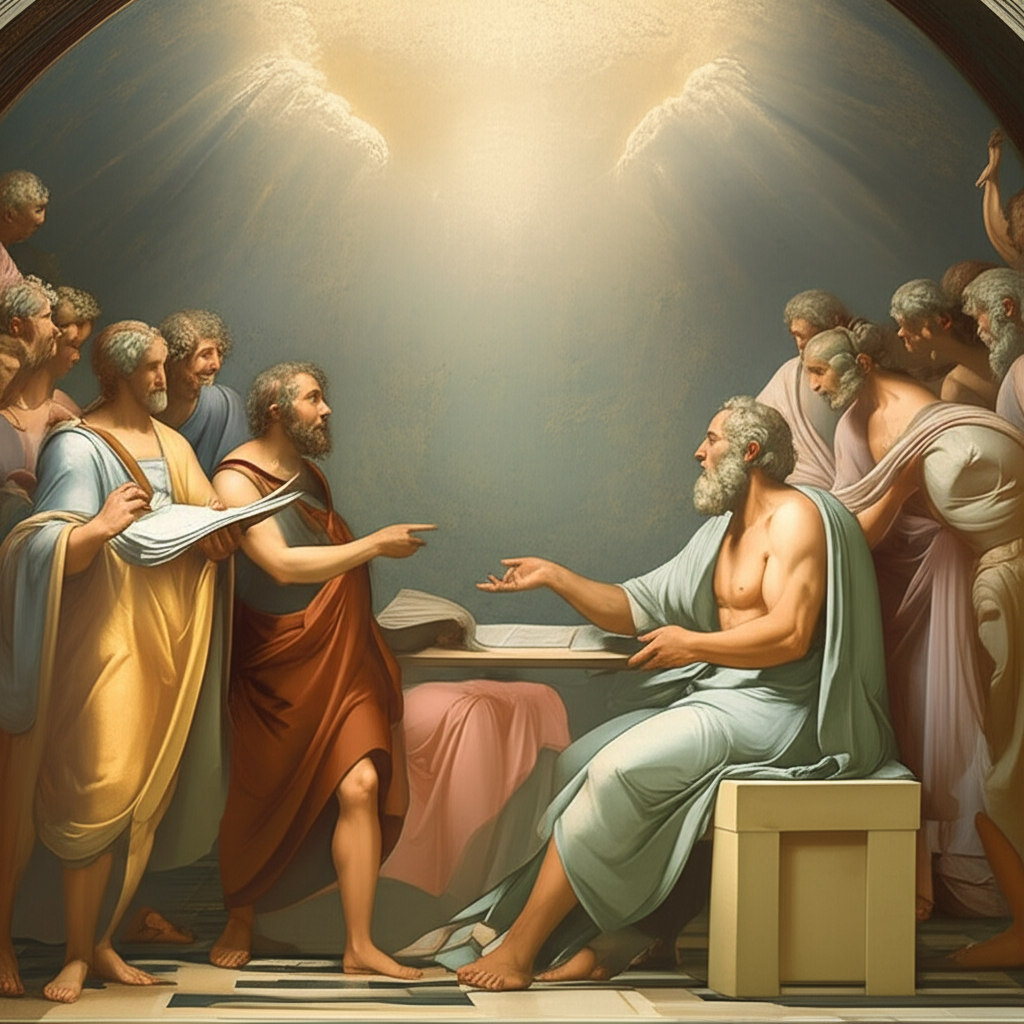
- The pursuit of poetic perfection is, in essence, a Platonic endeavor: an attempt to bring the ideal into being.
- The "Idea" precedes and informs the "Form," guiding the poet's choices.
Aristotle's Pragmatism: Form as Purposeful Structure
While Plato ascended to the realm of pure Ideas, his student Aristotle brought philosophy back to earth, focusing on the observable world and the practicalities of creation. In his seminal work, Poetics, Aristotle meticulously dissects the elements of tragedy, emphasizing how Form is not just an aesthetic choice but a functional necessity.
For Aristotle, the form of a poem (or play) is the arrangement of its parts, designed to achieve a specific effect. The plot's structure, the character's development, the rhythm and diction—all contribute to the poem's overall purpose, whether it be to evoke catharsis, impart moral wisdom, or simply delight. Here, the Idea of the poem's Art lies in its effective construction, its ability to fulfill its intended function.
Table: Form and Function in Poetic Art
| Poetic Form | Key Structural Elements | Primary Philosophical/Artistic Function |
|---|---|---|
| Sonnet | 14 lines, specific rhyme scheme (e.g., ABAB CDCD EFEF GG), iambic pentameter | Exploration of a single idea or argument, often concluding with a turn (volta) |
| Haiku | 3 lines, 5-7-5 syllables | Capturing a fleeting moment, often from nature, with brevity and depth |
| Villanelle | 19 lines, 5 tercets + 1 quatrain, 2 repeating rhymes & 2 repeating lines | Meditative exploration of a single theme, creating a hypnotic, obsessive quality |
| Free Verse | No strict meter or rhyme, relies on organic rhythm | Mimicking natural speech, allowing the poem's internal logic to dictate its shape and flow |
Aristotle teaches us that Form is not merely a container for the Idea, but an active participant in its realization. The careful arrangement of words and lines is the Art of the poem, shaping our experience and understanding.
Form as Constraint and Liberation: The Poetic Paradox
It seems paradoxical: how can constraint lead to liberation? Yet, in Poetry, this is often the case. The very limitations imposed by a chosen Form—the fixed number of lines in a sonnet, the syllable count of a haiku, the metrical demands of a heroic couplet—can ignite a unique kind of creativity.
The poet, faced with these structural boundaries, is forced to distill their Idea, to find the most precise and evocative language, to innovate within the confines. This process refines the initial inspiration, sharpening its edges and revealing its true essence. The idea of a challenge becomes the catalyst for artistic ingenuity. The chosen Form is not a cage, but a crucible in which raw linguistic material is transformed into refined Art.
The Poet as Architect: Shaping the Idea into Art
Ultimately, the poet is an architect of language, a sculptor of thought. They take an abstract Idea—a feeling, a concept, a narrative—and give it concrete Form. This act of creation is where philosophy meets craft, where inspiration merges with disciplined execution.
Every choice, from the rhythm of a line to the placement of a comma, contributes to the poem's overall Form and, consequently, to the reader's understanding of its underlying Idea. The Art of poetry, therefore, is the masterful synthesis of content and structure, where the Form not only holds the Idea but actively participates in its unfolding and amplification.
The Indispensable Form: A Philosophical Imperative
To speak of Poetry without acknowledging its Form is to miss a fundamental truth about its nature. Form is not an afterthought, a decorative embellishment; it is intrinsic to the poem's identity, its very being. Like the human body gives form to the soul, poetic structure gives tangible existence to the abstract Idea.
Whether drawing from Plato's transcendent Forms or Aristotle's pragmatic Poetics, the philosophical exploration of "Form" in "Poetry" reveals that structure is not merely a convention but a profound philosophical statement. It is the means by which an Idea becomes perceptible, by which language is elevated to Art, and by which the transient becomes eternal.
**## 📹 Related Video: PLATO ON: The Allegory of the Cave
Video by: The School of Life
💡 Want different videos? Search YouTube for: "Philosophy of Art and Beauty - Plato vs. Aristotle"**
**## 📹 Related Video: PLATO ON: The Allegory of the Cave
Video by: The School of Life
💡 Want different videos? Search YouTube for: "What is Poetic Form? Understanding Structure in Poetry"**