

The Enduring Idea of Form in Metaphysics: Unpacking the Fabric of Being
Summary
The Idea of Form in Metaphysics is a cornerstone of Western thought, representing a profound inquiry into the fundamental nature of reality. From Plato's transcendent archetypes to Aristotle's immanent essences, the concept of Form seeks to explain what gives things their identity, structure, and intelligibility. It grapples with the question of Being – what truly exists and how we can know it – asserting that beyond the fleeting appearances of the physical world, there lies an underlying, stable principle that defines existence. This article explores the historical development and enduring significance of this pivotal philosophical concept.
Unveiling Reality: The Quest for Enduring Principles
For centuries, philosophers have grappled with a fundamental question: what is the true nature of reality? Beyond the ever-changing flux of sensory experience, is there something stable, immutable, and universally true that gives order and meaning to the cosmos? This profound inquiry lies at the heart of Metaphysics, and few concepts have been as central to this quest as the Idea of Form. It represents humanity's persistent attempt to understand the whatness of things, the underlying blueprint that makes a 'tree' a tree, or 'justice' truly just.
Plato's Transcendent Forms: The Archetypes of Being
No discussion of Form can begin without acknowledging its most famous proponent, Plato. Drawing heavily from the intellectual currents of his time, particularly the Eleatics' emphasis on unchanging Being and the Pythagoreans' focus on mathematical harmony, Plato posited a radical solution to the problem of change and permanence.
For Plato, the Forms are not mere mental concepts but independently existing, perfect, and eternal entities that reside in a realm separate from our physical world. They are the ultimate realities, the blueprints or paradigms for everything we perceive.
- Characteristics of Platonic Forms:
- Transcendent: They exist outside space and time.
- Immutable: They never change or perish.
- Perfect: They are ideal exemplars of their kind.
- Intelligible: They are apprehended by the intellect, not the senses.
- Universal: A single Form accounts for all particular instances.
Consider the Form of Beauty. For Plato, all beautiful things—a sunset, a poem, a face—are beautiful only insofar as they participate in or imitate the single, perfect, unchanging Form of Beauty. This Idea of Beauty itself is not seen with the eyes but understood with the mind. Our physical world, with its imperfect and transient particulars, is merely a shadow or reflection of this higher, more real realm of Forms.
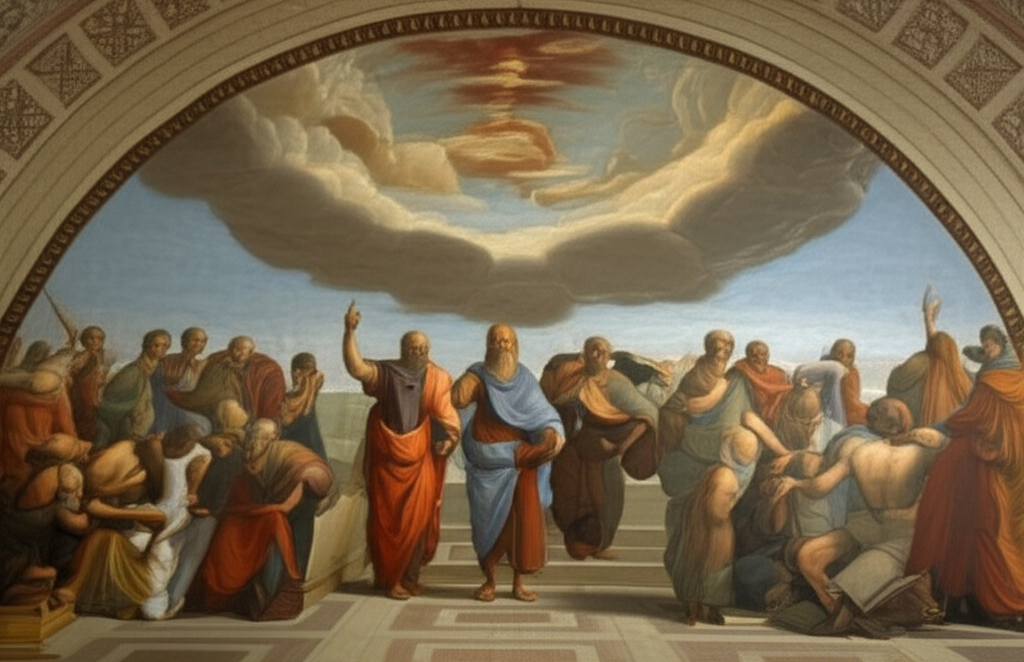
Plato's famous Allegory of the Cave, chronicled in The Republic (Great Books of the Western World, Vol. 7), vividly illustrates this distinction, positing that our perception of the physical world is akin to prisoners seeing only shadows on a cave wall, mistaking them for reality, while true enlightenment comes from turning towards the sun—the Form of the Good—and apprehending the Forms themselves. This pursuit of the Forms, for Plato, is the highest aim of philosophy and the path to true knowledge and virtue.
Aristotle's Immanent Forms: Essence Within Particulars
While deeply influenced by his teacher Plato, Aristotle offered a profound reinterpretation of the Idea of Form. For Aristotle, Forms are not separate from the world we inhabit; rather, they are inherent in the particular objects themselves. This shift marked a significant departure, bringing the focus of Metaphysics back to the empirical world.
Aristotle introduced the concept of hylomorphism, asserting that every physical substance is a compound of two intrinsic principles: matter and Form.
- Matter (hyle): The undifferentiated stuff or potentiality from which things are made. It is the "what-it-is-made-of."
- Form (eidos): The essence, structure, or defining principle that makes a thing what it is. It is the "what-it-is."
For instance, in a bronze statue, the bronze is the matter, while the specific shape and structure that makes it a statue (e.g., a statue of Apollo) is its Form. The Form gives the matter its identity, purpose, and actuality. Without the Form, matter is merely potential; without matter, the Form cannot exist as a concrete particular.
Comparing Platonic and Aristotelian Forms:
| Feature | Plato's Forms | Aristotle's Forms |
|---|---|---|
| Existence/Location | Transcendent, separate realm of perfect archetypes | Immanent, within particular objects as their essence |
| Nature | Ideal, eternal, unchanging paradigms | Essential structure, defining principle, actuality |
| Relationship to Matter | Particulars participate in or imitate Forms | Form informs matter, actualizing its potential |
| Epistemology | Knowledge through intellect, recollection | Knowledge through empirical observation and abstraction |
| Primary Focus of Being | The Forms themselves | The composite substance (matter + form) |
Aristotle's Metaphysics (Great Books of the Western World, Vol. 8) is largely an inquiry into this Idea of Form as the primary substance and the principle of Being. He sought to understand the causes and principles of things by analyzing their inherent forms, leading to a more empirically grounded philosophy that profoundly influenced scientific inquiry for centuries.
The Enduring Philosophical Debate and Its Legacy
The divergent views of Plato and Aristotle on the Idea of Form established a foundational tension in Western philosophy that continues to resonate.
- Medieval Philosophy: Christian theologians, notably St. Augustine and St. Thomas Aquinas, grappled with integrating these concepts into their understanding of God and creation. Augustine leaned towards Platonic Forms as divine ideas in the mind of God, while Aquinas incorporated Aristotelian Form and matter into his elaborate philosophical system, explaining the nature of created Being.
- Modern Philosophy: While the explicit language of "Forms" became less prominent, the underlying questions persisted. Rationalists like Descartes sought universal, unchanging Ideas (akin to Forms) through reason, while empiricists like Locke and Hume focused on how our ideas are derived from sensory experience, challenging the notion of inherent Forms. Kant, in a sense, synthesized these by positing that the mind itself imposes forms of understanding on raw sensory data.
The Idea of Form, whether transcendent or immanent, has consistently served as a conceptual tool for philosophers to address fundamental questions of identity, classification, causality, and the very structure of Being.
Why the Idea of Form Still Matters
The ancient debates surrounding the Idea of Form are far from mere historical curiosities; they inform our contemporary understanding of reality in subtle yet profound ways.
- Science and Classification: Modern science, particularly biology and chemistry, relies heavily on classifying things based on their shared characteristics and underlying structures—their "forms." The concept of species, for instance, reflects an enduring Idea of a defining Form.
- Logic and Language: Our ability to use general terms ("cat," "justice," "triangle") implies an underlying commonality or Form that unites diverse particulars. Language itself relies on our capacity to grasp universal Ideas.
- Ethics and Aesthetics: Discussions about universal moral principles or objective standards of beauty often implicitly appeal to a Platonic sense of ideal Forms. If there is such a thing as "justice itself" or "beauty itself," it suggests an enduring Form.
- Artificial Intelligence and Information Theory: The challenge of teaching machines to recognize patterns and categorize information echoes the philosophical quest to identify the "forms" that define objects and concepts.
The Idea of Form compels us to look beyond superficial appearances and ask what truly constitutes a thing, what gives it its essence, and how it relates to the broader fabric of Being. It forces us to confront the deepest questions about the nature of reality and our place within it.
Conclusion
From the lofty, eternal realm of Plato's archetypes to the immanent essences that structure Aristotle's world, the Idea of Form stands as a testament to humanity's enduring intellectual curiosity. It is a concept that has shaped the trajectory of Metaphysics, providing a framework for understanding not just what things are, but why they are. The journey through the Forms, whether seen as transcendent blueprints or inherent principles, remains a vital pathway to comprehending the intricate and profound nature of Being itself.
📹 Related Video: PLATO ON: The Allegory of the Cave
Video by: The School of Life
💡 Want different videos? Search YouTube for: "Plato's Theory of Forms explained"
📹 Related Video: ARISTOTLE ON: The Nicomachean Ethics
Video by: The School of Life
💡 Want different videos? Search YouTube for: "Aristotle's Metaphysics - Form and Matter"