

Beyond the Symbols: The Enduring Idea of Form in Mathematics
For centuries, thinkers have grappled with the profound question of what constitutes reality, and nowhere does this philosophical quest intersect more beautifully with the tangible than in the realm of mathematics. This article explores how the ancient philosophical concept of "Form" or "Idea," particularly as articulated by Plato, finds a potent and surprisingly direct manifestation in the very fabric of mathematical thought. Far from being mere abstract games, mathematical concepts offer us a unique window into a world of pure, unchanging Forms, accessible through the rigorous application of Logic.
The Platonic Echo in Numbers: A Glimpse into Pure Ideas
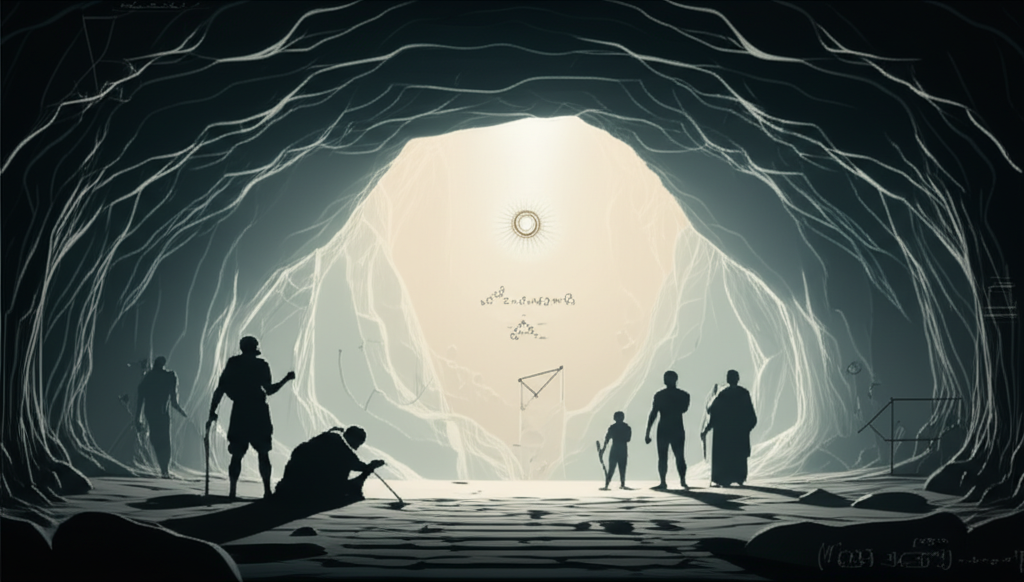
Isn't it fascinating how a simple geometric shape, like a circle, can hold such universal power? We can draw countless circles, each imperfect, each a mere approximation, yet the Idea of a circle – perfectly round, every point equidistant from its center – remains eternally pristine. This distinction between the imperfect physical manifestation and the perfect, unchanging Idea is the very essence of Plato's Theory of Forms, a cornerstone of Western philosophy found within the Great Books of the Western World.
For Plato, these Forms were not mere concepts in our minds but existed independently, a realm of perfect archetypes that our senses could only dimly perceive. Mathematics, with its focus on universal truths and immutable relationships, was seen as the purest path to apprehending these Forms. The triangle we sketch on a napkin is ephemeral; the Form of triangularity, with its angles always summing to 180 degrees, is eternal and absolute. This isn't just about shapes; it applies equally to numbers. The Idea of "two," for instance, transcends any pair of objects; it's an intrinsic property, a fundamental Form that underpins all duality.
Mathematics as the Language of Pure Form and Logic
Mathematics, in its purest sense, doesn't describe the physical world directly, but rather the underlying Forms and structures that govern it. Consider the elegant simplicity of an equation like E=mc². While it describes physical phenomena, the equation itself is a statement of pure mathematical Form, a relationship between abstract quantities that holds true regardless of any particular physical manifestation.
The beauty of mathematics lies in its reliance on Logic. Through rigorous deduction and axiomatic reasoning, mathematicians unveil these inherent Forms. We don't invent mathematical truths; we discover them. The Pythagorean theorem wasn't created by Pythagoras; he merely elucidated a pre-existing, eternal Form of relationship between the sides of a right-angled triangle. This process of discovery, driven by unassailable Logic, reveals the deep structure of reality.
| Mathematical Concept | The "Form" or "Idea" It Embodies | How Logic Unveils It |
|---|---|---|
| Number (e.g., 5) | The absolute quantity, the essence of 'fiveness' independent of objects. | Axioms of arithmetic, set theory defining cardinality. |
| Circle | Perfect roundness, infinite symmetry, equidistant points from a center. | Geometric postulates, theorems proving properties. |
| Group Theory | The abstract structure of symmetry and transformation, regardless of what is being transformed. | Group axioms (closure, identity, inverse, associativity) and their logical consequences. |
| Topology | The inherent properties of space that remain invariant under continuous deformation (e.g., connectivity, holes). | Definitions of open sets, continuity, and proofs of topological invariants. |
These mathematical Forms are not subject to opinion or change. They are universal, immutable, and exist independently of human perception. This is why mathematics provides such a powerful framework for understanding the universe – it taps into the very Ideas that structure existence.
From Abstract Forms to Concrete Applications
While the Idea of Form in mathematics might seem abstract, its profound impact on our understanding of the physical world is undeniable. From the elliptical orbits of planets (derived from conic sections, a pure geometric Form) to the complex algorithms that power our digital world, the abstract Forms of mathematics provide the blueprint for reality. Engineers rely on the Forms of calculus to design bridges, physicists use the Forms of differential equations to model natural phenomena, and computer scientists build algorithms based on the Logic of discrete structures.
This interplay between the abstract Idea and its concrete application only serves to reinforce the notion that mathematics is not merely a tool, but a window into a deeper, more fundamental reality. The enduring power of mathematical Forms suggests a universe structured by elegant, logical principles, waiting to be discovered by the inquiring mind.
YouTube: Plato Theory of Forms explained
YouTube: The Philosophy of Mathematics - Why are numbers real?
📹 Related Video: What is Philosophy?
Video by: The School of Life
💡 Want different videos? Search YouTube for: "The Idea of Form in Mathematics philosophy"