

Chloe Fitzgerald here, stepping into the fascinating intersection where philosophy meets the most abstract of sciences. When we speak of Mathematics, our minds often conjure images of complex calculations or intricate proofs. But beyond the mechanics lies a profound philosophical question: What is mathematics truly about? For centuries, thinkers have grappled with the notion that mathematics isn't merely invented but discovered, revealing an inherent order in the cosmos. This notion brings us directly to the concept of Form and Idea, a philosophical bedrock laid down by figures whose works grace the pages of the Great Books of the Western World.
The Unseen Architecture: Exploring the Idea of Form in Mathematics
Mathematics, often seen as a discipline of numbers and equations, is fundamentally a quest for Form and Idea. From ancient Greek geometry to modern abstract algebra, mathematicians grapple with underlying structures, patterns, and relationships that exist independently of our perception. This article explores how the philosophical concept of Form, rooted in Plato's Ideas, finds its clearest expression in Mathematics, where Logic serves as the indispensable tool for its discovery and articulation.
Plato's Enduring Legacy: The Ideal Forms
The journey into the Idea of Form in Mathematics must begin with Plato. His theory of Forms, or Ideas (from the Greek eidos), posits that beyond the imperfect, changing world we perceive, there exists a realm of perfect, eternal, and unchanging Forms. A physical circle might be drawn imperfectly, but the Form of a Circle—perfect roundness, equidistant points from a center—exists independently, as an eternal blueprint.
Plato saw Mathematics as the clearest pathway to grasping these Forms. Unlike the fleeting shadows of the sensible world, mathematical objects like numbers, geometric shapes, and abstract relations embody these perfect Forms. When a geometer proves the Pythagorean theorem, they are not merely demonstrating a truth about a specific triangle drawn on a chalkboard, but about the Form of all right-angled triangles. This insight, profoundly influential, suggests that mathematical truths are not contingent but necessary, reflecting an underlying, perfect order.
- Key takeaway: Plato's Forms provide a philosophical framework for understanding why mathematical truths feel eternal and universal.
Mathematics: The Realm of Pure Form
If Plato gave us the philosophical scaffolding, Mathematics itself provides the magnificent edifice. It is in this discipline that the Idea of Form truly takes flight. Whether we're exploring the symmetries of a snowflake, the elegant progression of the Fibonacci sequence, or the abstract structures of group theory, mathematics is, at its heart, the study of pure Form.
Consider these examples:
- Geometry: The ancient Greeks, particularly Euclid, systematized the study of spatial Forms. A perfect square, a true sphere, or an infinitely long line are not physical objects; they are ideal Forms whose properties are explored through rigorous Logic.
- Algebra: Moving beyond specific numbers, algebra deals with the Forms of relations and operations. Equations represent abstract patterns and structures that hold true regardless of the specific values assigned to variables. The Form of an equation like a² + b² = c² expresses a universal relationship.
- Set Theory: This modern branch of mathematics explores the Forms of collections and their relationships. A set is a pure Idea of grouping, and its properties are derived logically, revealing fundamental structures of organization.
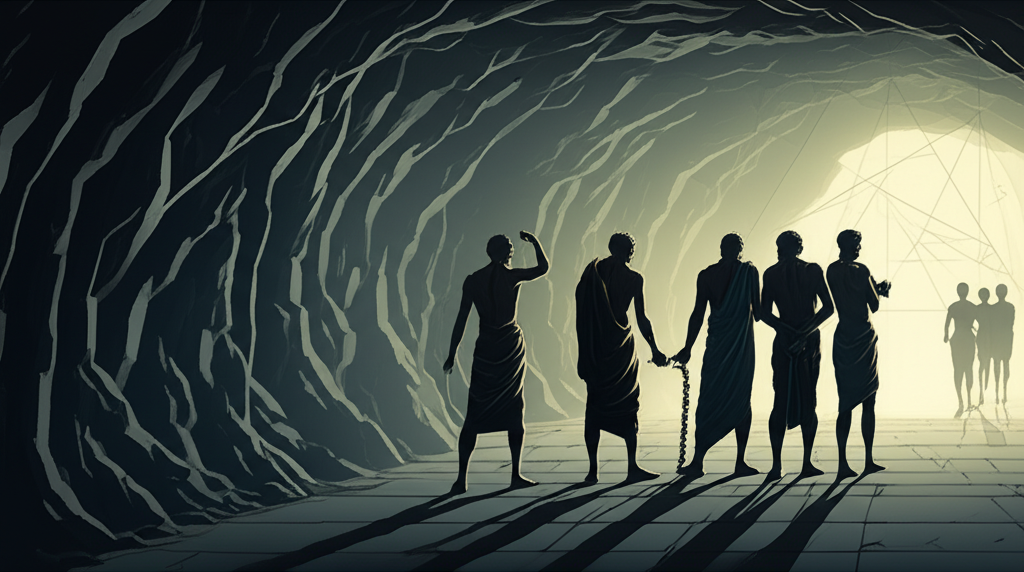 subtly integrated into the light source or the cave's opening, suggesting that mathematical Forms are the true reality beyond the shadows.)
The Indispensable Role of Logic in Unveiling Forms
How do we access these perfect Forms? Through the rigorous application of Logic. From Aristotle's syllogisms to modern symbolic logic, the ability to reason deductively is the mathematician's primary tool. Logic allows us to move from axioms (fundamental Ideas assumed to be true) to theorems (new truths derived from those Ideas) with absolute certainty.
- Deductive Reasoning: The very structure of a mathematical proof is an exercise in Logic. Each step follows necessarily from the previous one, building an unassailable chain of reasoning that reveals the properties of a particular Form.
- Axiomatic Systems: Think of Euclid's Elements. He started with a few self-evident Ideas (axioms and postulates) and, through Logic, built an entire universe of geometric Forms. This systematic approach demonstrates how Logic is not just a method but the very language through which mathematical Forms are articulated and understood.
| Philosophical Concept | Mathematical Manifestation | Role of Logic |
|---|---|---|
| Idea/Form | Geometric shapes, algebraic structures, number patterns | Defines, proves properties, ensures consistency |
| Reality | Abstract mathematical objects (e.g., the number 3, a perfect circle) | Establishes relationships, validates existence within the system |
| Truth | Theorems, universally valid equations | Guarantees certainty, demonstrates necessity |
From Abstract Forms to Concrete Understanding
The beauty of the Idea of Form in Mathematics is not just its abstract purity but its profound impact on our understanding of the concrete world. While Forms exist in an ideal realm, their properties manifest everywhere. The spiral of a galaxy, the growth pattern of a plant, the trajectory of a thrown ball—all are governed by mathematical Forms and Ideas unveiled through Logic.
This connection reminds us that philosophy and mathematics are not disparate fields but deeply intertwined quests for understanding the fundamental Forms that structure existence. The "Great Books" continually highlight this symbiotic relationship, presenting a vision where the pursuit of truth, whether through philosophical inquiry or mathematical proof, leads to the same underlying reality of Form.
Conclusion: The Enduring Quest
The Idea of Form in Mathematics is a timeless philosophical problem, one that continues to challenge and inspire. It invites us to look beyond the surface, to seek the underlying Ideas and Forms that govern not just numbers and shapes, but perhaps the very fabric of reality. Through the rigorous lens of Logic, mathematics offers a unique window into this ideal realm, a testament to the enduring power of human reason to grasp eternal truths.
📹 Related Video: PLATO ON: The Allegory of the Cave
Video by: The School of Life
💡 Want different videos? Search YouTube for: "Plato's Theory of Forms explained simply"
📹 Related Video: What is Philosophy?
Video by: The School of Life
💡 Want different videos? Search YouTube for: "The Unreasonable Effectiveness of Mathematics in the Natural Sciences philosophy"