

The Idea of Form in Animal Classification: From Platonic Blueprints to Aristotelian Science
The classification of the animal kingdom, a cornerstone of biological science, owes a profound and often unacknowledged debt to ancient philosophical concepts, particularly the "Idea" of "Form." From Plato's eternal, perfect blueprints to Aristotle's meticulous observation of immanent structures, the quest to categorize life has always wrestled with fundamental questions about what constitutes a species, what defines its essence, and how we recognize these underlying patterns amidst the bewildering diversity of nature. This article explores how the philosophical Idea of "Form" shaped the very foundations of animal classification, laying the groundwork for scientific inquiry that continues to evolve today.
The Platonic Blueprint: Eternal Ideas and the Animal Kingdom
At the heart of Plato's philosophy, as explored in works like Phaedo and Republic within the Great Books of the Western World, lies the concept of the Forms (or Ideas). These are not mere thoughts in a mind, but perfect, unchanging, non-physical archetypes existing in a transcendent realm, accessible only through intellect and reason.
The Realm of Pure Form
For Plato, every observable animal — be it a dog, a horse, or a human — is merely an imperfect copy or shadow of its corresponding perfect Form. There exists, in this higher realm, the Form of Dogness, the Form of Horseness, and the Form of Humanness. These Forms represent the true essence, the ideal type, of each species.
- The Idea of perfect Dogness: Embodies all the essential characteristics that make a dog a dog, independent of any particular, scruffy terrier or noble retriever.
- Immutability: These Forms do not change, ensuring a stable ground for knowledge and definition.
- Universality: They provide a universal standard against which all individual instances can be measured.
Imperfect Reflections in the Natural World
The physical world, according to Plato, is a world of flux and impermanence. The individual animals we encounter are transient participants in their respective Forms. A specific dog may be old, sick, or deformed, but it still "participates" in the Form of Dogness, however imperfectly. This philosophical framework provided an initial impetus for classification: to discern the underlying Idea or Form that groups diverse individuals into a coherent species, even if the physical manifestations varied. The goal was to look beyond the superficial to grasp the essential.
Aristotle's Empirical Turn: Immanent Forms and Observational Science
While deeply influenced by his teacher Plato, Aristotle, whose works on biology like History of Animals and Parts of Animals are seminal texts in the Great Books, brought the concept of "Form" down to earth. For Aristotle, the Form was not transcendent but immanent – it existed within the individual organism, as its organizing principle, its essence, its structure, and its function.
From Abstract Idea to Concrete Form
Aristotle rejected the notion of a separate realm of Forms. Instead, he argued that the Form of an animal is inseparable from its matter; it is what makes a particular collection of matter into a specific kind of living being. The Form of a horse, for instance, is the actual horse itself – its characteristic shape, its internal organs, its mode of reproduction, its behavior. This shift was monumental for the nascent field of science.
The Birth of Zoological Science and Classification
Aristotle became the world's first great systematizer of animal life. His approach was empirical and observational, collecting vast amounts of data on hundreds of species. He sought to identify the Form not through abstract contemplation, but through careful study of anatomy, physiology, and behavior. His method of classification involved defining species by their genus (a broader category) and their differentia (the distinguishing characteristics that set them apart within that genus).
Here are some key methodological principles from Aristotle's biological science:
- Observation: Meticulous study of living organisms, their habitats, and behaviors.
- Dissection: Examination of internal structures to understand function and organization.
- Teleology: Understanding the purpose or end-goal (telos) of an organism's parts and its overall existence, which informs its Form. For example, the wings of a bird have the Form of flight.
- Hierarchy: Grouping animals based on shared characteristics, moving from broader categories to more specific ones. He recognized groups like "bloodless" and "blooded" animals, and within those, further subdivisions based on locomotion, reproduction, and other features.
Example of Aristotelian Classification:
| Category | Description | Example (Animal) |
|---|---|---|
| Genus | Broader group sharing fundamental characteristics | "Blood-possessing" |
| Differentia | Distinguishing characteristics within the genus (e.g., number of legs, habitat) | "Two-footed" |
| Species | Defined by Genus + Differentia | Human |
Aristotle's work established the foundation for biological classification, emphasizing the importance of identifying essential Forms through empirical investigation. This was the true genesis of zoological science.
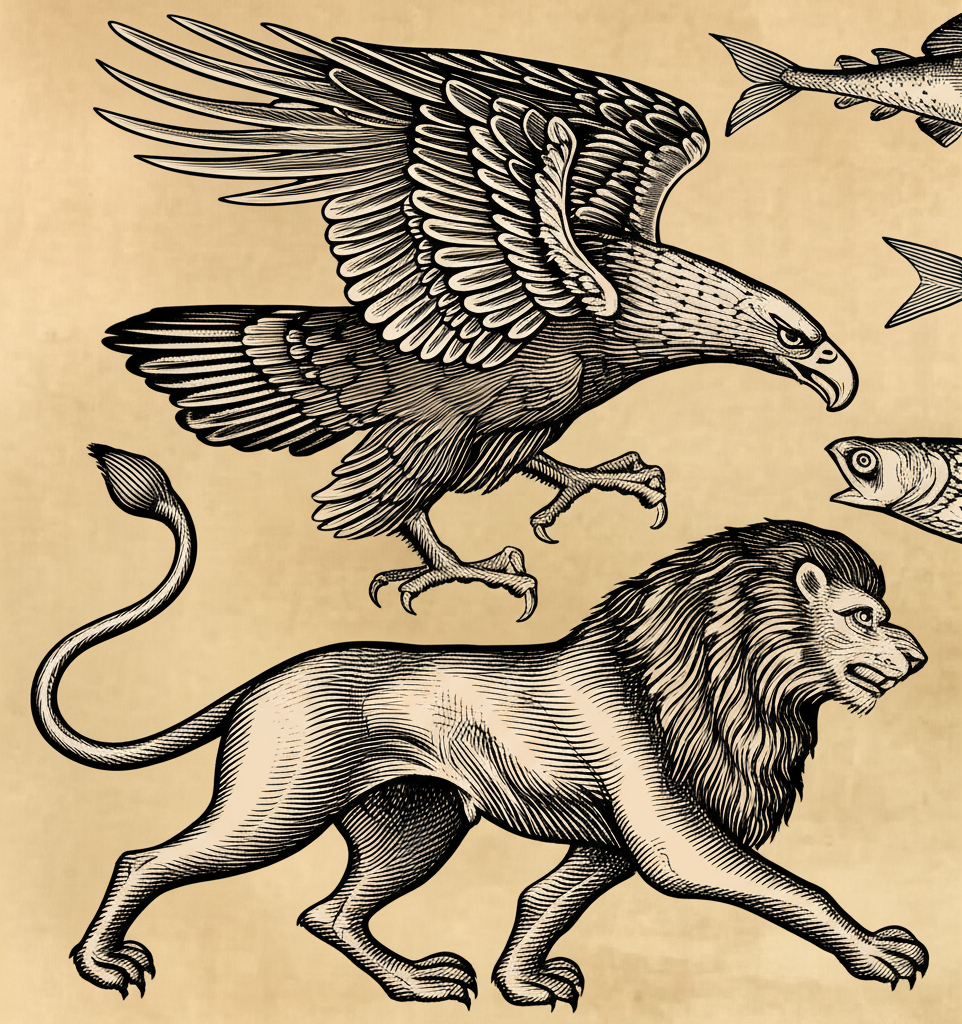 arranged in a hierarchical structure, with lines connecting them to overarching conceptual labels like "Vertebrates" or "Invertebrates," and philosophical symbols (like Plato's cave or Aristotle's Lyceum) subtly integrated into the background to suggest the intellectual lineage.)
The Enduring Legacy: Form in Modern Biological Science
The philosophical "Idea" of "Form" continues to resonate in modern biological science, albeit in evolved and sophisticated ways. While contemporary biology has moved far beyond static, essentialist Forms, the underlying quest to understand patterns, structures, and organizing principles remains.
Morphological Homologies and Genetic Blueprints
- Morphology: The study of the Form and structure of organisms. Biologists still classify animals based on shared anatomical features (e.g., the pentadactyl limb Form found in various vertebrates), recognizing underlying structural homologies that suggest common ancestry. These homologous structures are modern echoes of an underlying "Form" or blueprint.
- Genetics: The discovery of DNA and genetic codes provides a material basis for what might be considered the "Form" of an organism. The genetic blueprint dictates the developmental pathway and the eventual Form an animal will take. Variations in these genetic Forms drive evolution and create new species.
- Developmental Biology: The study of how a single cell develops into a complex organism explores the unfolding of an inherent Form, guided by genetic instructions and environmental interactions.
The Philosophical Underpinnings of Taxonomy
Even in the age of molecular phylogenetics, the act of classifying animals into species, genera, and families still involves identifying shared characteristics and distinguishing features – a direct descendant of Aristotle's differentia. The concept of a "type specimen" in taxonomy, for example, serves as a concrete representation of the "Form" of a species, a reference point for its essential characteristics. The very debates around species concepts (e.g., biological species concept vs. phylogenetic species concept) are, at their core, philosophical arguments about what constitutes the "Form" or essence of a species.
Challenges, Evolution, and the Dynamic Idea of Form
While the "Idea of Form" provided a crucial starting point, its static nature presented challenges. Evolutionary theory, championed by Darwin, revolutionized our understanding, demonstrating that animal Forms are not fixed but dynamic, constantly changing through natural selection.
Beyond Static Categories
Modern science recognizes that species are not immutable Platonic Forms, but populations that evolve over time. However, the search for underlying patterns, developmental pathways, and genetic Forms that unite and differentiate life continues. The "Idea of Form" has evolved from a static essence to a dynamic, evolving blueprint, shaped by history and environment, yet still providing the conceptual framework for understanding the incredible diversity and underlying unity of the animal kingdom.
Conclusion
From Plato's transcendent Ideas to Aristotle's immanent Forms, the philosophical quest to understand the underlying essence of things profoundly shaped the early development of animal classification and the very methodology of science. The ancient thinkers, particularly those chronicled in the Great Books of the Western World, provided the intellectual scaffolding upon which modern biology has built its intricate understanding of life. While the specifics of "Form" have been refined and transformed by centuries of empirical discovery, the fundamental idea of seeking patterns, structures, and essential characteristics to categorize the natural world remains a testament to the enduring power of philosophical inquiry in shaping scientific endeavor.
YouTube Video Suggestions:
-
📹 Related Video: PLATO ON: The Allegory of the Cave
Video by: The School of Life
💡 Want different videos? Search YouTube for: "Plato Forms Theory Explained"
2. ## 📹 Related Video: ARISTOTLE ON: The Nicomachean Ethics
Video by: The School of Life
💡 Want different videos? Search YouTube for: "Aristotle Biology Classification History Animals"