

The Enduring Idea of Form in Animal Science and Classification
Summary: The endeavor to classify animals is not merely an exercise in cataloging physical traits; it is deeply rooted in the philosophical Idea of Form. From Plato's concept of perfect, unchanging archetypes to Aristotle's empirical observation of immanent essences, the notion of Form has profoundly shaped how we understand and categorize the natural world. This article explores how this ancient philosophical inquiry into Form continues to inform modern biological science, revealing the persistent quest to discern the underlying patterns and essential nature that define distinct groups of animals, rather than simply their superficial appearances.
The vast tapestry of life on Earth presents a bewildering array of creatures, each unique yet often sharing striking similarities with others. For millennia, humanity has sought to impose order on this natural chaos, to understand the relationships between different animals, and to define what makes a creature distinctly itself. This pursuit, far from being a purely empirical exercise, has always been underpinned by a profound philosophical question: What is the underlying Form that gives a creature its identity and allows us to group it with others?
The Platonic Echo: Ideal Forms and the Natural World
When we speak of the "Idea of Form," our minds are often drawn to the towering figure of Plato, whose philosophy, as explored in the Great Books of the Western World, posits a realm of perfect, eternal Forms existing independently of the physical world. For Plato, the Form of a horse, for instance, is not any particular horse we see, but the ideal, transcendent essence of "horseness" itself, of which all earthly horses are imperfect copies.
Though Plato himself focused more on ethical and metaphysical Forms, the idea that there exists an underlying, ideal blueprint for things has subtly influenced our perception of biological Form. When early naturalists sought to classify animals, they were, perhaps unconsciously, searching for these ideal types. What defines the Form of a bird? Is it merely feathers and wings, or is there an essential "bird-ness" that transcends individual variations? This quest for the fundamental Idea behind observable Form is a testament to Plato's enduring legacy, suggesting that true knowledge lies not in the mutable particular but in the immutable universal.
Aristotle's Empirical Turn: Form as Essence and Function
While Plato looked to the heavens for Forms, his most famous student, Aristotle, brought the Idea of Form down to earth. As detailed in his biological works within the Great Books, Aristotle's approach to science was meticulously empirical. For him, the Form of an animal was not a transcendent entity but an immanent essence – the organizing principle, structure, and function that makes a thing what it is. The Form of a dog, for example, is inherent in every dog, dictating its development, its behavior, and its place in the natural order.
Aristotle's classification of animals was revolutionary precisely because it was based on this understanding of Form. He didn't just group animals by superficial resemblance; he looked for their essential characteristics, their means of reproduction, their habitats, and their physiological structures. His method involved:
- Observation: Meticulous study of animals in their natural environments.
- Definition: Articulating the unique characteristics that constitute the Form of a species or genus.
- Classification: Grouping animals based on shared Forms and differentiating them by specific features.
For Aristotle, the Form of an animal was its very nature, guiding its development and defining its purpose (telos). This practical, observational approach laid the groundwork for all subsequent biological science, emphasizing that to classify an animal is to understand its inherent Form, its essence, rather than just its outward appearance.
From Ancient Philosophy to Modern Science
The philosophical Idea of Form has continued to evolve alongside scientific understanding. Carolus Linnaeus, the father of modern taxonomy, while not explicitly a Platonist, certainly sought to identify distinct, stable "types" or Forms that defined species, echoing the search for underlying patterns. His binomial nomenclature provided a structured way to categorize the myriad Forms of life.
With the advent of evolutionary theory, the Idea of Form took on a dynamic dimension. Charles Darwin showed that Forms are not static but evolve through natural selection. Yet, even in a world of change, science still seeks to understand the Forms that persist, adapt, and diverge. The concept of a "species" itself is an attempt to define a particular Form—a group of animals that share a common ancestry and can interbreed.
Today, molecular biology and genetics offer a deeper understanding of biological Form. The DNA sequence of an animal can be seen as the ultimate blueprint, the encoded Form that dictates its physical characteristics, its functions, and its place in the tree of life. Yet, even with this granular detail, the philosophical question remains: Is the Form merely the sum of its genetic parts, or is there an emergent Idea of Form that transcends the molecular level?
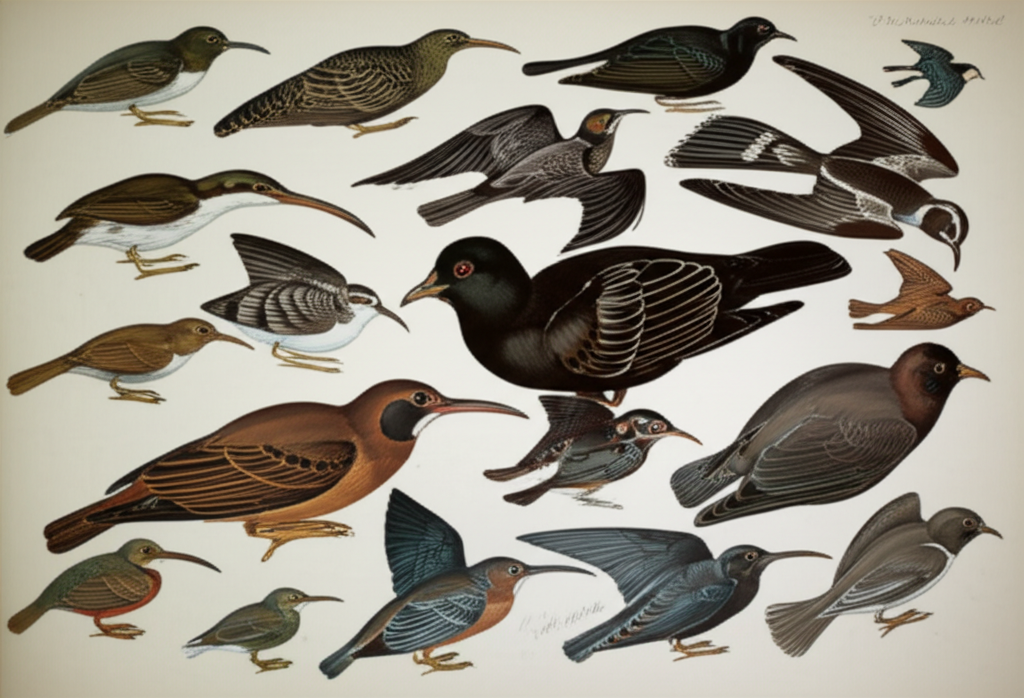
The Enduring Philosophical Question
The classification of animals is thus a continuous dialogue between observation and Idea. We observe the specific forms of animals in the world, and through these observations, we strive to grasp the underlying Form that defines them. Whether we are discussing the Form of a mammal, a reptile, or a specific species like Homo sapiens, we are grappling with questions of essence, identity, and the fundamental patterns that structure existence.
The Idea of Form in animal classification reminds us that science is not divorced from philosophy. Our methods of categorization, our understanding of species, and our very definition of what constitutes an animal are deeply influenced by ancient philosophical inquiries into the nature of reality. It is a testament to the power of these foundational Ideas that they continue to guide our understanding of the natural world, bridging the gap between abstract thought and empirical discovery.
YouTube: Plato's Theory of Forms explained
YouTube: Aristotle's Biology and Classification
📹 Related Video: What is Philosophy?
Video by: The School of Life
💡 Want different videos? Search YouTube for: "The Idea of Form in Animal Classification philosophy"