

The Timeless Gaze: Unraveling the Idea of Eternity and the Divine
The concept of eternity stands as one of philosophy's most profound and elusive ideas, fundamentally challenging our human experience of sequential time. It is an idea inextricably linked to the divine, serving as a cornerstone for understanding the nature of God across centuries of Western thought. This article explores how the greatest minds, from Plato to Aquinas, grappled with eternity, distinguishing it sharply from mere endless time, and positing it as an essential attribute of the ultimate divine being.
Eternity vs. Time: A Fundamental Distinction
To truly grasp the idea of eternity, we must first confront our ingrained understanding of time. For us, time is a linear progression: a past that is gone, a present we inhabit fleetingly, and a future yet to come. It is marked by succession, change, and measurement. Our lives are defined by beginnings and ends, by moments following one another.
- Temporal Existence:
- Succession: Events occur one after another.
- Change: Beings and states are in constant flux.
- Measurement: Hours, days, years, marked by movement.
- Contingency: Events could have been otherwise.
- Becoming: A process of moving towards a future state.
Eternity, as conceived in the philosophical tradition, is radically different. It is not simply sempiternity – time without end – but a state of absolute timelessness. It is often described as a single, indivisible present, where all things are held simultaneously, without past or future.
- Eternal Existence:
- Simultaneity: All moments are present at once (tota simul).
- Immutability: Unchanging, beyond flux and decay.
- Unmeasurable: Not subject to temporal units or progression.
- Necessity: Existing without dependence or potentiality.
- Being: A state of complete, perfect actualization.
This distinction is crucial. When we speak of God's eternity, we are not imagining an infinitely long lifespan, but rather an existence entirely outside the constraints of chronological succession.
The Idea of Eternity in Classical Philosophy
The seeds of this profound idea were sown early in Western thought, long before the explicit articulation of a monotheistic God.
Plato's Eternal Forms
In Plato's philosophy, as found in works like Phaedo and Republic (parts of the Great Books of the Western World), true reality resides not in the fleeting, changing world of sensory experience, but in the realm of Forms or Ideas. These Forms – of Beauty, Justice, Goodness, etc. – are perfect, unchanging, and, crucially, eternal. They exist outside of space and time, providing the timeless blueprints for everything that exists in the temporal world. For Plato, grasping these Forms was a step towards understanding true, immutable reality, a precursor to the divine attributes.
Aristotle's Unmoved Mover
Aristotle, in his Metaphysics (also in Great Books), posits the existence of an Unmoved Mover as the ultimate cause of all motion in the cosmos. This Mover is pure actuality, without any potentiality for change, because if it could change, it would require another mover to initiate that change, leading to an infinite regress. As pure actuality, the Unmoved Mover is free from the imperfections and changes inherent in the temporal world. Its existence is therefore timeless in its essence, a state of perfect, unchanging being that inspires the motion of the universe.
Christian Thought and the Divine Timelessness
The philosophical groundwork laid by Plato and Aristotle found new and profound expression in Christian theology, where the idea of eternity became an indispensable attribute of God.
Augustine of Hippo: God Beyond Time
Saint Augustine, in his Confessions (a cornerstone of the Great Books), famously grappled with the nature of time and God's relationship to it. He argued that God did not create in time, but created time itself. Therefore, God exists utterly outside of time. For God, there is no past or future, only an eternal present. God's knowledge is not foresight (seeing what will happen), but an eternal, simultaneous apprehension of all things. This profound insight solidified the notion of divine timelessness as distinct from mere endless duration.
Boethius and the "Whole, Simultaneous Possession"
Perhaps the most influential articulation of eternity comes from Boethius in The Consolation of Philosophy (another key Great Book). Facing execution, Boethius meditates on God's providence and foreknowledge. He defines eternity as:
Aeturnitas est interminabilis vitae tota simul et perfecta possessio.
(Eternity is the whole, perfect, and simultaneous possession of interminable life.)
This definition emphasizes three key aspects:
- Interminable Life: It has no end (and implicitly, no beginning).
- Perfect Possession: It is complete, lacking nothing.
- Whole and Simultaneous: It is experienced all at once, not sequentially.
This concept distinguishes God's existence as fundamentally different from anything we can experience. God doesn't live through time; God possesses all of life, all at once, eternally.
Thomas Aquinas: Synthesizing the Traditions
Building upon Aristotle's metaphysics and Augustine's theology, Thomas Aquinas, in his Summa Theologica (found in Great Books), further refined the understanding of God's eternity. He argued that God is pure act (actus purus), without any potentiality, and therefore immutable. Change implies succession, and succession is time. Since God is immutable, God must be eternal, existing outside of time. For Aquinas, eternity is a single, indivisible "now" that encompasses all of time.
The Philosophical Imperative: Why God Must Be Eternal
The idea of eternity is not merely a poetic flourish when describing the divine; it is a philosophical necessity. The attributes traditionally ascribed to God – omnipotence (all-powerful), omniscience (all-knowing), and immutability (unchanging) – demand an eternal existence.
- A God bound by time would be subject to change, implying a potentiality that contradicts perfect actuality.
- A God who experiences time sequentially would learn and forget, undermining omniscience.
- A God with a beginning or end would not be the ultimate ground of being, but would depend on something else for existence.
Therefore, the Idea of God as the ultimate, uncaused cause, the perfect being, the ground of all reality, necessitates an existence that transcends the limitations of time. Eternity becomes not just a characteristic of God, but an intrinsic aspect of the very concept of God as ultimate reality.
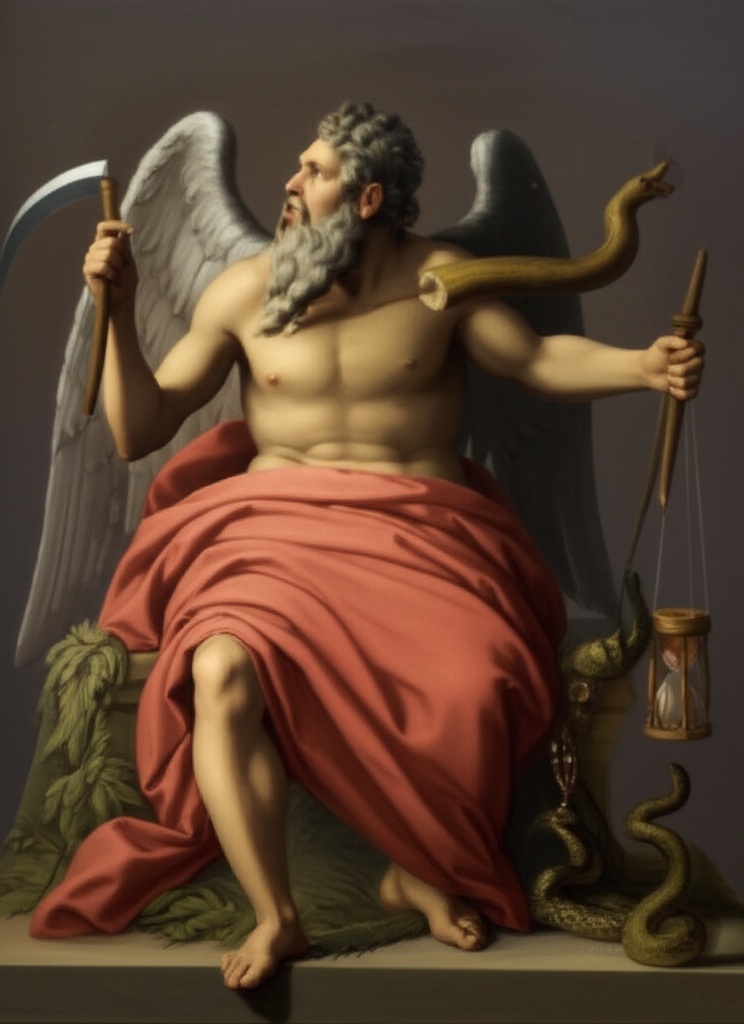 , personified as an old, winged man, being held captive or transcended by a radiant, youthful figure representing Aeternitas (Eternity). The background features a vast, star-filled cosmos, symbolizing existence beyond temporal boundaries, with faint classical ruins at the bottom, signifying the transient nature of earthly creations.)
Reflecting on the Eternal
The journey through the idea of eternity, from Plato's Forms to Boethius's simultaneous possession, reveals a consistent philosophical effort to articulate a mode of existence utterly unlike our own. It forces us to stretch our minds beyond the confines of our temporal experience, to contemplate a being that simply is, fully and completely, without beginning or end, past or future. This profound idea continues to challenge and inspire, inviting us to ponder the deepest mysteries of existence and the divine.
📹 Related Video: What is Philosophy?
Video by: The School of Life
💡 Want different videos? Search YouTube for: "Boethius Consolation of Philosophy eternity explained"
📹 Related Video: What is Philosophy?
Video by: The School of Life
💡 Want different videos? Search YouTube for: "Augustine God and Time philosophy"