

The Unfolding Idea of Eternity and the Divine: Beyond the Sands of Time
The concept of Eternity stands as one of philosophy's most profound and elusive ideas, particularly when tethered to the nature of the Divine. It is not merely a protracted stretch of Time, an endless succession of moments, but something fundamentally different – an existence entirely outside of temporal sequence. This supporting article delves into this intricate relationship, exploring how various traditions within the Great Books of the Western World have grappled with the notion of God's timelessness, its implications for reality, and the perennial challenge it poses to human comprehension.
Distinguishing Eternity from Endless Time
To truly grasp the Idea of Eternity as it pertains to the Divine, we must first disentangle it from its common misconception: sempiternity. Sempiternity denotes infinite duration within Time – a beginningless and endless existence. However, the philosophical and theological tradition often reserves Eternity for an existence altogether outside of Time.
Consider Boethius, writing in The Consolation of Philosophy, who famously defined Eternity as "the complete possession of an endless life enjoyed as a simultaneous whole." This definition is crucial:
- Complete Possession: It implies a fullness, nothing lacking.
- Endless Life: It suggests no cessation, no finitude.
- Simultaneous Whole: This is the most radical part – not a sequence, but an apprehension of all existence at once, without past or future.
This means that for an eternal being, there is no "before" or "after," no "was" or "will be." All moments are simply "are." Plato, long before Boethius, hinted at this with his Forms, existing in a realm beyond flux and Time, a perfect, unchanging idea.
God: The Atemporal Being
The attribution of Eternity in this profound sense is almost universally applied to God across monotheistic and many philosophical traditions. If God is the ultimate ground of being, the creator of all things, then God must necessarily precede and transcend Time itself.
St. Augustine, in his Confessions, grapples eloquently with this. He posits that Time itself is a creation, an aspect of the created universe. Therefore, God cannot be bound by it. For God, there is no sequence of events; God's knowledge is not subject to a temporal unfolding, nor is God's will. This has profound implications for divine attributes:
- Omniscience: If God is eternal, God knows all things not through sequential observation (past, present, future), but in a single, unified, eternal present. All of Time is simultaneously present to God.
- Immutability: An eternal God cannot change, for change implies a temporal succession from one state to another. God's essence and attributes are fixed and perfect, existing outside the flux of Time.
- Omnipresence: God's presence is not limited by spatial or temporal dimensions. God is fully present to all moments of Time at once.
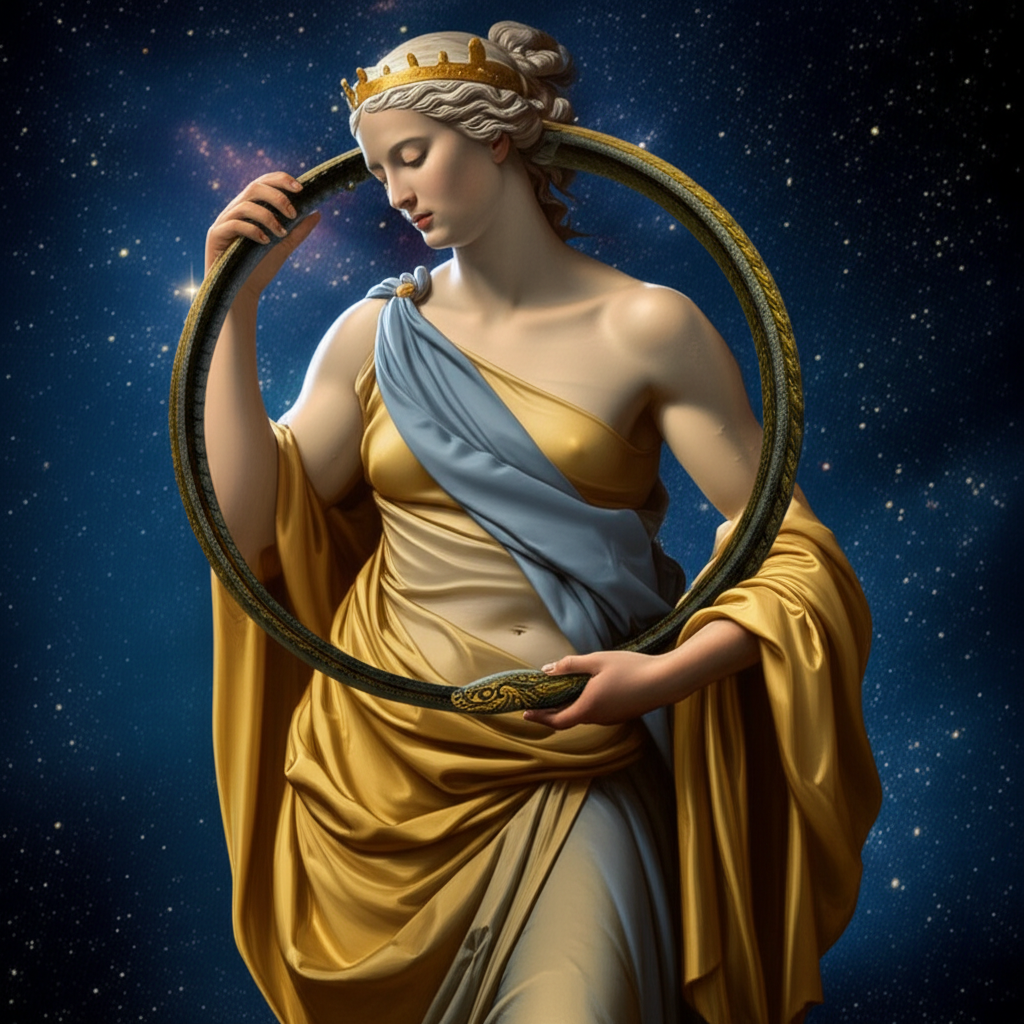 or an hourglass with sand flowing into an infinite void, surrounded by celestial bodies and symbols of timelessness, with a subtle, radiant light emanating from its core, suggesting the divine.)
The Philosophical Challenge of the Idea
While intellectually compelling, the Idea of Eternity presents a formidable challenge to human understanding. Our minds are inextricably linked to Time; we perceive the world in terms of succession, cause and effect, past and future. How can a temporal being truly grasp an atemporal reality?
This leads to several classic philosophical dilemmas:
- Divine Foreknowledge and Free Will: If God perceives all of Time in an eternal present, does this mean our future actions are already "known" and thus predetermined? If so, is our free will an illusion? Thinkers like Boethius and Aquinas wrestled with this, often concluding that God's knowledge is not causative; God sees what we will choose, rather than causing us to choose it.
- God's Interaction with the Temporal World: How does an eternal God act within Time? If God is truly outside Time, does divine intervention make sense? The Idea here often involves God initiating Time itself and sustaining it, acting not within its sequence but as its transcendent ground.
Eternity as a Perfected Present
Ultimately, the Idea of Eternity offers a profound vision of reality, especially for those seeking to understand the nature of the Divine. It suggests a fundamental perfection where all things are simultaneously present, where the fragmentation of past, present, and future dissolves into a single, unified reality. For God, every moment of Time – from the Big Bang to the final heat death of the universe – is not a sequence unfolding, but an eternally present truth. It is the ultimate "now," a totality of existence that transcends our linear perception. This concept, explored by philosophers from Aristotle's Unmoved Mover to Spinoza's Deus sive Natura, underscores a fundamental philosophical commitment to a reality that is ultimately coherent, whole, and utterly beyond the limits of our temporal experience.
YouTube: "Boethius Eternity Time God"
YouTube: "Augustine on Time and Eternity"
📹 Related Video: What is Philosophy?
Video by: The School of Life
💡 Want different videos? Search YouTube for: "The Idea of Eternity and the Divine philosophy"