

The Unfolding of Forever: Examining Eternity and the Divine
Summary: This article delves into the profound philosophical and theological concept of Eternity, not merely as endless Time, but as a state transcending temporal succession. We explore how thinkers from the "Great Books of the Western World" have grappled with this Idea, particularly in relation to the nature of God, who is often conceived as existing outside the bounds of creation and its temporal constraints.
The Human Condition and the Allure of Timelessness
Our human experience is inextricably bound by Time. We live in moments, anticipate futures, and recall pasts. Our existence is a narrative unfolding in succession. Yet, woven into the fabric of philosophical and theological inquiry is the compelling, often elusive, Idea of Eternity—a state utterly distinct from temporal duration. This concept becomes particularly salient when we consider the Divine, for how can an ultimate reality, a God, be confined by the very Time it is often believed to have created? The contemplation of Eternity challenges our most fundamental assumptions about existence, beckoning us to consider a reality beyond the tick-tock of the clock.
Ancient Echoes: Plato, Aristotle, and the Eternal Forms
The Idea of something eternal predates monotheistic conceptions of God as we understand them today. In the "Great Books," we find early Greek philosophers laying crucial groundwork for understanding a reality beyond the temporal.
- Plato's Forms: For Plato, as explored in works like The Republic and Timaeus, true reality resides not in the fleeting, sensory world, but in the realm of the Forms—perfect, unchanging, and eternal archetypes. The Form of Beauty, for instance, is not beautiful for a certain period; it simply is beautiful, timelessly. These Forms exist outside the flux of the sensible world, providing a blueprint for the transient things we perceive.
- Aristotle's Unmoved Mover: Aristotle, in his Metaphysics, posits the Unmoved Mover as the ultimate cause of all motion in the cosmos. This Mover is pure actuality, existing in a state of eternal being, causing motion without itself moving. It is a being of pure thought, contemplating itself eternally. Both Plato and Aristotle, in their distinct ways, point towards a reality that transcends the limitations of Time and change.
Christian Theology: God as the Creator of Time Itself
With the advent of Christian theology, the concept of Eternity became intrinsically linked to the nature of God. The "Great Books" of Christian thought offer profound insights into this relationship.
Saint Augustine's Revolutionary Insight
Saint Augustine, in his seminal Confessions, famously grapples with the perplexing question of what God was doing before creation. His profound insight was that God did not create in Time, but with Time. For Augustine, Time is a creation, an extension of the created order, and thus God exists outside of it. Eternity, therefore, is not an infinitely extended Time, but rather a complete and simultaneous possession of boundless life. To conceive of God as being "before" Time is to misunderstand the very nature of Eternity; God simply is, in an eternal present.
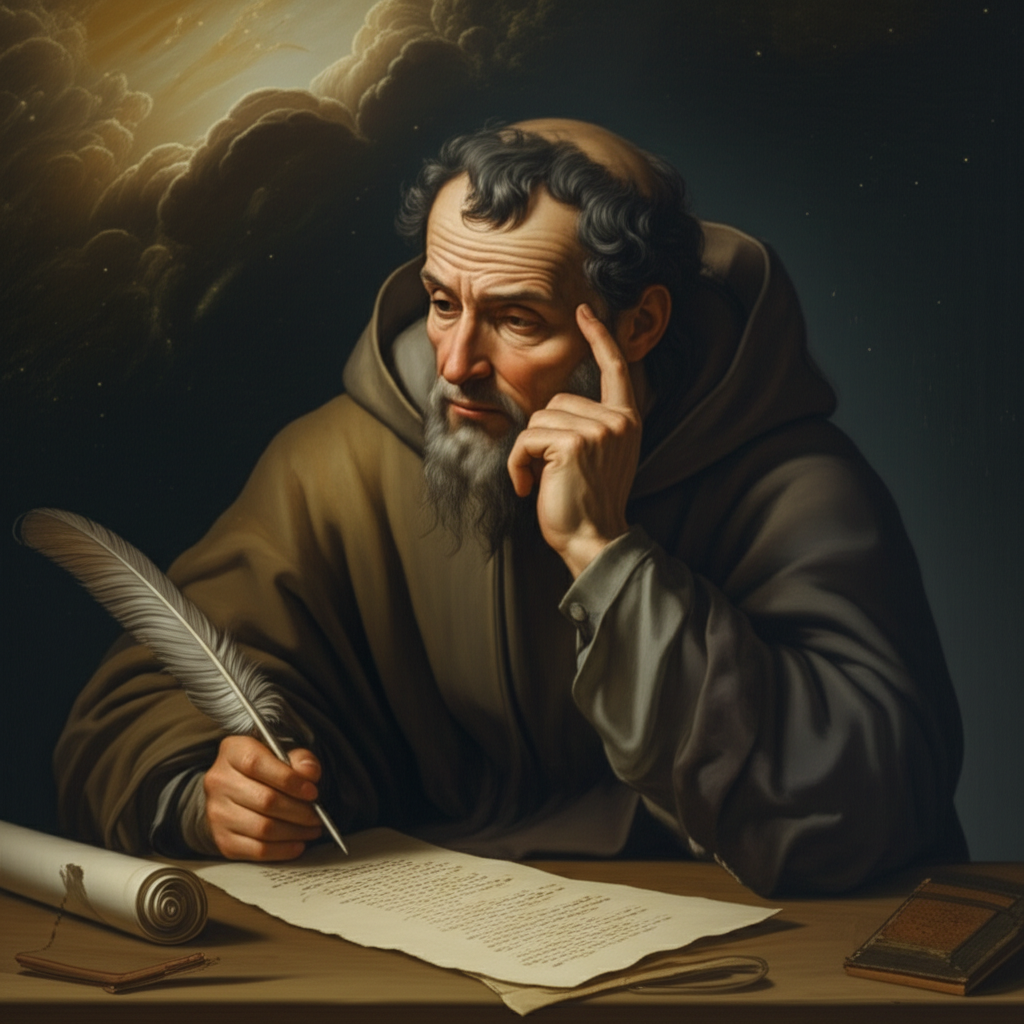
Thomas Aquinas and the Measure of Immoveable Being
Thomas Aquinas, building upon Augustine and Aristotle in his Summa Theologica, further articulated this Idea. For Aquinas, Eternity (aeternitas) is the proper measure of immoveable being, a distinct mode of duration belonging solely to God. He contrasts it with:
- Time (tempus): The measure of mutable being, characterized by succession and change (e.g., humans, animals, plants).
- Aevum (aevum): An intermediate duration for spiritual creatures like angels, who are immutable in their being but mutable in their choices and intellect.
God's Eternity is not an endless series of moments, but a single, indivisible, and perfect "now," where all things are simultaneously present to the divine intellect.
The Philosophical Challenge: Grasping the Idea of Timelessness
The Idea of Eternity presents a profound philosophical challenge. How can we, as temporal beings, truly grasp a state of being that lacks succession, change, or beginning and end? It's not simply an absence of Time, but a positive mode of existence that encompasses all moments simultaneously, or rather, transcends the very concept of "moments."
This leads to several key distinctions crucial for understanding the concept:
- Eternity vs. Infinite Time: This is perhaps the most critical distinction. Eternity is not simply Time without end (like an infinite line). Infinite Time still implies succession—a moment after another after another. Eternity is often conceived as a dimension entirely orthogonal to Time, or as a complete and simultaneous possession of all being at once.
- Eternity as Wholeness: The Idea of Eternity often implies a complete and perfect possession of being, an unchanging plenitude. There is no "becoming" in Eternity, only "being."
- The Divine Attribute: For many, Eternity is a core attribute of God, signifying His immutability, omnipotence, and independence from creation. It asserts that God is not subject to the limitations or changes inherent in temporal existence.
The Implications of an Eternal God
If God is truly eternal in this transcendent sense, it has significant implications for our understanding of divine action, providence, and even free will. How does an eternal God interact with a temporal world? Does divine foreknowledge negate human freedom if God "sees" all Time at once? These are questions that have fueled centuries of theological and philosophical debate, demonstrating the enduring power and complexity of the Idea of Eternity. It forces us to reconsider the very nature of causality and existence when one of the primary actors exists outside the temporal framework.
Conclusion: Glimpsing the Timeless
The journey through the "Great Books of the Western World" reveals that the Idea of Eternity is far more complex and profound than a mere extension of Time. It is a conceptual bedrock upon which much of our understanding of the Divine, and indeed reality itself, has been built. From Plato's unchanging Forms to Augustine's eternal God who creates Time, and Aquinas's precise definitions, philosophers and theologians have grappled with the limits of human comprehension when confronted with the boundless. To contemplate Eternity is to confront the limits of our temporal experience and to glimpse, however fleetingly, the possibility of a reality utterly transcendent, where God exists in an unchanging, perfect, and timeless now.
YouTube Video Suggestions:
-
📹 Related Video: ARISTOTLE ON: The Nicomachean Ethics
Video by: The School of Life
💡 Want different videos? Search YouTube for: ""Augustine on Time and Eternity explained""
-
📹 Related Video: What is Philosophy?
Video by: The School of Life
💡 Want different videos? Search YouTube for: ""Aquinas Eternity God vs Time philosophy""