

The Unfolding Idea: Eternity and the Divine Beyond the Sands of Time
The human mind, bound by the relentless march of Time, has perpetually grappled with the concept of the infinite, particularly as it relates to the divine. At the heart of this philosophical quest lies the profound Idea of Eternity – not merely an endless stretch of temporal moments, but a timeless, unchanging present often ascribed as a fundamental attribute of God. This article delves into how Western thought, drawing heavily from the foundational texts of the Great Books, has attempted to define, comprehend, and reconcile our temporal existence with the transcendent reality of the eternal, revealing Eternity as the very ground upon which the divine is conceived.
Grappling with the Infinite: Humanity's Eternal Question
From the earliest myths to the most intricate theological treatises, humanity has sought to understand its place within a cosmos that seems to extend infinitely beyond our grasp. The finite nature of our lives, our experiences, and our very perception of reality is intrinsically linked to Time. Yet, lurking beneath this temporal surface is an insistent intuition of something more, something permanent, something that is rather than becomes. This intuition crystallizes into the Idea of Eternity, a concept so vast it challenges the very limits of our language and reason. When we speak of God, we invariably confront this Idea, for how can the ultimate ground of being, the creator of all, be subject to the same fleeting moments as its creations?
Defining Eternity: Not Just More Time, But No Time
One of the most crucial distinctions in understanding Eternity is to separate it from mere infinite Time. The Great Books offer profound insights here. Plato, in his theory of Forms, posits an eternal, unchanging realm of perfect essences, distinct from the mutable world of appearances. While not directly defining God in the Abrahamic sense, his eternal Forms lay a conceptual groundwork for timeless reality.
However, it is Boethius, in his Consolation of Philosophy, who provides one of the most enduring definitions: "Eternity, then, is the complete possession of unending life all at once." This isn't a sequence of moments stretching forever, but a singular, undivided, and simultaneous grasp of all existence. St. Augustine, wrestling with the nature of Time in his Confessions, famously pondered, "What then is time? If no one asks me, I know what it is. If I wish to explain it to him who asks, I do not know." He concludes that Time is a creation, implying a Creator who exists outside of it—a timeless God.
Consider these key distinctions:
- Time: Sequential, past/present/future, mutable, created, experienced by finite beings.
- Eternity: Simultaneous, timeless present, immutable, uncreated, an attribute of the divine.
God and the Eternal Present: The Divine Attribute
The connection between Eternity and God is arguably the most fundamental theological Idea in Western thought. For many philosophers and theologians, God's very essence necessitates existence outside of Time. Thomas Aquinas, building on Aristotle's concept of an Unmoved Mover, systematically argues in his Summa Theologica that God is entirely simple, unchanging, and therefore eternal. If God were in Time, God would be subject to change, potentiality, and succession, which would contradict divine perfection.
This Idea of God's Eternity has several profound implications:
- Omniscience: If God exists in an eternal present, all of Time—past, present, and future—is simultaneously accessible, leading to the Idea of divine omniscience.
- Immutability: An eternal being cannot change, as change implies a succession of states over Time. This underpins the Idea of God's unwavering nature.
- First Cause: As the uncreated source of all creation, God must precede Time itself, acting as the ultimate, eternal First Cause.
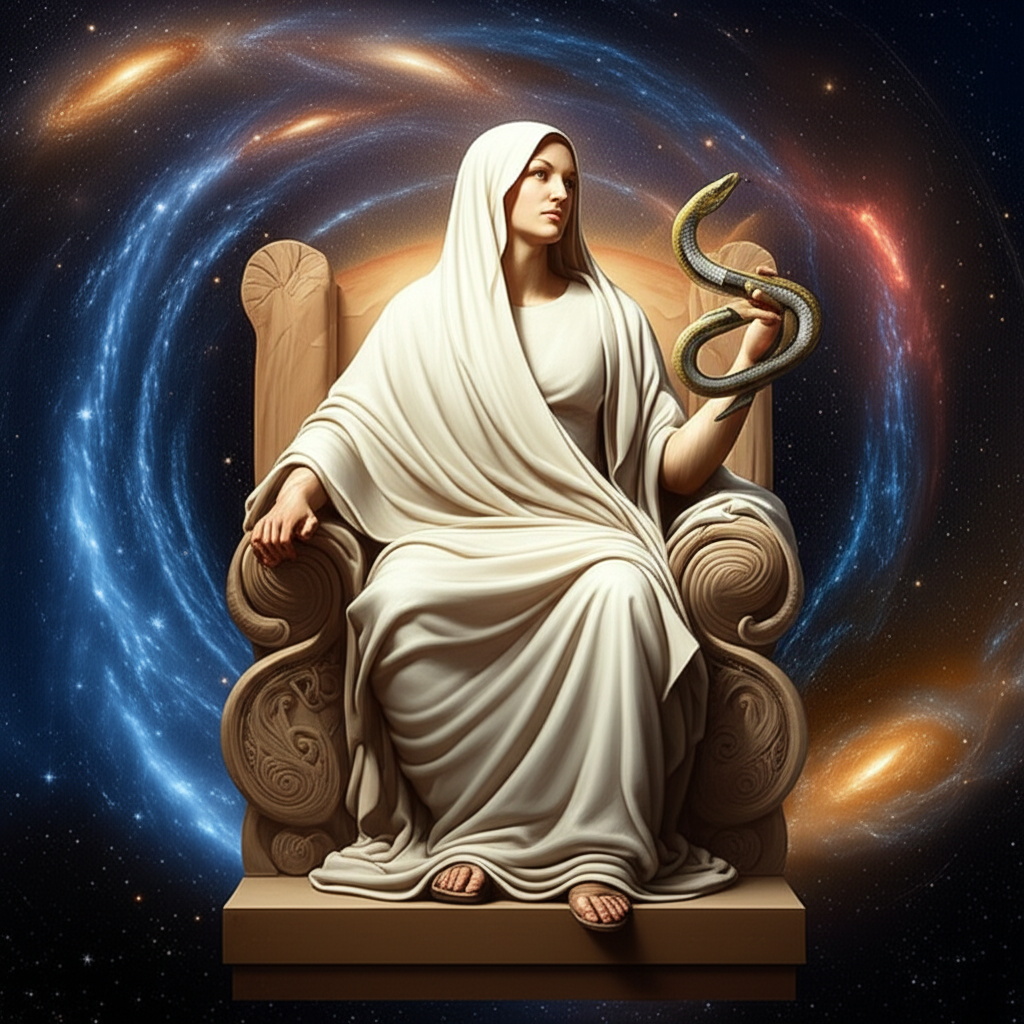 , while the other points upwards towards a radiant, timeless light. Below, faint, ephemeral figures represent humanity grappling with hourglasses and clocks, highlighting the contrast between temporal existence and the divine, eternal realm.)
The Paradox of Time and Eternity: Our Finite Grasp
The challenge, then, is how we, as beings steeped in Time, can possibly conceive of Eternity. Our language, our thought processes, and our very consciousness are structured by temporal succession. We speak of "before" and "after," "will be" and "was." To think of something that "is" all at once, without sequence, is to attempt to transcend the very framework of our cognition.
This paradox is central to the philosophical journey. While we cannot experience Eternity, we can, through intellectual abstraction and faith, grasp the Idea of it. It becomes a regulative Idea, a concept that shapes our understanding of ultimate reality, even if its full comprehension remains beyond our immediate reach. The tension between our temporal existence and the Idea of a timeless God fuels much of theological and metaphysical inquiry.
The Enduring Idea: Eternity's Philosophical Legacy
The Idea of Eternity and its intrinsic link to the divine continues to resonate in contemporary philosophy, even as some traditions challenge its classical definition. Modern physics, with its complex understanding of spacetime, offers new perspectives on the nature of Time, but the philosophical question of a timeless ground of being persists. Whether viewed as a literal state, a conceptual necessity for divine perfection, or a profound metaphor for ultimate reality, the Idea of Eternity remains an indispensable lens through which we attempt to comprehend God and the fundamental nature of existence. It is an Idea that, like the divine it describes, seems to endure beyond the fleeting moments of our Time.
YouTube Video Suggestions:
- YouTube: Boethius Consolation of Philosophy Eternity Time
- YouTube: Augustine Confessions Time Eternity God
📹 Related Video: What is Philosophy?
Video by: The School of Life
💡 Want different videos? Search YouTube for: "The Idea of Eternity and the Divine philosophy"