

The Timeless Echo: Exploring the Idea of Eternity and the Divine
The Idea of Eternity, particularly in its profound connection to the concept of God, stands as one of philosophy's most enduring and complex challenges. Far from being merely an endless stretch of Time, true Eternity is often conceived as existing entirely outside or beyond the temporal flux, a state of timelessness that defines the divine. This article delves into how philosophers and theologians, drawing heavily from the foundational texts found within the Great Books of the Western World, have grappled with this elusive concept, differentiating it from infinite duration and exploring its implications for our understanding of reality, divinity, and human existence.
The Enigma of Eternity: More Than Just Endless Time
For many, the initial thought of Eternity conjures images of Time stretching infinitely forward and backward, an unending sequence of moments. However, philosophical and theological traditions, particularly those that inform our understanding of God, propose a far more radical Idea. This divine Eternity is not a quantity of Time but a quality of being, a state of existence that is utterly independent of temporal succession.
Ancient Greek thinkers, even before explicit monotheistic theology, hinted at this distinction. Plato, in his discussions of the Forms, posits a realm of perfect, unchanging Ideas that exist outside the corrupting influence of Time and change. Aristotle's Unmoved Mover, the ultimate cause of motion in the cosmos, is conceived as pure actuality, existing eternally and without potential, thus implying a timeless existence beyond the sequential nature of our world. These early explorations, found in volumes like The Dialogues of Plato and The Metaphysics of Aristotle within the Great Books, laid crucial groundwork for later conceptualizations of divine timelessness.
God as the Embodiment of Eternity
The most profound and intricate discussions of Eternity emerge when it is directly linked to the nature of God. For monotheistic traditions, God is not merely very old, or destined to live forever; God is Eternity. This means God experiences all moments simultaneously, or rather, experiences no moments at all in the human sense of temporal progression.
St. Augustine of Hippo, in his Confessions (another cornerstone of the Great Books), famously grapples with the problem of God's creation of the world. If God created the world in Time, what was God doing before creation? Augustine's brilliant resolution is that Time itself is a creation, and therefore, God exists outside of it. God's Eternity is an "ever-present now," a simultaneous possession of all life without beginning, middle, or end.
Later, Thomas Aquinas, in his monumental Summa Theologica (also a key text in the Great Books), further refined this Idea. He posited that God's essence is pure actuality, lacking any potentiality for change, and thus God is immutable. This immutability necessitates timelessness; for something to change, it must exist through Time. Therefore, God's being is inherently eternal, not in the sense of existing through infinite Time, but in existing outside of it altogether.
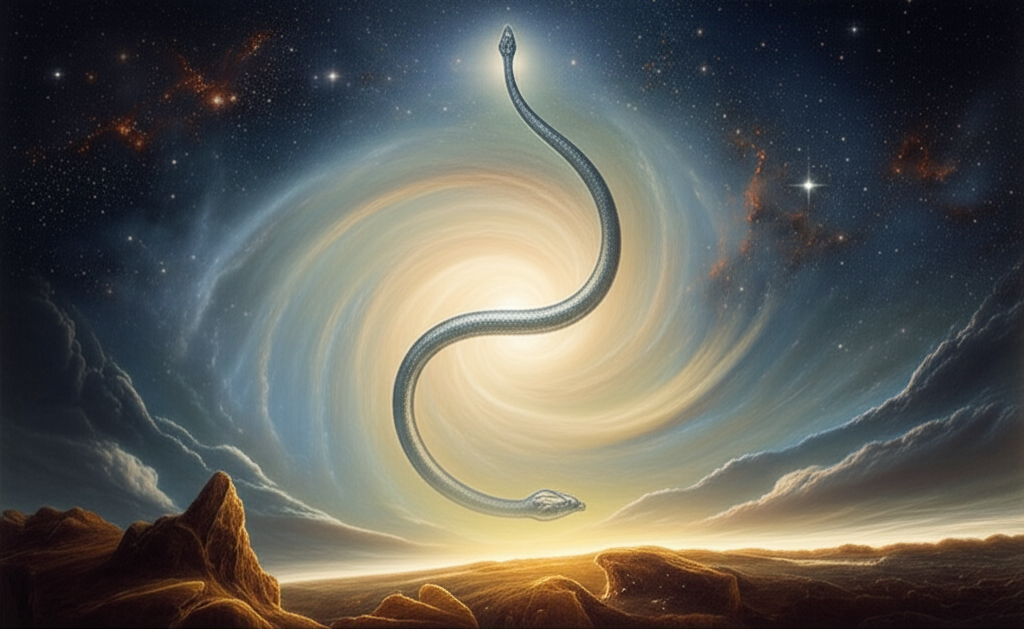
Eternity vs. Time: A Crucial Distinction
To fully grasp the philosophical weight of Eternity, it is essential to distinguish it clearly from infinite Time. This distinction is not merely semantic; it fundamentally alters our understanding of the divine and the nature of reality.
Consider the following points of divergence:
| Aspect | Eternity | Time |
|---|---|---|
| Nature | Timeless, a-temporal, simultaneous | Sequential, linear, successive |
| Experience | "Ever-present now," whole and complete | Past, present, future; flux and change |
| Duration | No duration, infinite being | Measurable duration, finite or infinite |
| Causality | Outside the chain of temporal cause/effect | Operates within cause and effect |
| Divine Link | Often attributed to God's essence | Created alongside the universe's existence |
Boethius, another pivotal figure in the Great Books tradition, particularly in The Consolation of Philosophy, provided one of the most famous definitions of Eternity: "the whole, simultaneous and perfect possession of interminable life." This definition highlights the critical element of "simultaneous possession," meaning that for an eternal being, all moments are present at once, rather than unfolding in sequence. This Idea challenges our very cognitive framework, as human experience is inextricably bound to the flow of Time.
Philosophical Ramifications
The Idea of Eternity and its divine connection has profound implications across various philosophical domains:
- Metaphysics: It forces us to reconsider the fundamental nature of existence. If God exists outside Time, then Time itself might be an emergent property of the created universe, rather than a fundamental aspect of all reality.
- Theology: It shapes doctrines of divine omniscience, omnipotence, and immutability. If God is eternal, then God's knowledge is not gained through observation over Time, but is an eternal, complete apprehension of all things.
- Cosmology: It influences theories about the beginning and end of the universe. If God is timeless, then the creation event is not a moment in Time for God, but an eternal act.
- Human Understanding: It pushes the boundaries of human comprehension. Our temporal existence makes it incredibly difficult to truly grasp a-temporal being, yet the pursuit of this Idea enriches our philosophical landscape, inviting us to contemplate realities beyond our immediate experience.
In essence, the Idea of Eternity serves as a cornerstone for understanding the divine, providing a framework for attributing qualities to God that transcend the limitations of our temporal world. It is a concept that demands rigorous thought and an openness to radically different modes of existence, continually reminding us of the vastness of philosophical inquiry.
YouTube: Philosophical concept of eternity vs. infinite time
YouTube: Aquinas God and Time explained
📹 Related Video: What is Philosophy?
Video by: The School of Life
💡 Want different videos? Search YouTube for: "The Idea of Eternity and the Divine philosophy"