

The Idea of a Just State: A Timeless Pursuit
The pursuit of a just State is perhaps one of humanity's most enduring and complex philosophical endeavors. From the ancient polis to modern democracies, thinkers have grappled with the fundamental Idea of how a society should be organized to ensure fairness, equity, and the flourishing of its citizens. This pillar page delves into the multifaceted concept of the just State, tracing its evolution through the annals of Western thought, examining the core tenets of Justice, and exploring how the very structure of a Constitution attempts to embody these ideals. Far from a static blueprint, the Idea of a just State is a dynamic and ever-evolving conversation, reflecting humanity's continuous striving for a better collective existence.
What is "Justice" and "The State"? Defining the Core Concepts
To understand the Idea of a just State, we must first clarify its constituent parts.
- Justice: More than merely adherence to law, Justice in the philosophical sense often refers to a state of moral rightness based on ethics, rationality, law, natural law, religion, or equity. It implies fairness in the distribution of goods, opportunities, and burdens, and the impartial application of rules. Plato, in his Republic, famously sought to define Justice not just for the individual soul, but as the foundational principle for an ideal State.
- The State: This refers to an organized political community living under a single system of government. It possesses sovereignty over a defined territory and population. Its purpose, scope, and legitimate authority have been subjects of intense debate throughout history, with the concept of a "just" State implying that its power and actions serve the common good and uphold principles of fairness.
The profound connection between these two concepts is evident: a State is deemed truly legitimate and worthy of allegiance only if it can demonstrate a commitment to Justice in its structures, laws, and governance.
Ancient Foundations: From Polis to Empire
The earliest systematic explorations of the just State emerged from ancient Greece, laying the groundwork for millennia of philosophical inquiry.
- Plato's Ideal State: In The Republic, Plato famously outlines a hierarchical State ruled by philosopher-kings, individuals whose wisdom and understanding of the Forms (including the Form of Justice) qualify them to govern. For Plato, Justice in the State mirrors Justice in the individual soul: each part performing its proper function in harmony. The Idea was not necessarily practical, but a theoretical model to understand true Justice.
- Aristotle's Practical Justice: Aristotle, Plato's student, took a more empirical approach in Politics and Nicomachean Ethics. He believed that the State (the polis) exists for the sake of the "good life" and that Justice is central to achieving this. He distinguished between distributive Justice (fair allocation of resources) and corrective Justice (rectifying wrongs). For Aristotle, a just State promotes civic virtue and is characterized by the rule of law, with various forms of Constitution (monarchy, aristocracy, polity) being just if they serve the common good, and unjust if they serve only the rulers' interests.
- Roman Law and Republicanism: While less focused on abstract philosophical ideals, the Roman Republic and subsequent Empire contributed significantly through the development of sophisticated legal systems and the concept of citizenship. The Idea of law as a rational framework, binding on all, provided a concrete manifestation of Justice within the State.
Medieval Visions: Divine Order and Earthly Rule
With the rise of Christianity, the Idea of a just State often intertwined with theological concepts, questioning the relationship between divine law and human governance.
- Augustine's City of God: Saint Augustine, profoundly influenced by the fall of Rome, posited a distinction between the "City of God" (a spiritual realm of true Justice) and the "Earthly City" (human states, inherently flawed by sin). For Augustine, no human State could perfectly embody Justice, but it could strive for a semblance of order and peace, serving as a necessary restraint on human vice. True Justice was ultimately found in God's eternal law.
- Aquinas and Natural Law: Thomas Aquinas, synthesizing Aristotelian philosophy with Christian theology, argued for a hierarchical system of law: eternal law, divine law, natural law, and human law. A just human law, and by extension a just State, must align with natural law, which is discoverable by human reason and reflects God's eternal plan. The Idea was that a State derived its legitimacy from its adherence to these higher, universal principles of Justice.
The Dawn of Modernity: Social Contract and Sovereign Power
The Renaissance and Enlightenment periods brought a radical shift, moving away from divine justifications towards human reason and individual rights as the basis for a just State.
- Machiavelli's Realpolitik: Niccolò Machiavelli, in The Prince, presented a starkly pragmatic view of the State. For him, the primary Idea was not Justice or morality, but the acquisition and maintenance of power. A ruler's actions, even if seemingly unjust, could be justified if they served the stability and survival of the State. This challenged traditional notions of ethical governance.
- Hobbes' Leviathan: Thomas Hobbes, writing in the aftermath of civil war, argued that in a "state of nature," life is "solitary, poor, nasty, brutish, and short." To escape this, individuals enter a social contract, surrendering some freedoms to an absolute sovereign (the State) in exchange for security and order. For Hobbes, a just State is one that effectively prevents a return to chaos, even if it means an authoritarian structure.
- Locke's Natural Rights: John Locke offered a more optimistic vision. He posited that individuals possess inherent natural rights (life, liberty, and property) even in a state of nature. The State is formed by consent to protect these rights. If the government fails to do so, citizens have the right to resist. The Idea of a just State here is one that is limited by a Constitution and accountable to the people it governs.
- Rousseau's General Will: Jean-Jacques Rousseau, in The Social Contract, argued that true freedom lies in collective self-governance. Individuals surrender their particular wills to the "general will" of the community, which always aims for the common good. A just State is one where laws are an expression of this general will, ensuring equality and liberty for all citizens.
Enlightenment and Beyond: Rights, Reason, and Revolution
The Enlightenment cemented the Idea of individual rights and rational governance, leading to revolutions and new forms of constitutionalism.
- Kant's Categorical Imperative: Immanuel Kant emphasized the moral duty of individuals and the State to act according to universalizable principles. A just State treats individuals as ends in themselves, not merely as means, and upholds laws that could be rationally willed by all. This moral autonomy is central to his Idea of Justice.
- Utilitarianism (Mill): John Stuart Mill, a prominent utilitarian, argued that a just State is one that maximizes overall happiness and well-being for the greatest number of people. While individual rights are important, they are ultimately justified by their contribution to utility. His work On Liberty explores the balance between individual freedom and state power in achieving a just society.
- Marx's Critique: Karl Marx offered a radical critique, arguing that the State in capitalist societies is fundamentally an instrument of class oppression, designed to protect the interests of the ruling class. For Marx, true Justice could only be achieved in a classless society, where the State as an oppressive apparatus would eventually "wither away."
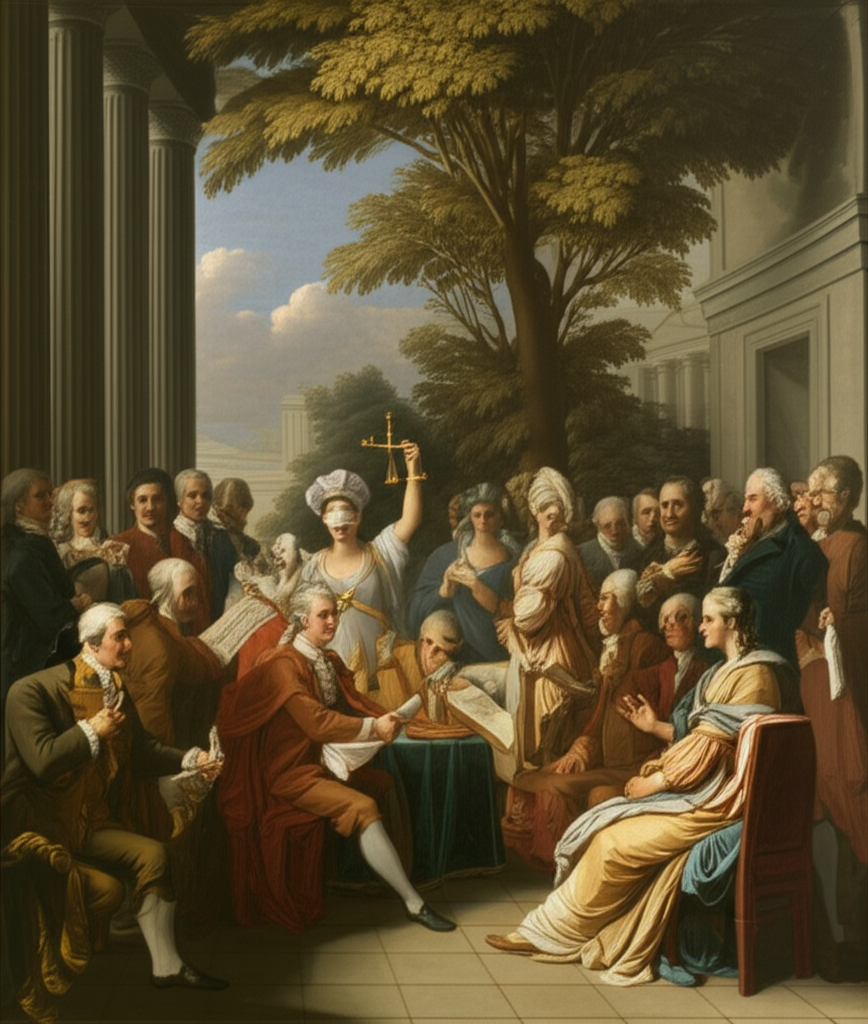
Constructing Justice: The Role of the Constitution
The Idea of a just State finds its most concrete expression in a Constitution. This foundational document attempts to codify the principles of Justice and establish the framework for governance.
- Definition: A Constitution is a body of fundamental principles or established precedents according to which a State or other organization is acknowledged to be governed.
- Purpose: A just Constitution serves several critical functions:
- Limits Power: It defines and restricts the powers of government, preventing tyranny.
- Ensures Rights: It enshrines the fundamental rights and freedoms of citizens.
- Establishes Structure: It outlines the organization of government (e.g., legislative, executive, judicial branches) and the division of powers.
- Provides Stability: It offers a stable framework for governance, promoting predictability and the rule of law.
- Key Elements of a Constitutional Framework for Justice:
- Rule of Law: All, including rulers, are subject to the law.
- Separation of Powers: Distributing governmental authority to prevent concentration.
- Protection of Rights: Bills of Rights or similar declarations.
- Mechanisms for Amendment: Allowing the Constitution to adapt to evolving societal understandings of Justice.
- Independent Judiciary: Ensuring impartial interpretation and enforcement of laws.
The ongoing debate about constitutional interpretation reflects the dynamic nature of the Idea of Justice itself – how to apply timeless principles to contemporary challenges.
Contemporary Challenges and Evolving Ideas of Justice
In the 20th and 21st centuries, the conversation about the just State has expanded to address new complexities and injustices.
- Rawls' Theory of Justice: John Rawls, in A Theory of Justice, proposed a thought experiment: the "veil of ignorance." If individuals were to design a society without knowing their own position within it, they would choose principles that ensure fairness, especially for the least advantaged. This led to his two principles of Justice: equal basic liberties for all, and social and economic inequalities arranged to benefit the least advantaged and be attached to positions open to all.
- Feminist and Post-Colonial Critiques: These perspectives have challenged traditional, often Eurocentric and patriarchal, notions of the just State, highlighting how existing structures perpetuate inequalities based on gender, race, and colonial legacies. They demand a broader Idea of Justice that addresses systemic oppression.
- Global Justice: In an interconnected world, the Idea of Justice extends beyond national borders, encompassing issues like international human rights, climate change, wealth disparities between nations, and the responsibilities of states to one another.
- Digital Age Dilemmas: The rise of artificial intelligence, mass surveillance, and the digital economy presents new ethical challenges for the just State, concerning privacy, data Justice, and algorithmic bias.
The Ongoing Quest for a Just State
The Idea of a just State is not a problem to be solved once and for all, but rather an enduring aspiration and a continuous process of critical reflection and societal action. From Plato's ideal Republic to modern constitutional democracies, the journey to define, establish, and maintain a truly just State remains at the heart of political philosophy. It requires constant vigilance, open dialogue, and a commitment to evolving our understanding of what it means for a society to be truly fair, equitable, and conducive to human flourishing. The Constitution may provide the framework, but the living spirit of Justice must be continually nurtured by its citizens and leaders.
📹 Related Video: PLATO ON: The Allegory of the Cave
Video by: The School of Life
💡 Want different videos? Search YouTube for: ""Plato's Republic Justice" for a concise overview of ancient Greek political thought on justice."
📹 Related Video: ARISTOTLE ON: The Nicomachean Ethics
Video by: The School of Life
💡 Want different videos? Search YouTube for: ""John Locke Social Contract Theory Explained" for insights into the origins of constitutional government and natural rights."