

The Scales of Consequence: Unpacking the Idea of a Just Punishment
The concept of a "just punishment" is one of philosophy's most enduring and vexing challenges. At its core, it asks not merely how we should penalize wrongdoing, but why and to what extent we are morally permitted to inflict suffering or deprivation upon another. This isn't just a legalistic quibble; it delves into our very understanding of Justice, the role of Law in society, and the eternal struggle between Good and Evil. A just punishment seeks to balance societal protection with individual rights, ensuring that our responses to transgression are not merely vengeful, but purposeful, proportionate, and ultimately, reflective of our highest ethical ideals.
The Enduring Question: What Makes Punishment Just?
From the earliest human societies, the need to respond to harm has been undeniable. But the leap from simple retaliation to a reasoned, ethical system of punishment is monumental. How do we determine if a punishment is fair? Is it about making the wrongdoer suffer in proportion to their deed? Or is it about preventing future crimes and rehabilitating offenders? These questions have echoed through the halls of thought for millennia, shaping civilizations and legal systems alike.
Philosophical Foundations from the Great Books
The Great Books of the Western World offer a rich tapestry of perspectives on this very dilemma.
- Plato's Republic: Here, justice is explored not just as a legal concept but as an intrinsic order of the soul and the state. Punishment, in this view, is often seen as a means to restore balance, to heal the soul of the offender, or to educate citizens on the nature of virtue. It's less about retribution and more about the ultimate good of the individual and the polis.
- Aristotle's Nicomachean Ethics: Aristotle delves into corrective justice, suggesting that when an injustice occurs, the aim is to restore the original equality that was disturbed. Punishment, therefore, aims to rectify the imbalance created by the wrongful act, moving towards a proportionate response that brings things back to equilibrium.
- Immanuel Kant's Critique of Practical Reason: Kant, a staunch retributivist, argued that punishment should be inflicted simply because a crime has been committed. For him, a person is an end in themselves, and treating them merely as a means (e.g., for deterrence or rehabilitation) is morally wrong. Justice demands that the guilty suffer, and the punishment must be proportionate to the moral culpability of the act. His famous "categorical imperative" suggests that punishment must be universalizable – if an act is wrong, its punishment must be equally applied.
- Cesare Beccaria's On Crimes and Punishments: A foundational text for modern penal reform, Beccaria argued passionately against arbitrary, cruel, and disproportionate punishments. He advocated for clear, predictable Law, emphasizing deterrence and the prevention of future crimes over pure retribution. His work was instrumental in shifting focus towards a more utilitarian approach to punishment, where its purpose is to protect society and maintain order with the minimum necessary suffering.
The Dual Faces of Punishment: Retribution vs. Utility
The philosophical debate largely crystallizes around two primary theories of punishment:
-
Retributive Justice:
- Core Idea: Punishment is deserved because a wrong has been committed. It's about "paying back" the offender for their transgression.
- Keywords: Lex talionis (an eye for an eye), desert, moral blameworthiness, proportionality.
- Goal: To affirm the moral order, to satisfy the demands of Justice, and to ensure that offenders receive their just deserts. It looks backward at the crime.
- Proponents: Kant, often associated with ancient legal codes.
-
Utilitarian Justice:
- Core Idea: Punishment is justified if it serves a greater good for society. Its value lies in its future-oriented effects.
- Keywords: Deterrence (general and specific), rehabilitation, incapacitation, societal protection.
- Goal: To prevent future crimes, to reform offenders, to protect the community, and to maintain social order. It looks forward to the consequences.
- Proponents: Beccaria, Jeremy Bentham, John Stuart Mill.
The Interplay of Good and Evil in Punishment
The very notion of punishment presupposes a distinction between Good and Evil. We punish acts deemed "evil" or harmful to individuals and society. But who defines these terms? And how do we ensure that our definitions are universal enough to ground a system of Law that applies fairly to all?
- Moral Culpability: A just punishment often requires an assessment of the offender's intent and moral responsibility. Was the act accidental, negligent, or maliciously premeditated? The degree of perceived evil often dictates the severity of the punishment.
- Societal Values: Laws, and thus punishments, are ultimately reflections of a society's collective values about what is right and wrong. When these values shift, so too do the parameters of what constitutes a just response.
Challenges to Achieving Just Punishment
Even with clear theoretical frameworks, the practical application of just punishment is fraught with difficulties.
- Proportionality: How do we quantify harm and assign a "just" amount of suffering? Is it possible to truly balance the scales?
- Rehabilitation vs. Retribution: Can a system effectively pursue both goals simultaneously? Often, the demands of retribution (e.g., long prison sentences) conflict with the opportunities for rehabilitation.
- Bias and Inequality: Systemic biases, whether racial, economic, or social, can profoundly impact who is punished, and how severely, undermining the very ideal of Justice.
- The Role of Mercy: Does mercy have a place in a system striving for justice? Or does it compromise the principle of equal application of the Law?
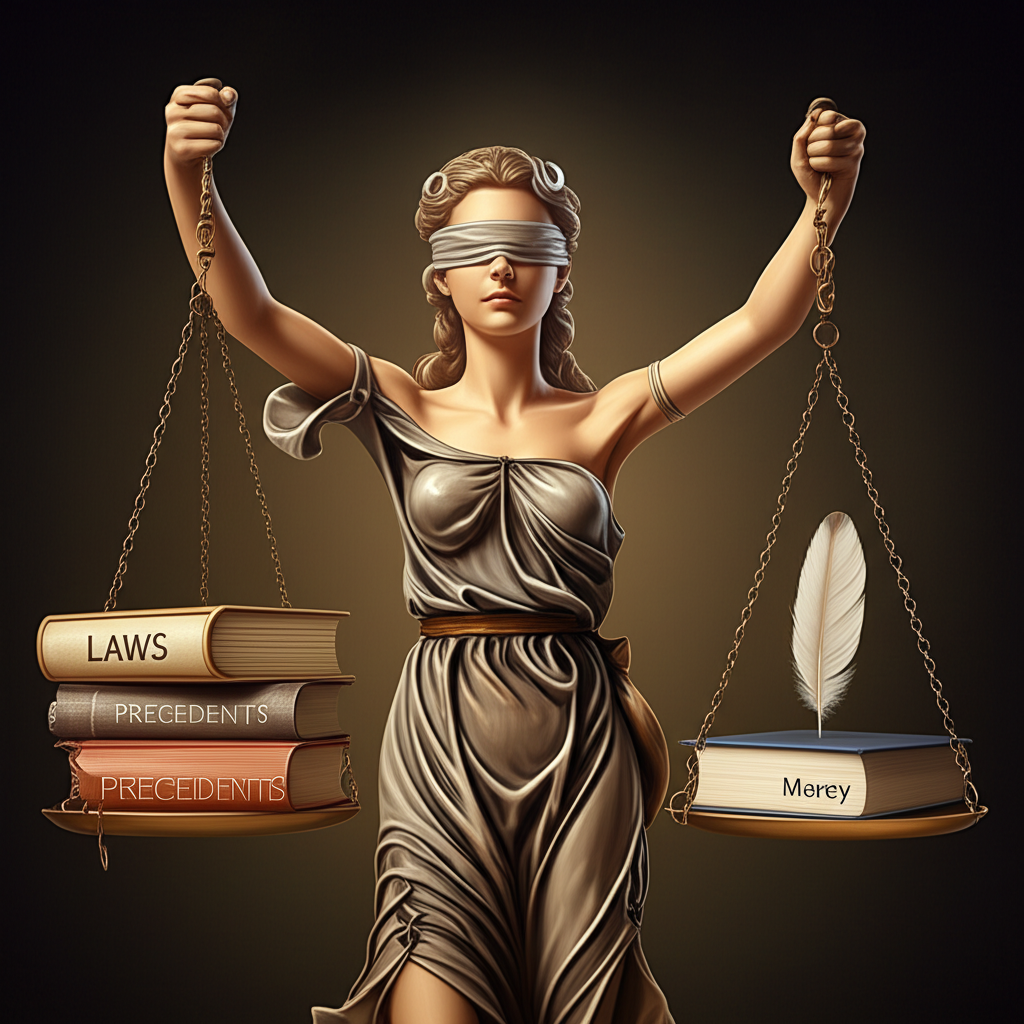
Conclusion: An Ongoing Philosophical Pursuit
The idea of a just punishment remains a dynamic and evolving concept, a testament to humanity's continuous striving for a more perfect society. It demands constant re-evaluation, informed by ethical reasoning, historical lessons, and an unwavering commitment to the principles of Justice. As we navigate the complexities of crime and consequence, we are compelled to continually ask: Does our system of Law truly embody our understanding of Good and Evil? And are our punishments truly just, or merely expressions of power? The pursuit of a truly just punishment is not a destination, but an eternal journey at the heart of human civilization.
📹 Related Video: What is Philosophy?
Video by: The School of Life
💡 Want different videos? Search YouTube for: ""The Philosophy of Punishment - Retribution vs. Utilitarianism""
📹 Related Video: PLATO ON: The Allegory of the Cave
Video by: The School of Life
💡 Want different videos? Search YouTube for: ""Plato's Republic - Justice and the Ideal State Explained""