

The Enduring Quest for Order: Unpacking the Idea of a Just Constitution
Summary
The Idea of a Just Constitution represents humanity's perennial pursuit of a framework for society that is not merely orderly, but also equitable and conducive to human flourishing. From the ancient philosophical inquiries into the nature of the ideal state to the modern emphasis on rights and the rule of Law, this concept grapples with fundamental questions: What grants authority legitimacy? How can power be constrained to prevent tyranny? And what principles must underpin a social order to truly serve the common good? This article explores the historical development of this profound Idea, drawing upon the insights of the Great Books of the Western World, to illuminate the complex interplay between structure, ethics, and the Law in shaping a Just society.
Introduction: The Imperative of a Just Framework
Human societies, from their earliest formations, have grappled with the fundamental challenge of establishing order. Yet, order alone, without a guiding principle of fairness and equity, can quickly devolve into oppression. This is where the profound Idea of a Just Constitution emerges—not merely a set of rules, but a philosophical blueprint for a society grounded in moral principles. It is the ambition to create a political structure, a Law-making body, and a system of governance that transcends mere expediency to embody Justice itself.
The journey to understand and articulate this Idea has been a central thread running through Western thought, influencing the grand narratives of political philosophy found within the Great Books. These foundational texts offer not just historical accounts, but timeless arguments about the nature of power, the rights of individuals, and the responsibilities of the state.
Ancient Foundations: Plato, Aristotle, and the Ideal State
The earliest and perhaps most profound explorations of a Just Constitution begin with the ancient Greeks, who meticulously dissected the various forms of governance and their ethical implications.
Plato's Vision: Harmony and the Philosopher-King
In Plato's Republic, the Idea of Justice is not merely a legal concept but a cosmic principle, reflecting the harmonious order of the soul and the state. For Plato, a Just society is one where each part performs its proper function, guided by reason. He posits an ideal Constitution ruled by "philosopher-kings," individuals whose wisdom and understanding of the Idea of the Good enable them to govern without personal interest, ensuring that the Law serves the collective well-being. This Constitution isn't democratic in the modern sense; rather, it's an aristocracy of intellect, where Justice is achieved through the alignment of individual virtue with the state's purpose.
Aristotle's Classification: The Common Good as the Benchmark
Aristotle, in his Politics, takes a more empirical approach, analyzing existing Constitutions and categorizing them based on two criteria: the number of rulers and their aim.
Aristotle's Classification of Constitutions:
| Number of Rulers | Good Form (for the Common Good) | Deviant Form (for Self-Interest) |
|---|---|---|
| One | Monarchy | Tyranny |
| Few | Aristocracy | Oligarchy |
| Many | Polity | Democracy |
For Aristotle, a Just Constitution—whether it be a monarchy, aristocracy, or polity—is one that prioritizes the common good rather than the self-interest of the rulers. He famously argued that the Law is "reason unaffected by desire," and thus, a Just Constitution embodies the rule of Law over the rule of men, ensuring stability and fairness. The "polity," a mixed Constitution blending elements of oligarchy and democracy, was often seen as his preferred practical Idea for achieving stability and Justice among a diverse citizenry.
The Social Contract Theorists: Consent, Rights, and Legitimate Authority
Centuries later, the Enlightenment brought forth a new paradigm for understanding the Idea of a Just Constitution: the social contract. This theory posits that legitimate government arises from the consent of the governed, fundamentally shifting the focus from divine right or inherent wisdom to the will of the people and the protection of individual rights.
Thomas Hobbes: Order from Chaos
In Leviathan, Thomas Hobbes paints a bleak picture of the "state of nature" as a "war of all against all." To escape this brutal existence, individuals rationally agree to surrender some of their freedoms to an absolute sovereign, creating a powerful state (the Leviathan) whose Law is the ultimate guarantor of peace and order. For Hobbes, a Just Constitution is one that effectively prevents civil strife, even if it means sacrificing extensive individual liberties. Justice is simply adherence to the covenants established.
John Locke: Natural Rights and Limited Government
John Locke, in his Two Treatises of Government, offers a more optimistic view. He argues for inherent natural rights—life, liberty, and property—that predate government. The purpose of a Just Constitution is to protect these rights, not to infringe upon them. Government, therefore, derives its legitimacy from the consent of the governed and operates under a system of Law that is clear, known, and applied equally. When a government fails to uphold this contract, the people retain the right to revolution, embodying a profound Idea of popular sovereignty and limited power.
Jean-Jacques Rousseau: The General Will and Popular Sovereignty
Rousseau's The Social Contract introduces the powerful Idea of the "general will." He argues that true freedom comes not from individual license, but from obedience to a Law that one has prescribed for oneself as part of the collective. A Just Constitution, for Rousseau, is one that accurately reflects the general will of the people, ensuring that the Law serves the common good and promotes equality. This Idea emphasizes direct participation and challenges the notion of representative government as potentially alienating citizens from their own sovereignty.
The Enlightenment and Modern Constitutionalism: Balancing Power and Rights
The philosophical groundwork laid by these thinkers profoundly influenced the development of modern constitutionalism, particularly in the formation of new nations.
Montesquieu: Separation of Powers
Baron de Montesquieu, in The Spirit of the Laws, meticulously analyzed various political systems and famously advocated for the separation of governmental powers into legislative, executive, and judicial branches. This Idea was not merely about efficiency but about preventing tyranny by ensuring that no single entity could accumulate absolute power. A Just Constitution, therefore, must incorporate checks and balances to safeguard liberty, embodying the Idea that power must be divided to remain Just.
The American Experiment: A Written Constitution
The framers of the United States Constitution drew heavily from these Enlightenment principles. Their Idea of a Just Constitution was a written document, establishing a government of enumerated powers, protecting individual rights (through the Bill of Rights), and incorporating a robust system of checks and balances. This Constitution was designed to be a supreme Law of the land, binding both the government and the governed, and providing a mechanism for its own amendment, reflecting the Idea that Justice might require adaptation over time.
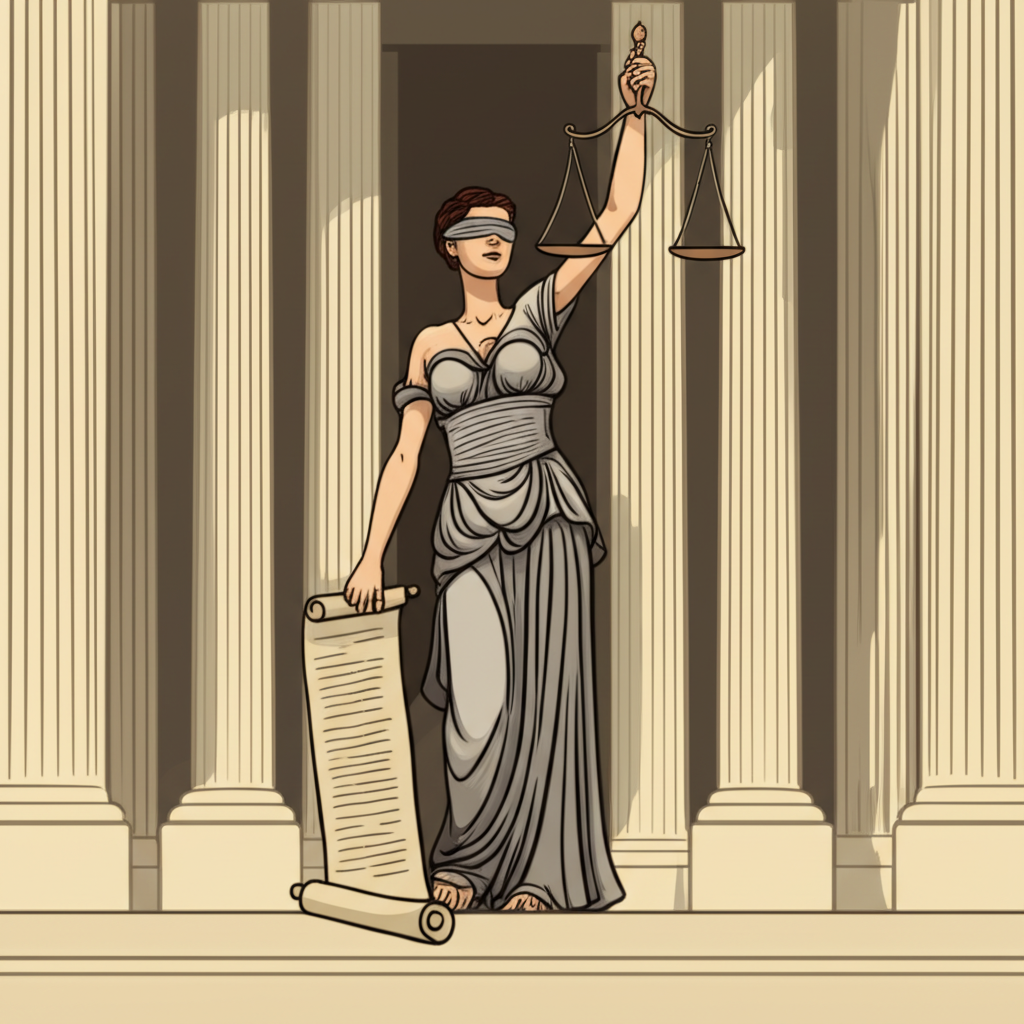
Key Elements of a Just Constitution
While the specific forms and interpretations have varied, certain core elements consistently emerge in the Idea of a Just Constitution:
- The Rule of
Law: All individuals and institutions, including the government itself, are subject to and accountable underLaw. This ensures predictability, fairness, and prevents arbitrary power. - Protection of Rights and Liberties: A
JustConstitutiondefines and safeguards fundamental human rights, such as freedom of speech, assembly, and due process, ensuring that the state cannot arbitrarily infringe upon individual autonomy. - Separation of Powers: The division of governmental authority into distinct branches (legislative, executive, judicial) with checks and balances prevents the concentration of power and guards against tyranny.
- Accountability and Transparency: Mechanisms for holding government officials responsible for their actions and ensuring that governmental processes are open to public scrutiny.
- Popular Sovereignty and Representation: The
Ideathat legitimate political authority ultimately derives from the consent of the governed, expressed through democratic processes or representative institutions. - Mechanisms for Amendment and Adaptation: A
JustConstitutionrecognizes that societies evolve and provides orderly procedures for its own revision, allowing it to remain relevant andJustacross generations. - Commitment to the Common Good: While protecting individual rights, a
JustConstitutionalso aims to foster conditions that benefit all members of society, striving for socialJusticeand collective well-being.
Challenges and the Ongoing Pursuit of Justice
The Idea of a Just Constitution is not a static blueprint but a dynamic aspiration. Challenges persist in its implementation and interpretation:
- Interpretation: How should constitutional
Lawbe interpreted in the face of new social issues or technological advancements? Original intent versus livingConstitutiondebates. - Power Dynamics: Even with checks and balances, the balance of power can shift, requiring constant vigilance to prevent one branch from overreaching.
- Social
Justice: Beyond formal legal equality, how does aConstitutionaddress systemic inequalities and promote substantiveJusticefor all citizens? - Global Challenges: In an interconnected world, how does a national
Constitutionrespond to transnational issues like climate change, pandemics, or global economic forces?
The ongoing pursuit of a Just Constitution is a continuous dialogue, a re-evaluation of principles, and a commitment to the Idea that society's foundational Law must always strive for greater equity and human dignity.
Conclusion: The Enduring Ideal
From the ancient Greek city-states to modern democracies, the Idea of a Just Constitution has served as a beacon for political thought and action. It is a testament to humanity's persistent belief that governance can be more than mere power; it can be an instrument of Justice. The thinkers of the Great Books of the Western World provide a rich tapestry of arguments, warnings, and aspirations that continue to inform our understanding of what it means to build a society where the Law serves not just order, but also fairness, liberty, and the profound Idea of human flourishing. The quest for a truly Just Constitution remains one of our most noble and essential endeavors.
**## 📹 Related Video: PLATO ON: The Allegory of the Cave
Video by: The School of Life
💡 Want different videos? Search YouTube for: "Plato's Republic and Justice"**
**## 📹 Related Video: ARISTOTLE ON: The Nicomachean Ethics
Video by: The School of Life
💡 Want different videos? Search YouTube for: "John Locke Social Contract Theory Explained"**