

The Infinite Echo: Exploring the Hypothesis of Multiple Worlds
The notion that our singular existence might be but one iteration within an infinite tapestry of realities is a profound and enduring Hypothesis. From the ancient philosophical musings on atomistic worlds to the cutting-edge theories of quantum Metaphysics and theoretical Astronomy, the idea of multiple Worlds challenges our most fundamental assumptions about reality, identity, and the very fabric of the cosmos. This article delves into the historical lineage and contemporary implications of this captivating concept, revealing its persistent power to inspire wonder and rigorous inquiry.
Introduction: Beyond Our Single Sphere
For millennia, humanity has looked up at the night sky and pondered the vastness beyond our immediate experience. Is this World all there is? The "Hypothesis of Multiple Worlds," often referred to as the multiverse theory in its modern scientific guise, suggests a resounding "no." It posits that our universe is not unique, but rather one among countless others, each potentially differing in its physical laws, initial conditions, or even its very history. This isn't merely a flight of fancy; it's a concept deeply rooted in philosophical tradition and increasingly explored by contemporary science, pushing the boundaries of what we consider knowable.
I. Ancient Whispers: The Genesis of Plurality
The seeds of the multiple Worlds Hypothesis were sown not in observatories, but in the minds of ancient Greek philosophers, whose inquiries formed the bedrock of Western thought, as chronicled in the Great Books of the Western World.
-
Early Philosophical Speculations:
- The Atomists: Figures like Democritus and Epicurus proposed a universe composed of an infinite number of indivisible particles, or atoms, moving in an infinite void. From this, it logically followed that there must be an infinite number of Worlds forming and dissolving throughout eternity. These were not merely distant stars but other planetary systems, perhaps even inhabited, echoing our own World in countless variations. This was a radical Hypothesis for its time, challenging the prevailing geocentric view.
- Plato's Forms and the Ideal World: While not advocating for multiple physical universes, Plato's theory of Forms, discussed extensively in his dialogues, posited a transcendent realm of perfect, immutable ideas existing independently of our material World. This provided a different kind of "multiplicity"—a metaphysical plurality where our perceived reality is but a shadow of a more fundamental, ideal World.
-
Aristotle's Counterpoint: In contrast, Aristotle, whose works profoundly shaped medieval Astronomy and Metaphysics, argued for a unique, finite cosmos with the Earth at its center. His system allowed for no other Worlds, as the very concept of "up" and "down" was defined relative to the Earth, making the existence of another such center impossible within his logical framework. This singular World view dominated Western thought for over a thousand years.
II. The Renaissance and Beyond: Expanding Horizons
The intellectual ferment of the Renaissance began to dismantle the Aristotelian cosmos, paving the way for a renewed interest in plurality.
- Copernicus and Bruno: Nicolaus Copernicus's heliocentric model, placing the Sun at the center of our solar system, was a monumental shift. Later, Giordano Bruno, reading Copernicus, took the Hypothesis much further, famously asserting that the stars were other suns, each potentially with its own planets and inhabitants. For this radical Metaphysics, suggesting an infinite number of Worlds, he was tragically condemned.
- The Dawn of Modern Science: With the invention of the telescope, Galileo Galilei's observations of mountains on the Moon and moons orbiting Jupiter revealed that celestial bodies were not perfect, ethereal spheres but Worlds unto themselves, further eroding the notion of Earth's unique status. The sheer vastness of space, as revealed by improving Astronomy, made the idea of other Worlds increasingly plausible.
III. Modern Science and the Multiverse: A New Hypothesis
The 20th and 21st centuries have seen the Hypothesis of multiple Worlds transform from philosophical speculation into a serious area of scientific inquiry, driven by developments in fundamental physics and cosmology.
- Quantum Mechanics and the Many-Worlds Interpretation (MWI):
- One of the most profound and perplexing aspects of quantum mechanics is that particles exist in a superposition of states until measured. Hugh Everett III, in his 1957 doctoral thesis, proposed the Many-Worlds Interpretation. This radical Hypothesis suggests that every time a quantum measurement is made, the universe branches, creating a new World for each possible outcome. In this view, all possibilities are realized in different Worlds, continually splitting off from our own.
- Cosmological Models:
- Inflationary Cosmology: Theories of cosmic inflation, which describe the rapid expansion of the early universe, naturally lead to the idea of a "multiverse." Eternal inflation suggests that inflation never truly stops everywhere, but rather continues in patches, giving rise to an infinite number of "pocket universes," each with its own Big Bang.
- String Theory and the Landscape: String theory, an attempt to unify all fundamental forces, suggests that our universe might be just one of an immense number of possible universes, each with different physical laws and fundamental constants. This "landscape" of possible universes is a direct consequence of the theory's mathematical structure, offering a concrete Metaphysics for the multiverse.
- The Role of Astronomy: While direct observation of other universes remains beyond current capabilities, Astronomy provides the theoretical framework and observational data (like the cosmic microwave background radiation) that inform and constrain these multiverse hypotheses.
IV. Metaphysical Labyrinths: What Does it All Mean?
The Hypothesis of multiple Worlds opens up a Pandora's Box of Metaphysical questions, challenging our understanding of reality, identity, and knowledge itself.
- Fundamental Metaphysical Questions:
- Identity and Existence: If there are infinite versions of "you" in other Worlds, each making different choices, what does that mean for your unique identity or free will? Does it dilute our sense of self or expand it infinitely?
- Reality's Nature: Is our World merely one slice of an infinite cosmic pie, or is it the only World that truly matters? How do we define "reality" if there are countless realities?
- Epistemological Challenges: How can we know these other Worlds? The very definition of a "universe" often implies a causally disconnected realm. If we cannot observe or interact with them, can we truly claim to know they exist, or are they forever confined to the realm of Hypothesis?
- The Problem of Evil/Good: If every possible outcome exists, then every good and every evil act is actualized somewhere. What does this mean for morality, responsibility, or the nature of a benevolent creator, if one believes in such?
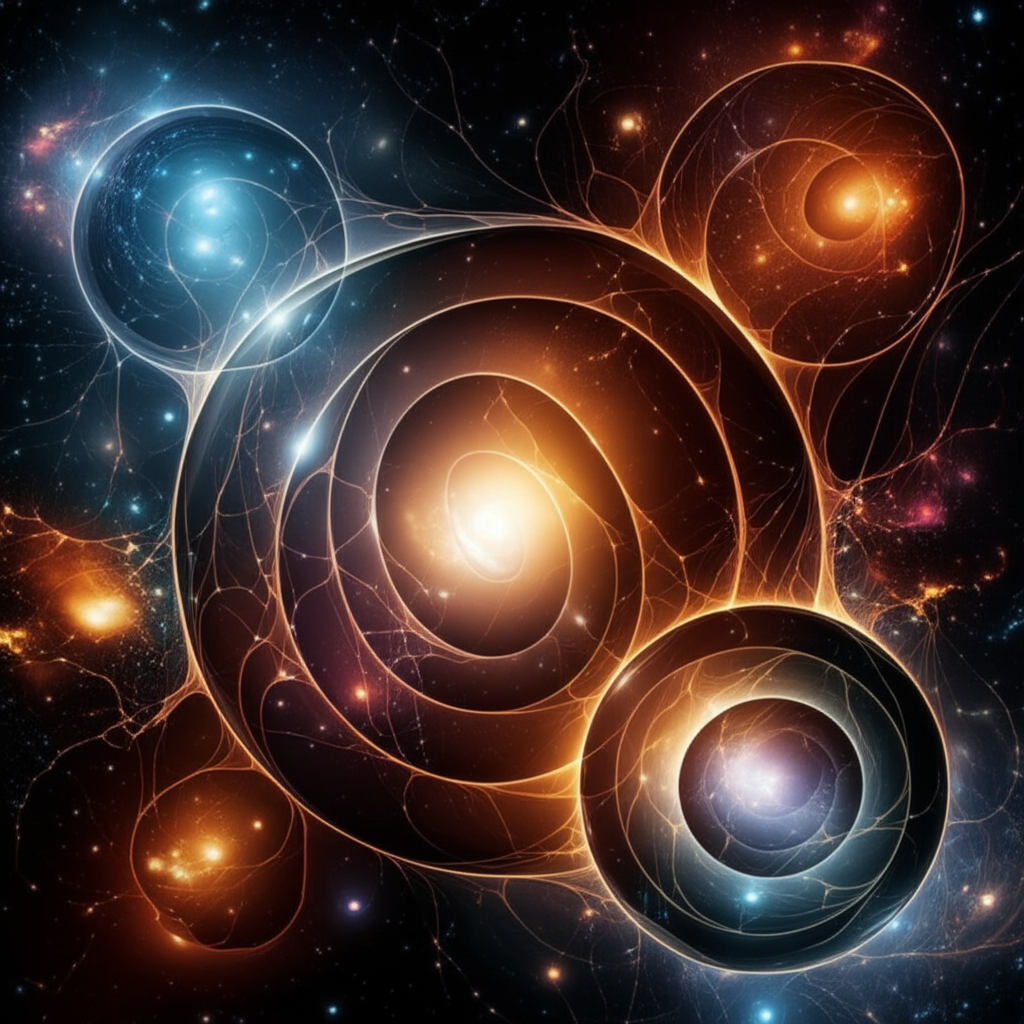
V. Critiques and Philosophical Reservations
Despite its allure, the Hypothesis of multiple Worlds faces significant philosophical and scientific critiques.
- Parsimony (Occam's Razor): A common objection is that positing an infinite number of unobservable universes is an unnecessary multiplication of entities. Why invoke such a vast and complex structure when a simpler explanation might suffice?
- Falsifiability: A cornerstone of scientific theory is falsifiability – the ability to design an experiment that could prove the theory wrong. Many versions of the multiverse Hypothesis are criticized for being unfalsifiable, making them more akin to Metaphysical speculation than empirical science.
- The Limits of Scientific Explanation: Where does scientific explanation end and philosophical speculation begin? While theoretical physics can construct models, the ultimate question of whether these other Worlds "exist" in any meaningful sense often falls into the domain of Metaphysics.
Conclusion: The Enduring Quest for Worlds Beyond
The Hypothesis of Multiple Worlds, whether viewed through the lens of ancient Atomism, quantum Metaphysics, or inflationary Astronomy, represents humanity's enduring quest to understand its place in the cosmos. It challenges us to reconsider the boundaries of reality, the nature of existence, and the very meaning of "our World." While definitive proof remains elusive, the journey of inquiry itself, fueled by this profound Hypothesis, continues to expand the horizons of both scientific thought and philosophical wonder, echoing through the pages of intellectual history.
📹 Related Video: What is Philosophy?
Video by: The School of Life
💡 Want different videos? Search YouTube for: ""Many Worlds Interpretation Explained Philosophy""
📹 Related Video: ARISTOTLE ON: The Nicomachean Ethics
Video by: The School of Life
💡 Want different videos? Search YouTube for: ""Multiverse Theory Physics and Metaphysics""