

The Infinite Tapestry: Exploring the Hypothesis of Multiple Worlds
The idea that our world is but one among many, a single thread in an unimaginably vast cosmic tapestry, has captivated thinkers for millennia. From the atomists of ancient Greece to the cutting-edge theories of modern astronomy and quantum physics, the hypothesis of multiple worlds challenges our most fundamental assumptions about reality, existence, and our place within the grand scheme. This article delves into the philosophical and scientific journey of this profound concept, exploring its enduring metaphysical implications.
A Plurality of Existences: Ancient Roots and Enduring Questions
At its core, the hypothesis of multiple worlds posits that what we perceive as reality – our universe, our dimension, our timeline – is not the sole existing reality. This concept, far from being a modern invention, finds its origins deep within the philosophical traditions chronicled in the Great Books of the Western World. It asks: Is our world unique, or are there others, perhaps infinite in number, each with its own laws, histories, or even inhabitants? This question forces us to confront the limits of our perception and the boundless possibilities of existence.
From Ancient Cosmoi to Modern Universes
The journey of the multiple worlds hypothesis is a fascinating intellectual odyssey, marked by periods of fervent debate and quiet dormancy.
The Early Atomists and Infinite Possibilities
The earliest proponents of a plurality of worlds were the pre-Socratic Greek atomists, such as Leucippus and Democritus. They posited an infinite void filled with an infinite number of indivisible atoms. From the random collisions and aggregations of these atoms, they argued, an infinite number of cosmoi (worlds or universes) could arise, each forming, decaying, and reforming. For them, the existence of our world was not a singular miracle but a statistical inevitability within an eternal, boundless system. This was a purely materialistic and mechanistic hypothesis, devoid of divine intervention.
The Aristotelian Monoworld and Medieval Debates
Aristotle, whose cosmology dominated Western thought for over a millennium, firmly rejected the idea of multiple worlds. His geocentric model, with a single, unique Earth at its center, surrounded by perfect celestial spheres, left no room for other universes. For Aristotle, the very structure of the cosmos, with its natural places and movements, precluded the existence of any other such arrangement.
However, even during the height of Aristotelian influence, the question occasionally resurfaced, particularly in medieval scholasticism. The question was often framed in terms of God's omnipotence: Could God have created other worlds? Thinkers like Thomas Aquinas generally concluded that while God could have, there was no necessity for it, preserving the uniqueness of our world within a divinely ordered cosmos. Yet, the very posing of the question kept the hypothesis alive, albeit in a theological context.
The Scientific Turn: Astronomy and the Multiverse
The scientific revolution, particularly the advancements in astronomy, began to dismantle the Aristotelian cosmos and paved the way for a renewed consideration of multiple worlds.
- Copernicus and the Demotion of Earth: The heliocentric model, while not directly proposing other universes, profoundly altered our perspective. If Earth was just another planet orbiting the sun, then what about the countless other stars? Could they too have planets, perhaps even inhabited ones? This expanded the concept of a "world" from a unique entity to one among many celestial bodies.
- The Expanding Universe and Beyond: Twentieth-century astronomy revealed a universe far vaster and stranger than previously imagined. The discovery of galaxies beyond our own, the Big Bang theory, and the concept of cosmic inflation have all, in different ways, opened doors to various forms of the multiverse hypothesis.
Modern scientific hypotheses about multiple worlds often fall into several categories:
- Level I: Infinite Worlds (Observable Universes): In an infinitely large universe, every possible configuration of matter and energy would eventually repeat. Thus, there could be infinite "worlds" identical to ours, or with slight variations, existing beyond our observable horizon.
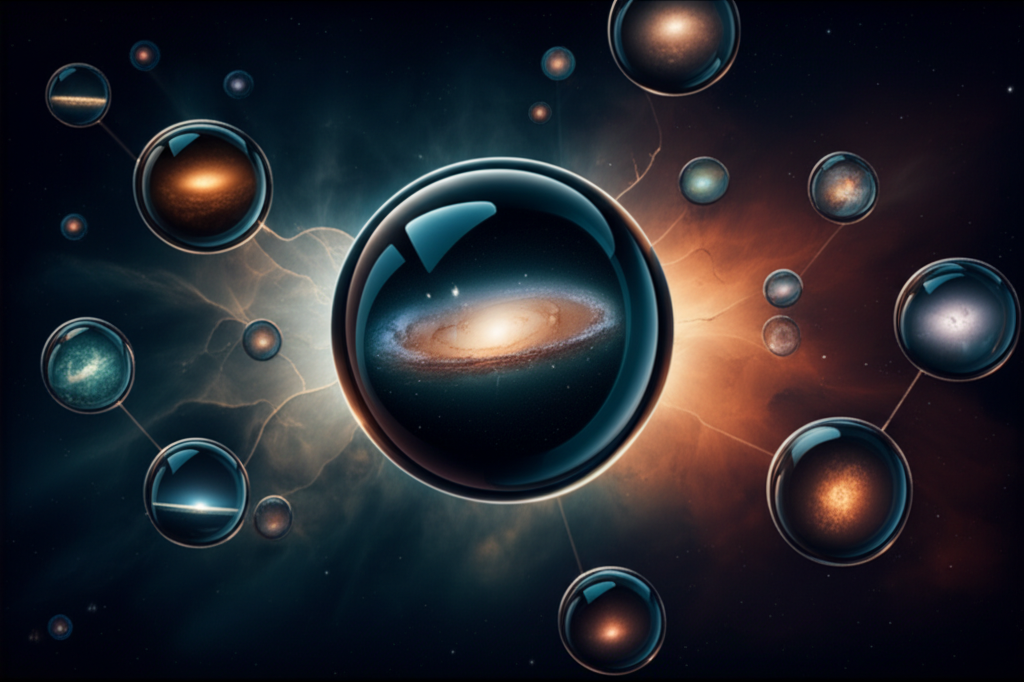
- Level II: Bubble Universes (Inflationary Multiverse): Theories of cosmic inflation suggest that our universe might be just one "bubble" in a vast, eternally inflating meta-universe. Other bubbles could have different physical laws and constants.
- Level III: Quantum Many-Worlds Interpretation (MWI): From quantum mechanics, the MWI suggests that every quantum measurement or decision causes the universe to split into multiple branches, each representing a different outcome. Every possibility becomes real in a separate world.
- Level IV: Mathematical Universes: This radical hypothesis proposes that all mathematically consistent structures exist as actual universes.
The Metaphysics of Parallel Existence
Beyond the scientific models, the hypothesis of multiple worlds plunges us into profound metaphysical waters.
- Defining "World": What exactly constitutes a "world" in this context? Is it a separate spacetime continuum, a different set of physical laws, or merely a different outcome of historical events? The definition impacts the philosophical implications significantly.
- Identity and Individuality: If there are infinite copies of us, or worlds where we made different choices, what does that mean for our sense of self, our free will, and our unique identity?
- Reality and Possibility: The multiverse hypothesis blurs the line between what is and what could be. If every possibility is realized in some world, does that elevate possibility to a form of reality?
- The Problem of Verification: How could we ever verify the existence of these other worlds, especially if they are causally disconnected from our own? This remains a central philosophical challenge.
The metaphysical questions raised by the multiverse are perhaps more compelling than the scientific ones, forcing us to re-evaluate our fundamental understanding of existence itself.
Concluding Thoughts: Infinite Possibilities, Infinite Questions
The hypothesis of multiple worlds, whether viewed through the lens of ancient atomism, medieval theology, or modern astronomy, remains one of the most intellectually stimulating concepts in philosophy and science. It pushes the boundaries of our imagination and challenges us to consider the universe not as a singular entity, but as a potentially infinite collection of realities. As we continue to explore the cosmos and the fundamental nature of reality, this profound hypothesis will undoubtedly remain a cornerstone of our inquiry, reminding us that the answers to our deepest questions might lie beyond the confines of our familiar world.
📹 Related Video: What is Philosophy?
Video by: The School of Life
💡 Want different videos? Search YouTube for: ""The Philosophy of the Multiverse Explained""
📹 Related Video: What is Philosophy?
Video by: The School of Life
💡 Want different videos? Search YouTube for: ""Ancient Greek Philosophy on Multiple Universes""