

The Unseen Interior: Exploring the Hypothesis of Animal Consciousness
The question of whether animals possess a conscious mind is not merely a scientific curiosity but a profound philosophical challenge. At its core, the Hypothesis of Animal Consciousness posits that non-human animals experience subjective states – sensations, emotions, desires, and perhaps even forms of self-awareness – much like humans do. This is not simply about observable behavior but about the inner life, the qualitative 'what it is like' to be a bat, a dog, or an octopus. This hypothesis compels us to re-evaluate our understanding of intelligence, morality, and the very nature of existence beyond the human sphere, bridging ancient philosophical inquiries with cutting-edge scientific investigation.
From Ancient Souls to Modern Minds: A Philosophical Lineage
The contemplation of animal interiority is far from a modern invention. Throughout the Great Books of the Western World, philosophers have grappled with the nature of the psyche and its manifestations across species.
- Aristotle, in his treatise On the Soul, meticulously categorized different types of souls (nutritive, sensitive, rational), granting animals a sensitive soul capable of perception, desire, and movement, but reserving rational thought for humans. This laid a foundational distinction that would echo for centuries.
- Later, René Descartes famously argued that animals were mere automata – complex biological machines devoid of consciousness, feelings, or a non-physical mind. His view, while influential, presented a stark, mechanistic vision of animal existence, largely based on the absence of language and apparent lack of rational thought.
- However, dissenting voices, such as Michel de Montaigne, challenged this anthropocentric view, suggesting that animals might possess forms of reason and perception that we, in our human arrogance, fail to recognize or adequately interpret. He marveled at their ingenuity and adaptation, hinting at an inner world that deserved deeper consideration.
These historical debates, though couched in terms of "soul" or "reason," laid the groundwork for the contemporary hypothesis of animal consciousness, shifting the focus from metaphysical substance to empirical evidence of subjective experience.
Defining the Hypothesis: What Does it Mean to Be Conscious?
When we speak of the Hypothesis of Animal Consciousness, we are proposing that animals are not just reacting to stimuli but are experiencing them. This involves several key aspects:
- Sentience: The capacity to feel, perceive, and experience sensations (e.g., pain, pleasure, hunger).
- Affective States: The ability to experience emotions (e.g., fear, joy, sadness, affection).
- Cognitive Awareness: The capacity for perception, attention, memory, and perhaps even problem-solving that goes beyond mere instinct.
- Self-Awareness: In more complex cases, the ability to recognize oneself as a distinct individual and to reflect on one's own existence.
The hypothesis suggests that these qualities are not exclusive to Homo sapiens but are distributed across the animal kingdom, albeit in myriad forms and complexities.
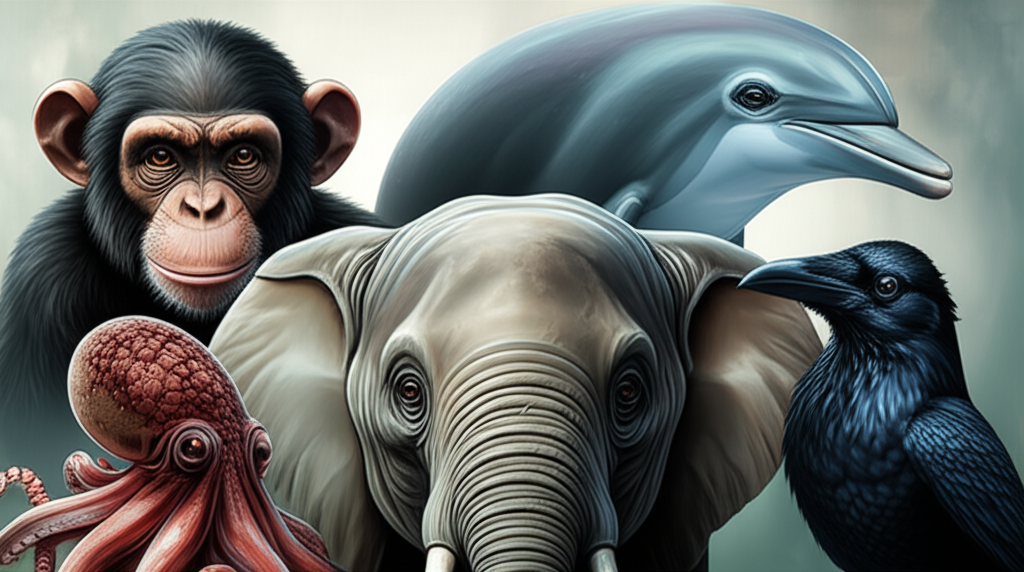
The Scientific Quest for the Animal Mind
Modern science employs a multidisciplinary approach to investigate the hypothesis. Researchers utilize tools from ethology, neuroscience, cognitive psychology, and even philosophy of mind to gather evidence.
Table 1: Approaches to Studying Animal Consciousness
| Approach | Description | Example Evidence |
|---|---|---|
| Behavioral | Observing complex, flexible, and adaptive behaviors. | Tool use, problem-solving, mirror self-recognition, grief. |
| Neurological | Studying brain structure, activity, and neurochemical processes. | Similar brain regions for emotion/pain; EEG patterns. |
| Pharmacological | Observing responses to psychoactive drugs. | Animals reacting to anesthetics, anxiolytics. |
| Comparative | Drawing parallels between human and animal cognitive/emotional processes. | Similar social structures, empathy, communication. |
While no single piece of evidence definitively "proves" consciousness, the cumulative weight of observations suggests a rich inner world for many species. The 2012 Cambridge Declaration on Consciousness, signed by a prominent group of neuroscientists, affirmed that "non-human animals, including mammals and birds, and many other creatures, possess the neurological substrates of consciousness."
Philosophical Implications and Ethical Considerations
Accepting the Hypothesis of Animal Consciousness has profound implications, stretching far beyond academic curiosity.
- Re-evaluating Intelligence: It challenges anthropocentric notions of intelligence, suggesting that different species possess different forms of cognitive prowess, none inherently superior.
- Ethical Obligations: If animals possess minds capable of suffering and joy, our moral obligations towards them fundamentally shift. This impacts debates on animal welfare, animal rights, factory farming, scientific experimentation, and even pet ownership. The question moves from "Can they reason?" to "Can they suffer?"
- Understanding Ourselves: By studying other conscious beings, we gain a deeper understanding of the evolutionary origins and diverse manifestations of consciousness, shedding light on our own place within the tapestry of life.
The journey to understand the animal mind is ongoing, a fascinating intersection of ancient philosophical wonder and contemporary scientific rigor. The hypothesis invites us to look beyond the surface and ponder the rich, unseen interior lives that share our planet.
YouTube Video Suggestions:
-
📹 Related Video: What is Philosophy?
Video by: The School of Life
💡 Want different videos? Search YouTube for: ""The Inner Life of Animals: Philosophy and Science""
-
📹 Related Video: ARISTOTLE ON: The Nicomachean Ethics
Video by: The School of Life
💡 Want different videos? Search YouTube for: ""What is Animal Consciousness? Neuroscientists Explain""