

The Enduring Quest: Hypotheses on the Origin of the World
From the earliest whispers of humanity, the question of our origins – the genesis of the World itself – has been an ineluctable challenge to human intellect and imagination. This pillar page embarks on a journey through the myriad hypothesis that have sought to explain how everything came to be, traversing the realms of ancient myth, profound philosophy, and cutting-edge Astronomy and Evolution. We will explore how these explanations have evolved, reflecting humanity’s shifting understanding of the cosmos and our place within it, from divine fiat to cosmic expansion, always driven by an insatiable curiosity about the primordial state of existence.
The Primordial Soup of Thought: Early Philosophical and Mythological Origins
Long before empirical science could offer testable hypothesis, humanity grappled with the mystery of creation through narrative and philosophical speculation. These early accounts, often found within the foundational texts of civilization, laid the groundwork for all subsequent inquiry.
Mythic Cosmogony: Creation from Chaos or Divine Will
Across diverse cultures, the World often emerges from a state of primordial chaos, a formless void, or a cosmic egg. The ancient Egyptians, for instance, spoke of a primeval ocean, Nun, from which the sun god Ra emerged to create the World. In the Norse sagas, the universe began in Ginnungagap, a vast emptiness, from which fire and ice collided to form the giant Ymir and, subsequently, the cosmos. These narratives, while not scientific hypothesis, provided coherent explanations for their respective cultures, imbuing the universe with meaning and purpose.
The Greek Dawn: From Elements to Forms
The early Greek philosophers, often referred to as Presocratics, initiated a monumental shift towards seeking natural explanations. Thales posited water as the fundamental element, Anaximander proposed the apeiron (the boundless), and Anaximenes favored air. These thinkers moved beyond purely mythological explanations, attempting to identify a single, underlying substance from which the World arose – an early form of scientific hypothesis.
Plato, in his seminal work Timaeus, accessible through the Great Books of the Western World, presents a detailed cosmogony involving a divine craftsman, the Demiurge. This Demiurge, not a creator ex nihilo, but an ordering intelligence, fashioned the World from pre-existing chaotic matter, imposing order and mathematical harmony according to eternal Forms. This philosophical hypothesis emphasizes reason, structure, and a teleological purpose in creation. Aristotle, a student of Plato, offered a different perspective, often suggesting an eternal, uncreated cosmos, set in motion by an Unmoved Mover, a pure actuality that is the ultimate cause of all motion.
The Celestial Dance: Astronomical Revolutions and the World's Place
As human observation of the heavens grew more sophisticated, so too did the hypothesis concerning the structure and origin of the World. Astronomy became a crucial lens through which to understand our cosmic address.
From Geocentric to Heliocentric: A Paradigm Shift
For centuries, the Ptolemaic geocentric model, eloquently detailed in his Almagest (another cornerstone of the Great Books), dominated Western thought. This hypothesis placed Earth at the center of the universe, with celestial bodies orbiting in perfect spheres. It aligned with both theological doctrines and everyday observation.
However, the Renaissance brought forth a profound revolution. Nicolaus Copernicus, in On the Revolutions of the Heavenly Spheres, proposed the heliocentric hypothesis, placing the Sun at the center. Galileo Galilei, through his telescopic observations, provided empirical evidence supporting this view, challenging millennia of entrenched belief. Johannes Kepler further refined this hypothesis with his laws of planetary motion, describing elliptical orbits. This shift was not merely astronomical; it fundamentally altered humanity's perception of the World and its cosmic significance.
Newton's Clockwork Universe: The Laws of Motion
Isaac Newton's Principia Mathematica, a monumental work within the Great Books, provided a universal framework for understanding the cosmos. His laws of motion and universal gravitation explained the forces governing celestial bodies, suggesting a mechanistic, predictable universe operating according to immutable laws. This grand hypothesis presented a World whose intricate workings could be understood through rational inquiry, hinting at a divine architect who set the clockwork in motion.
Unfolding Time: Geological Strata and Biological Evolution
While Astronomy focused on the large-scale structure, other disciplines began to unravel the World's deep history and the origins of life itself.
The Deep Time of Geology
The 18th and 19th centuries witnessed the birth of modern geology. Thinkers like Charles Lyell, with his principle of uniformitarianism, argued that geological processes observed today have operated consistently throughout Earth's history. This hypothesis implied a vastly older Earth than previously imagined, providing the necessary timescale for slow, incremental changes that would later be central to theories of Evolution.
Darwin's Revolutionary Hypothesis: The Evolution of Life
Perhaps no hypothesis has more profoundly reshaped our understanding of origins than Charles Darwin's theory of Evolution by natural selection, presented in On the Origin of Species (another essential text from the Great Books). This groundbreaking work provided a coherent, evidence-based explanation for the diversity of life, demonstrating that species were not immutable but had evolved over vast periods from common ancestors. This extended the concept of "origin" beyond the physical World to the biological realm, showcasing an ongoing process of change and adaptation.
Key Shifts in Understanding Origins
| Era/Thinker | Primary Hypothesis | Focus | Impact on "World" Concept |
|---|---|---|---|
| Ancient Myths | Divine creation, emergence from chaos | Meaning, purpose | World as imbued with spiritual significance, often static |
| Plato (Timaeus) | Demiurge ordering pre-existing matter | Reason, mathematical order | World as a rationally structured, purposeful creation |
| Ptolemy | Geocentric model | Earth's central position | World as the fixed center of the cosmos |
| Copernicus/Galileo | Heliocentric model | Sun's central position | World (Earth) as a planet among others, in motion |
| Newton | Universal gravitation, mechanistic universe | Laws of nature | World as a predictable, law-governed system |
| Darwin | Evolution by natural selection | Biological change | World as dynamic, constantly evolving, life's diversity explained |
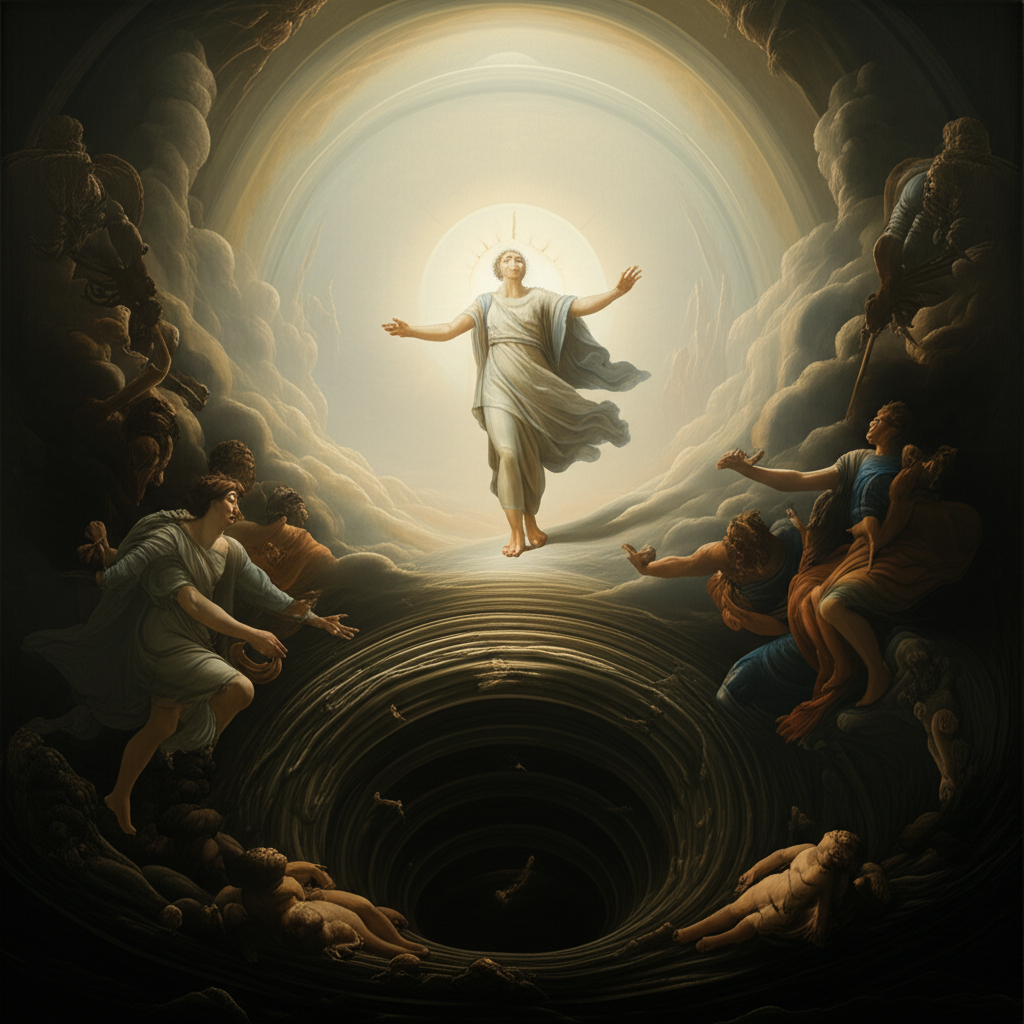 imposing structure upon swirling, formless elements, while nascent celestial bodies begin to coalesce in the background, symbolizing the transition from primordial disorder to a structured cosmos.)
The Modern Cosmos: From Big Bang to Multiverse
The 20th century unleashed a new wave of cosmological hypothesis, fueled by advanced Astronomy and theoretical physics, pushing the boundaries of our understanding to the very edge of existence.
The Big Bang Hypothesis: The Universe's Beginning
The prevailing scientific hypothesis for the origin and Evolution of the universe is the Big Bang theory. Proposed by Georges Lemaître and supported by Edwin Hubble's observations of an expanding universe, this hypothesis posits that the universe began as an extremely hot, dense point approximately 13.8 billion years ago and has been expanding and cooling ever since. Evidence such as the cosmic microwave background radiation (CMB) and the abundance of light elements (hydrogen, helium) strongly supports this model. It describes not just the origin of matter and energy, but of space and time themselves.
Inflation and the Multiverse: Expanding Horizons
Within the Big Bang framework, the inflationary hypothesis, proposed by Alan Guth, addresses several puzzles, such as the universe's flatness and homogeneity. It suggests a period of extremely rapid, exponential expansion in the first fractions of a second after the Big Bang.
Beyond this, more speculative hypothesis concerning the origin of the World include the Multiverse theory, which proposes that our universe is just one of many, perhaps an infinite number, each with its own physical laws and properties. While highly theoretical, such concepts continue to push the philosophical and scientific boundaries of what an "origin" might entail.
The Enduring Philosophical Implications of Origin Hypotheses
The journey through these hypothesis reveals more than just scientific progress; it illuminates the profound philosophical shifts in human thought. Each new understanding of the World's origin forces a re-evaluation of our place, purpose, and the very nature of reality.
- From Divine Creation to Natural Processes: The gradual shift from explanations rooted in divine intervention to those based on natural laws and processes has reshaped our understanding of agency and causality in the universe.
- The Role of Observation and Reason: The evolution of hypothesis demonstrates the increasing reliance on empirical observation and rational deduction, highlighting the power of the scientific method in unraveling cosmic mysteries.
- The Nature of Knowledge: The ongoing refinement and replacement of hypothesis underscore the provisional nature of scientific knowledge, a continuous quest rather than a fixed dogma.
- The "Why" vs. the "How": While science excels at explaining how the World originated and evolved, the philosophical "why" – the ultimate purpose or meaning – often remains a domain of ethical, spiritual, and metaphysical inquiry.
Conclusion: The Infinite Horizon of Inquiry
The myriad hypothesis concerning the origin of the World stand as a testament to humanity's enduring intellectual curiosity. From the poetic myths of ancient peoples to the intricate equations of modern cosmology, each attempt to explain our genesis has enriched our understanding, not only of the cosmos but of ourselves. The journey from the Demiurge to the Big Bang, from static spheres to Evolutionary change, is a narrative of intellectual courage and relentless inquiry. As we continue to probe the depths of space and time, new hypothesis will undoubtedly emerge, pushing the boundaries of knowledge and forever reminding us that the greatest adventure lies in the questions we dare to ask about our origins.
📹 Related Video: PLATO ON: The Allegory of the Cave
Video by: The School of Life
💡 Want different videos? Search YouTube for: "Plato Timaeus cosmology explained"
📹 Related Video: ARISTOTLE ON: The Nicomachean Ethics
Video by: The School of Life
💡 Want different videos? Search YouTube for: "Big Bang theory philosophical implications"