

The Unfolding Tapestry: A Journey Through the History of Science and Knowledge
The story of humanity is inextricably linked to the relentless pursuit of knowledge and the evolving methodologies of science. Far from a linear march, this history is a complex, often circuitous, but ultimately accelerating journey of discovery, challenging assumptions, and refining our understanding of the cosmos and ourselves. To truly grasp the essence of human progress, we must delve into the intellectual currents that have shaped our inquiries, from ancient philosophical musings to the sophisticated empirical methods of today. This article explores the pivotal moments and transformations that define the grand narrative of how we came to know what we know.
Ancient Seeds: Philosophy's Cradle of Science
Before "science" as a distinct discipline existed, its foundational elements were forged in the crucible of philosophy. The earliest civilizations, from Mesopotamia to Egypt, accumulated vast practical knowledge in astronomy, mathematics, and engineering, driven by necessity and observation. However, it was in ancient Greece that the systematic, rational inquiry into the nature of reality truly began.
- Pre-Socratics: Thinkers like Thales, Anaximander, and Heraclitus sought natural explanations for phenomena, moving beyond mythical accounts. They initiated the quest for underlying principles, attempting to rationalize the chaos of the world.
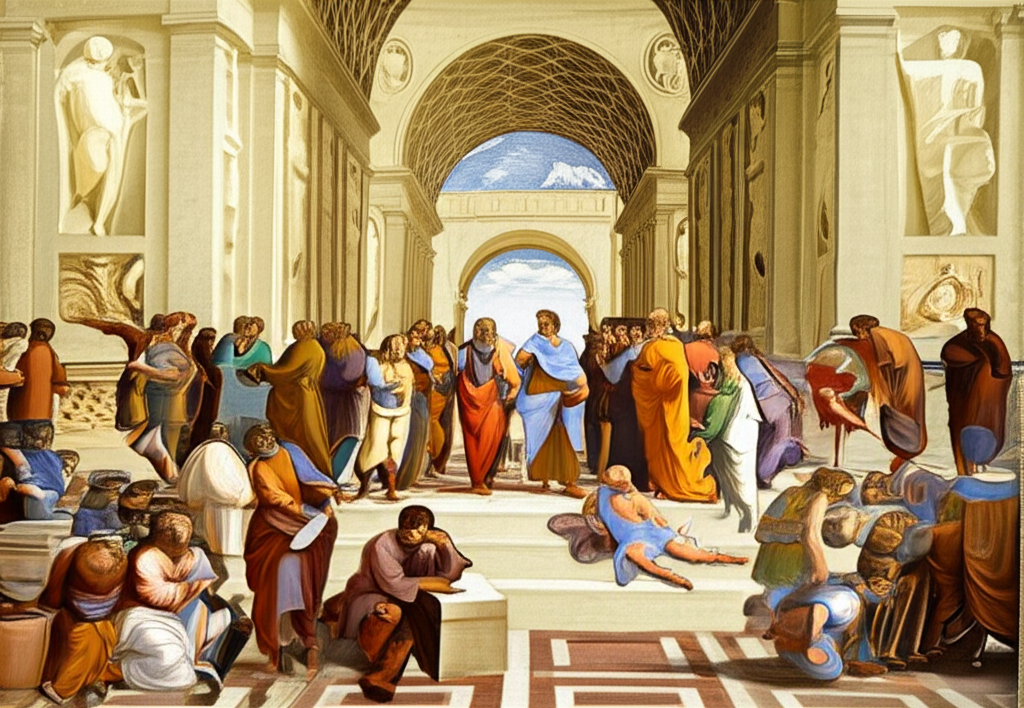
- Plato and Aristotle: These giants, whose works form cornerstones of the Great Books of the Western World, profoundly shaped Western thought.
- Plato, with his theory of Forms, emphasized abstract reasoning and the pursuit of ideal truths, influencing mathematical and theoretical approaches to knowledge. His Academy was a hub for philosophical and mathematical inquiry.
- Aristotle, a master of observation and classification, laid the groundwork for empirical science. His treatises on logic, physics, biology, and metaphysics provided a comprehensive framework for understanding the natural world that would dominate for over a millennium. His emphasis on careful observation and categorization was a crucial step in the history of scientific method.
The Medieval Bridge: Preservation and Scholasticism
Following the decline of the Roman Empire, much of this ancient knowledge was preserved and further developed in the Islamic world, where scholars translated, commented upon, and expanded Greek texts. Figures like Ibn Sina (Avicenna) and Ibn Rushd (Averroes) were pivotal in keeping the flame of rational inquiry alive, often integrating empirical observation with philosophical thought.
In medieval Europe, scholasticism, exemplified by thinkers like Thomas Aquinas, sought to synthesize Aristotelian philosophy with Christian theology. While often seen through the lens of religious dogma, scholasticism fostered rigorous logical argumentation and a systematic approach to knowledge, ensuring that the intellectual tools developed by the Greeks were not lost but adapted and refined for new contexts. The emphasis was on reasoning from established principles, a form of deductive inquiry that, while different from modern empirical science, was nevertheless a vital period in the history of intellectual development.
The Great Awakening: Renaissance and the Scientific Revolution
The 16th and 17th centuries witnessed a seismic shift – the Scientific Revolution – which fundamentally altered the course of science and the acquisition of knowledge. This period, fueled by the rediscovery of classical texts during the Renaissance and a burgeoning spirit of inquiry, marked a profound departure from purely deductive reasoning.
- A New Epistemology: Figures like Francis Bacon advocated for empiricism and inductive reasoning, emphasizing observation and experimentation as the true paths to knowledge. His work laid the philosophical groundwork for modern scientific method.
- Astronomical Revolutions: Nicolaus Copernicus, Johannes Kepler, and Galileo Galilei challenged the geocentric model of the universe, offering heliocentric alternatives based on mathematical reasoning and telescopic observation. Galileo's insistence on empirical evidence and mathematical description of natural laws was a watershed moment, often leading to conflict with established authorities.
- Newton's Synthesis: Isaac Newton's Principia Mathematica, another monumental work from the Great Books, provided a unified theory of motion and gravity, demonstrating that the universe operated according to predictable, mathematical laws. This triumph of reason and observation cemented the new scientific paradigm and ushered in an era of unprecedented progress.
The Scientific Revolution was not merely about new discoveries; it was about a new way of knowing, a redefinition of science itself, leading to an explosion of knowledge and a profound sense of human progress.
📹 Related Video: PLATO ON: The Allegory of the Cave
Video by: The School of Life
💡 Want different videos? Search YouTube for: "The Scientific Revolution: Crash Course History of Science"
Enlightenment and Specialization: Reason's Triumph
The intellectual ferment of the Scientific Revolution blossomed into the Enlightenment of the 18th century. Reason became the guiding light, applied not only to the natural world but also to human society, politics, and ethics. Philosophers like John Locke, David Hume, and Immanuel Kant grappled with the nature of knowledge, the limits of human understanding, and the implications of scientific discovery for human freedom and progress.
This era also saw the increasing specialization of science. Chemistry emerged as a distinct field, geology began to map the Earth's deep history, and biology started classifying life forms with unprecedented detail. Encyclopedias became symbols of the ambition to systematically gather and organize all human knowledge. The belief in the power of reason and empirical inquiry to solve problems and improve the human condition became a hallmark of the age.
Modern Frontiers: Unraveling the Cosmos and the Self
The 19th and 20th centuries witnessed an exponential acceleration in the accumulation of knowledge and the refinement of scientific methodologies.
- Evolutionary Biology: Charles Darwin's theory of natural selection revolutionized our understanding of life's history and its diversity, profoundly impacting not just biology but philosophy and theology.
- Physics Transformed: Albert Einstein's theories of relativity and quantum mechanics fundamentally altered our perception of space, time, matter, and energy, pushing the boundaries of human comprehension and demonstrating the often counter-intuitive nature of ultimate reality.
- The Rise of New Sciences: Fields like genetics, neuroscience, computer science, and cosmology emerged, each opening vast new domains of inquiry. The development of powerful technologies, from telescopes to particle accelerators, allowed for observations and experiments previously unimaginable.
Today, science continues its relentless march, generating knowledge at an astonishing pace. From the search for exoplanets to understanding the intricacies of the human brain, the quest for progress remains the driving force. The philosophical implications of this ever-expanding knowledge are profound, constantly challenging our ethical frameworks, our understanding of consciousness, and our place in the universe.
📹 Related Video: What is Philosophy?
Video by: The School of Life
💡 Want different videos? Search YouTube for: "Philosophy of Science - Karl Popper vs Thomas Kuhn"
The Enduring Quest for Knowledge and Progress
The history of science and knowledge is a testament to the insatiable human curiosity and the remarkable capacity for intellectual progress. It is a narrative of triumphs and setbacks, of paradigm shifts and incremental discoveries, all contributing to a richer, more nuanced understanding of existence. From the ancient Greeks who first dared to ask "why," to the modern scientists probing the fabric of reality, the journey of inquiry is continuous.
Understanding this history is not merely an academic exercise; it is essential for appreciating the foundations upon which our modern world is built. It reminds us that knowledge is never complete, that science is a dynamic process, and that the pursuit of truth is an ongoing, collaborative human endeavor. As Daniel Sanderson, I contend that this grand narrative is the very essence of philosophical inquiry – to understand how we came to know, and what that knowing truly means for our existence. The tapestry continues to unfold, woven with new discoveries, challenging questions, and the enduring human spirit of exploration.