

The Unfolding Tapestry: A Philosophical Journey Through the History of Science and Knowledge
The human quest to understand the world and our place within it is perhaps the most enduring and defining characteristic of our species. This article embarks on a concise yet profound journey through the history of science and knowledge, tracing how our understanding has evolved from ancient observations to the complex, interconnected disciplines of today. Drawing inspiration from the vast intellectual landscape chronicled in the Great Books of the Western World, we will explore the pivotal moments, the revolutionary thinkers, and the enduring questions that have shaped our intellectual progress, revealing that the pursuit of knowledge is not a linear march but a dynamic, often circuitous, and perpetually evolving endeavor.
The Dawn of Inquiry: From Myth to Proto-Science
Long before the concept of "science" as we understand it, early civilizations engaged in meticulous observation and developed sophisticated systems of knowledge.
- Ancient Mesopotamia and Egypt: These cultures developed advanced mathematics, astronomy, and engineering, primarily driven by practical needs such as agriculture, calendar keeping, and monumental construction. Their understanding, while empirical, was often interwoven with mythical and religious explanations for natural phenomena.
- Pre-Socratic Greece (c. 6th-5th Century BCE): A radical shift began with thinkers like Thales, Anaximander, and Heraclitus, who sought natural explanations for the cosmos, attempting to identify fundamental principles (arche) without recourse to divine intervention. This marked a crucial step towards rational inquiry, laying the groundwork for what would become philosophy and, eventually, science.
These early inquiries represent the foundational layers of our accumulated knowledge, demonstrating humanity's innate drive to categorize, explain, and predict.
The Classical Synthesis: Reason, Logic, and the Birth of Western Thought
The golden age of Greek philosophy, particularly in Athens, cemented the methods and frameworks that would influence Western thought for millennia.
- Plato (c. 428–348 BCE): Emphasized the realm of Forms, suggesting that true knowledge resides not in the fleeting sensory world but in immutable, perfect ideals accessible through reason. His Academy laid the groundwork for systematic philosophical inquiry.
- Aristotle (384–322 BCE): A towering figure whose influence cannot be overstated. He championed empirical observation, systematic classification, and logical deduction. His works covered virtually every field of knowledge imaginable – from biology and physics to ethics and politics. Aristotle's method, combining observation with logical inference, was a proto-scientific approach that dominated intellectual thought for nearly two millennia.
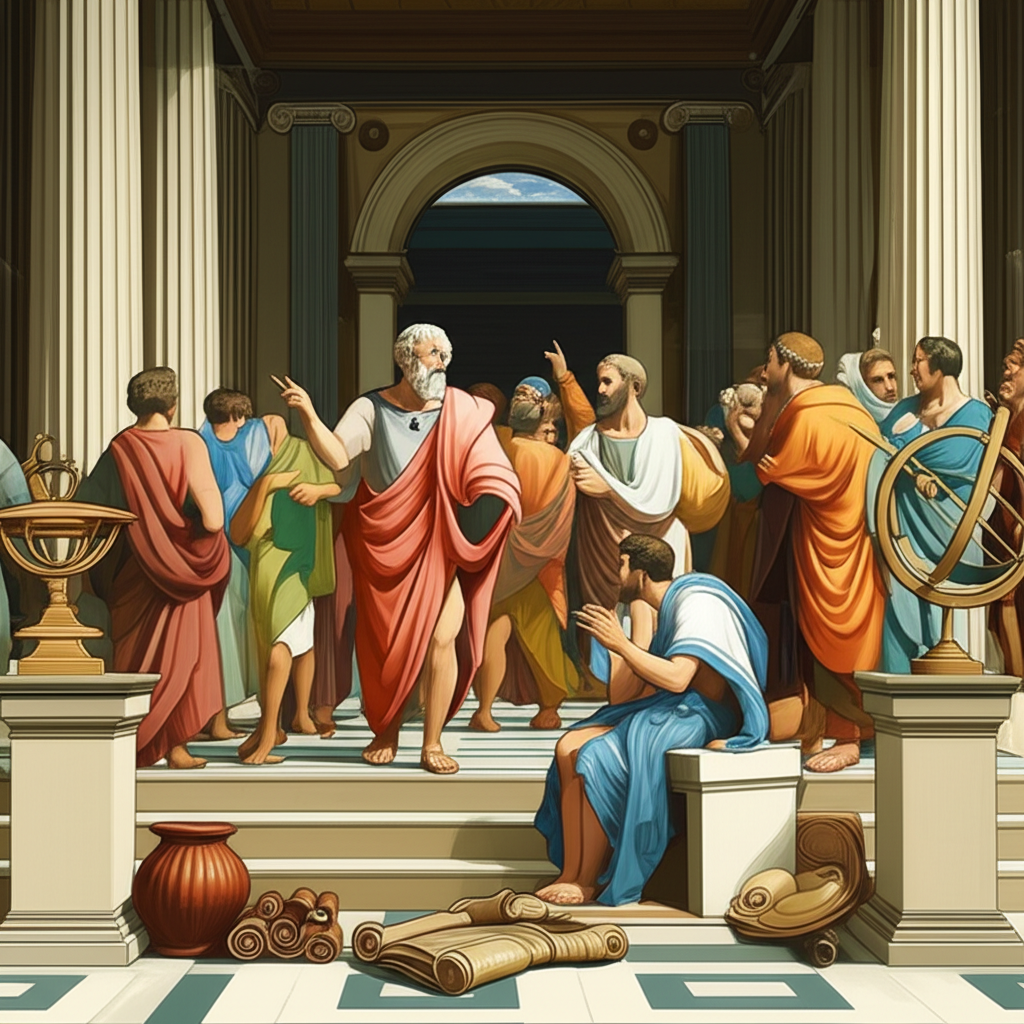
Aristotle's contributions were monumental, establishing categories of thought and methods of reasoning that became cornerstones of Western intellectual tradition. His emphasis on observing the natural world, even if his physics were later superseded, was a critical step in the history of science.
The Medieval Bridge: Preservation, Transmission, and Scholasticism
Following the decline of the Roman Empire, much of ancient Greek knowledge was preserved and developed in other cultures, particularly in the Islamic world.
- The Islamic Golden Age (c. 8th-14th Century CE): Scholars in Baghdad, Cordoba, and other centers translated and built upon Greek texts. They made groundbreaking advancements in mathematics (algebra, algorithms), astronomy, medicine, optics, and chemistry. Figures like Avicenna (Ibn Sina) and Averroes (Ibn Rushd) were crucial in reintroducing Greek thought to Europe.
- Medieval Europe and Scholasticism: European scholars, primarily within monastic orders and later universities, focused on reconciling classical reason (especially Aristotle's) with Christian theology. Thinkers like Thomas Aquinas synthesized faith and reason, contributing to the development of rigorous logical debate and systematic inquiry within a theological framework.
This period, often mischaracterized as a "dark age," was vital for the transmission and critical engagement with ancient knowledge, setting the stage for future intellectual explosions.
The Scientific Revolution: A Paradigm Shift in Understanding
The 16th and 17th centuries witnessed a radical transformation in how humanity approached the natural world, giving birth to modern science.
| Key Figures & Contributions | Impact on Science & Knowledge |
|---|---|
| Nicolaus Copernicus (1473-1543) | Heliocentric model of the solar system, challenging millennia of geocentric thought. |
| Francis Bacon (1561-1626) | Championed inductive reasoning and the empirical method, emphasizing observation and experimentation. |
| Galileo Galilei (1564-1642) | Used telescopes for astronomical observation, conducted experiments on motion, challenging Aristotelian physics. |
| René Descartes (1596-1650) | Advocated deductive reasoning, systematic doubt, and the separation of mind and matter, foundational to modern philosophy and mathematics. |
| Isaac Newton (1642-1727) | Developed laws of motion and universal gravitation, unifying terrestrial and celestial mechanics, establishing a mechanistic view of the universe. |
This era marked a profound shift from relying solely on authority (ancient texts, religious dogma) to direct observation, experimentation, and mathematical description. The emphasis moved from what things are to how they work, fundamentally altering the nature of knowledge and accelerating progress.
The Enlightenment and Beyond: Reason, Specialization, and Relativistic Truths
The success of the Scientific Revolution fueled the Enlightenment, an intellectual movement that championed reason, individualism, and skepticism.
- The Enlightenment (18th Century): Philosophers like Locke, Voltaire, and Kant applied scientific reasoning to society, politics, and ethics, advocating for human rights, democracy, and the pursuit of knowledge for societal improvement. The belief in human progress through reason became a central tenet.
- 19th and 20th Century Expansions: Science became increasingly specialized, leading to breakthroughs in biology (Darwin's theory of evolution), chemistry (periodic table), and physics (electromagnetism, thermodynamics). The 20th century brought revolutionary theories like relativity (Einstein) and quantum mechanics, challenging Newtonian determinism and introducing probabilistic understandings of the universe.
- The Information Age: The digital revolution has democratized access to information, creating unprecedented opportunities for knowledge dissemination and collaboration, but also new challenges in discerning truth and managing information overload.
The Enduring Quest: The Nature of Progress and the Future of Knowledge
Reflecting on the vast history of science and knowledge, it becomes clear that progress is rarely linear. It involves periods of rapid advancement, revolutionary paradigm shifts (as described by Thomas Kuhn), and sometimes, the rediscovery of forgotten ideas. Each era builds upon, critiques, and often overturns the understandings of its predecessors.
The very definition of "knowledge" itself has evolved, from Plato's immutable Forms to Aristotle's empirical classifications, to the probabilistic and often counter-intuitive realities revealed by modern physics. What remains constant is humanity's insatiable curiosity and the iterative process of questioning, observing, theorizing, and testing. The journey of science is the unending story of our collective attempt to make sense of existence, a progress that continues to unfold with every new discovery and every revised understanding.
📹 Related Video: ARISTOTLE ON: The Nicomachean Ethics
Video by: The School of Life
💡 Want different videos? Search YouTube for: "The History of Science Documentary"
📹 Related Video: What is Philosophy?
Video by: The School of Life
💡 Want different videos? Search YouTube for: "Philosophy of Science Explained"