

The Grand Tapestry of Knowledge: Tracing Science and Evolution Through History
A Journey Through Inquiry and Understanding
The story of human understanding is one of constant evolution, a relentless pursuit of Knowledge that has shaped our perception of the universe and ourselves. This article delves into the interwoven History of Science and Evolution, exploring how these two monumental forces have not only advanced our comprehension of the natural world but also profoundly influenced philosophical thought. From ancient philosophical inquiries into the cosmos to the revolutionary insights of Darwin and beyond, we trace the development of systematic inquiry, the shifting paradigms of scientific discovery, and the profound impact these have had on the very fabric of human Knowledge. It is a narrative of observation, hypothesis, and the persistent drive to understand the intricate mechanisms that govern life and the universe.
I. The Dawn of Inquiry: Ancient Roots of Scientific Thought
Long before the term "science" took its modern form, humanity engaged in systematic observation and rational inquiry. The History of this nascent scientific thought is deeply embedded in ancient philosophy, particularly in the Hellenic world. Thinkers like Thales, Anaximander, and Heraclitus, in their attempts to identify the arche or fundamental principle of the cosmos, laid the groundwork for a naturalistic understanding of the world, seeking explanations beyond mythological narratives.
- Pre-Socratic Cosmology: Early attempts to explain the universe through natural phenomena rather than divine intervention.
- Aristotelian Biology and Physics: Aristotle, a giant among the "Great Books" authors, meticulously categorized species, observed natural processes, and developed comprehensive systems of physics and biology. While many of his conclusions were later superseded, his emphasis on empirical observation and logical deduction was a crucial step in the History of Science. His works, such as Physics and History of Animals, demonstrate an early commitment to systematic Knowledge acquisition.
This era, though lacking controlled experimentation, fostered a spirit of inquiry and a belief in the discoverability of natural laws, setting the stage for future scientific revolutions.
II. The Scientific Revolution: A Paradigm Shift in Understanding
The 16th and 17th centuries witnessed a dramatic transformation in how Knowledge was acquired and validated, a period we now call the Scientific Revolution. This era fundamentally reshaped the relationship between observation, mathematics, and empirical evidence, establishing the bedrock of modern Science.
Key Figures and Their Contributions:
| Scientist | Major Contribution | Impact on Knowledge |
|---|---|---|
| Nicolaus Copernicus | Heliocentric model of the solar system | Challenged geocentric dogma, initiated a shift in cosmic perspective. |
| Galileo Galilei | Telescopic observations, laws of motion | Championed empirical evidence, faced religious opposition for scientific truth. |
| Johannes Kepler | Laws of planetary motion | Introduced mathematical precision to celestial mechanics. |
| Isaac Newton | Laws of universal gravitation, calculus | Unified celestial and terrestrial physics, established a mechanistic worldview. |
This period, heavily represented in the "Great Books," marked a decisive turn from purely philosophical speculation to a rigorous, empirical approach. It demonstrated that Knowledge could be systematically built and tested, paving the way for unprecedented advancements. The universe, once a subject of theological or abstract philosophical contemplation, became a grand mechanism amenable to scientific investigation.
III. The Emergence of Evolutionary Thought: A New Lens on Life
While the Scientific Revolution transformed physics and astronomy, the Evolution of biological Knowledge took a different, though equally profound, path. The idea that species might change over time has a long History, but it was in the 19th century that it gained scientific rigor.
- Pre-Darwinian Ideas: Thinkers like Jean-Baptiste Lamarck proposed mechanisms for species change, albeit based on inheritance of acquired characteristics. Geologists like Charles Lyell, through works like Principles of Geology, established the concept of deep time and gradual geological processes, which was crucial for envisioning slow biological change.
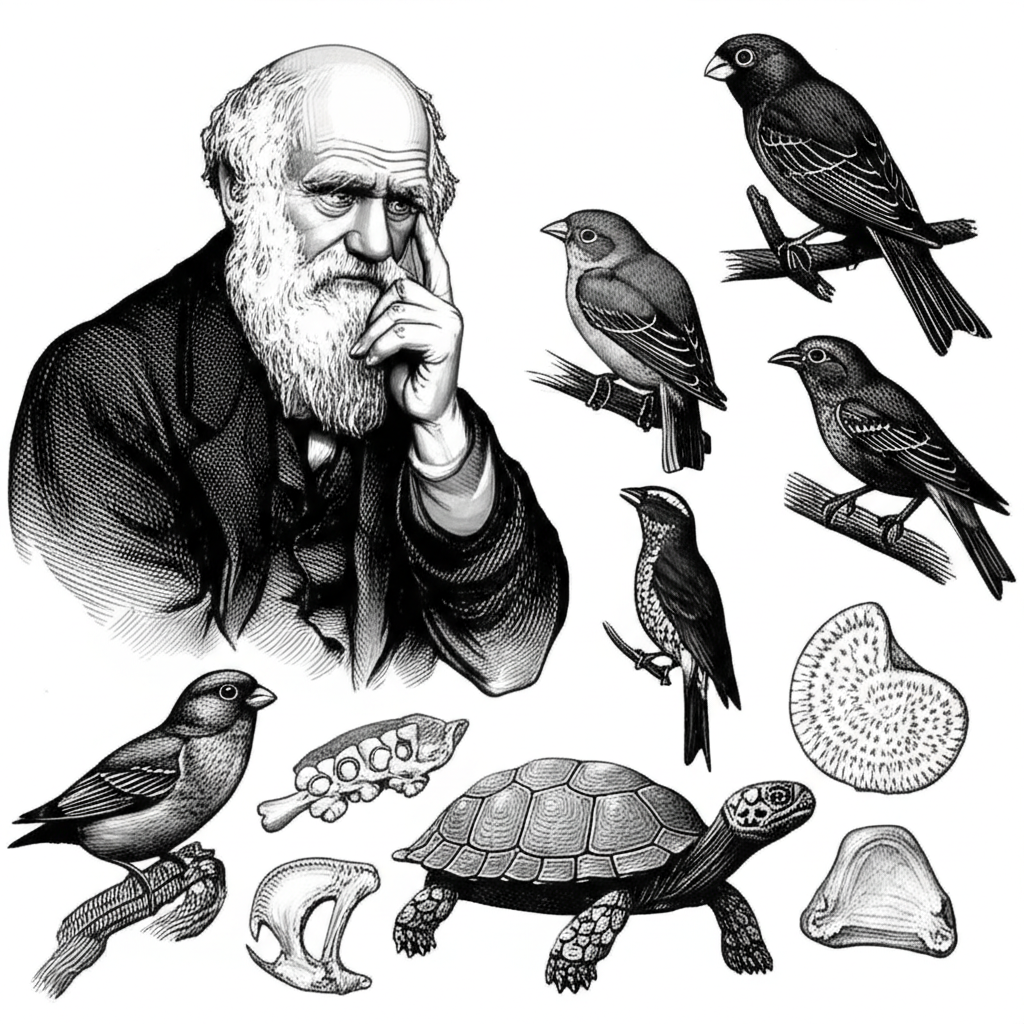
- Darwin's Revolution: Charles Darwin's On the Origin of Species (1859), another cornerstone of the "Great Books," provided a compelling mechanism for Evolution: natural selection. His extensive observations and meticulous argumentation presented a coherent theory that explained the diversity of life, adaptation, and the common ancestry of all organisms. This work not only revolutionized biology but also had immense philosophical implications, challenging anthropocentric views and our understanding of human origins.
Darwin's theory initiated a new chapter in the History of Science, emphasizing the dynamic and interconnected nature of life on Earth. It fundamentally altered our Knowledge of biology, ecology, and our place within the grand scheme of life.
IV. Evolution's Unfolding Story: From Genes to Galaxies
The concept of Evolution did not stop with Darwin. The 20th century saw its integration with genetics, leading to the "Modern Synthesis," which combined natural selection with Mendelian inheritance. This fusion provided a robust framework for understanding the mechanisms of heredity and variation, deepening our Knowledge of how Evolution actually works at a molecular level.
Key Developments in Evolutionary Science:
- Genetics and DNA: The discovery of DNA's structure by Watson and Crick (1953) provided the physical basis for inheritance, offering unprecedented insights into evolutionary processes.
- Molecular Biology: Advanced techniques allowed for the comparison of genetic sequences across species, confirming common ancestry and mapping evolutionary relationships with astonishing precision.
- Beyond Biology: The concept of Evolution has also expanded beyond biology.
- Cosmic Evolution: The Evolution of stars, galaxies, and the universe itself, from the Big Bang to the present day, is a vast scientific narrative.
- Cultural Evolution: The Evolution of human societies, technologies, and ideas, though distinct from biological Evolution, shares analogous processes of variation, selection, and transmission of Knowledge.
This broader understanding highlights how Science continuously refines and expands our Knowledge, revealing interconnected evolutionary processes across all scales of existence.
V. The Philosophical Resonance: Science, Evolution, and the Human Condition
The History of Science and Evolution is not merely a chronicle of discoveries; it is a profound philosophical journey. The insights gleaned from these fields have consistently forced humanity to re-evaluate its most fundamental beliefs about nature, purpose, and existence.
- Challenging Anthropocentrism: Both the Copernican revolution and Darwinian Evolution displaced humanity from a uniquely central or divinely appointed position, fostering a more humble and naturalistic perspective.
- The Nature of Knowledge: Science has demonstrated the power of empirical investigation and critical thinking as primary modes of acquiring reliable Knowledge, influencing epistemology and the philosophy of Science.
- Ethical and Existential Questions: Evolutionary theory, in particular, has sparked intense debates about morality, human nature, and the meaning of life in a universe governed by natural processes. Philosophers continue to grapple with the implications of our evolutionary heritage for ethics, social structures, and individual identity.
The ongoing dialogue between Science and philosophy enriches our collective Knowledge, urging us to continuously question, explore, and adapt our understanding of the universe and our place within it. The journey of inquiry, stretching from the Great Books of antiquity to the cutting edge of modern research, reminds us that the pursuit of Knowledge is an ever-evolving human endeavor.
**## 📹 Related Video: PLATO ON: The Allegory of the Cave
Video by: The School of Life
💡 Want different videos? Search YouTube for: "The History of Science documentary"**
**## 📹 Related Video: ARISTOTLE ON: The Nicomachean Ethics
Video by: The School of Life
💡 Want different videos? Search YouTube for: "Evolution theory explained for beginners"**