

The Unfolding Tapestry: How Science and Evolution Illuminate Our History of Knowledge
The journey of human understanding is an intricate tapestry woven from the threads of History, Science, and Evolution. From the earliest philosophical ponderings to the groundbreaking discoveries of today, humanity's relentless quest for Knowledge has shaped our perception of the universe and our place within it. This article explores the profound interplay between these domains, tracing the intellectual lineage that has brought us to our current scientific worldview, drawing upon the enduring insights found within the Great Books of the Western World. It is a story not just of facts, but of the ever-evolving methods and philosophies that underpin our comprehension of reality.
The Dawn of Inquiry: Philosophy's Enduring Questions
Long before the term "science" existed in its modern form, the seeds of systematic inquiry were sown by ancient philosophers. Thinkers like Thales, Anaximander, and Heraclitus, as documented in the earliest philosophical texts, sought to understand the fundamental principles governing the cosmos not through myth, but through observation and reason. Aristotle, a towering figure whose works form a cornerstone of the Great Books, meticulously categorized the natural world, developed principles of logic, and laid down foundations for biology, physics, and metaphysics that would influence thought for millennia.
This early period established a crucial precedent: the belief that the universe is comprehensible and that Knowledge can be acquired through rational investigation. While their methods might seem rudimentary by today's standards, these pioneers initiated the History of intellectual exploration, setting the stage for all subsequent scientific endeavors. Their questions about causality, substance, and change are, in many ways, the philosophical ancestors of our modern scientific inquiries into Evolution and cosmology.
From Scholasticism to Revolution: The Rebirth of Empirical Science
The medieval period, often characterized by theological dominance, nonetheless played a vital role in preserving and transmitting ancient Knowledge, particularly through Islamic scholars who expanded upon Greek texts. When the intellectual ferment of the Renaissance and Reformation took hold in Europe, a new era dawned. The Scientific Revolution, beginning in the 16th century, marked a profound shift in methodology and worldview.
This period saw a move away from purely deductive reasoning based on ancient authorities towards empirical observation, experimentation, and mathematical analysis. Key figures include:
- Nicolaus Copernicus: Challenged the geocentric model, placing the sun at the center of the solar system, an idea that profoundly altered humanity's cosmic perspective.
- Galileo Galilei: Pioneered observational astronomy with the telescope and conducted experiments on motion, championing the scientific method and empirical evidence.
- Johannes Kepler: Formulated laws of planetary motion, demonstrating the mathematical harmony of the heavens.
- Isaac Newton: Unified celestial and terrestrial mechanics with his laws of motion and universal gravitation, providing a comprehensive, mechanistic view of the universe that dominated scientific thought for centuries.
The Scientific Revolution was not merely about new discoveries; it was about a new way of knowing. It established the bedrock of modern Science, emphasizing testable hypotheses, verifiable data, and the pursuit of objective Knowledge.
The Unveiling of Life: The Revolutionary Idea of Evolution
While the Scientific Revolution transformed our understanding of the physical universe, the 19th century brought an equally profound shift in our comprehension of life itself: the theory of Evolution. Early thinkers, even in antiquity, had speculated about the changing nature of species, but it was Charles Darwin, alongside Alfred Russel Wallace, who provided a compelling, evidence-based mechanism: natural selection.
Darwin's On the Origin of Species (1859) presented a meticulously argued case for the gradual development of life forms from common ancestors, driven by the pressures of survival and reproduction. This theory was revolutionary because it:
- Provided a naturalistic explanation for biodiversity: Moving beyond purely supernatural explanations for the variety of life.
- Established a deep History for life on Earth: Implying vast stretches of geological time necessary for such gradual change.
- Challenged anthropocentric views: Positioning humans as part of the natural world, subject to the same processes as other organisms.
The integration of genetics in the 20th century, particularly with the discovery of DNA, provided the molecular basis for Darwinian Evolution, solidifying its status as a foundational pillar of modern Science. The ongoing study of Evolution continues to deepen our Knowledge of biology, medicine, and our own origins.
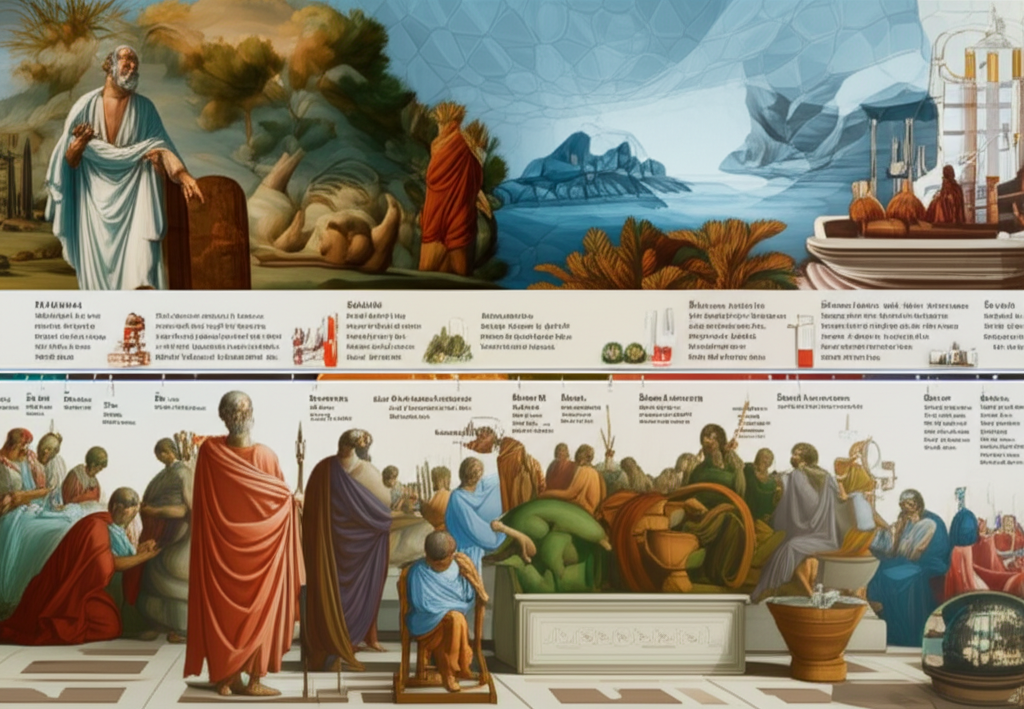 , transitioning through medieval Arabic scholars transcribing texts, then showing figures like Galileo with a telescope and Newton with an apple, culminating in Darwin observing finches. The background subtly illustrates the shift from a geocentric to a heliocentric model, and from static species to an evolutionary tree of life, all against a parchment-like backdrop symbolizing the "Great Books.")
The Ongoing Quest: Science, Philosophy, and the Future of Knowledge
Today, Science continues its relentless march, expanding our Knowledge at an unprecedented pace. From quantum mechanics to cosmology, from neurobiology to artificial intelligence, the boundaries of human understanding are constantly pushed. Yet, the philosophical questions that originated in the Great Books remain relevant. What is the nature of reality? How do we define truth? What are the ethical implications of our discoveries?
The History of Science and Evolution is not just a chronicle of facts, but a testament to humanity's enduring capacity for inquiry, critical thinking, and adaptation. It reminds us that Knowledge is never static, but an ever-evolving process, shaped by new evidence, new methodologies, and new ways of seeing the world. The dialogue between scientific discovery and philosophical reflection is a continuous one, essential for a comprehensive understanding of our universe and ourselves.
YouTube Video Suggestions:
- YouTube: The History of Science Documentary
- YouTube: Crash Course Philosophy Science Evolution
📹 Related Video: What is Philosophy?
Video by: The School of Life
💡 Want different videos? Search YouTube for: "The History of Science and Evolution philosophy"