

The Enduring Crown: A Philosophical Journey Through the History of Monarchy
The story of humanity is, in many ways, the history of its governments. Among the oldest and most persistent forms of political organization is monarchy, a system characterized by a single individual, the monarch, holding supreme power, often by hereditary right. From the earliest tribal chieftains to the constitutional figureheads of today, the institution of monarchy has undergone profound change, reflecting evolving societal values, philosophical justifications, and the relentless human quest for order, justice, and power. This article embarks on a philosophical exploration of monarchy's trajectory, drawing insights from the foundational texts of Western thought to understand its rise, transformations, and enduring legacy.
From Ancient Roots to Divine Mandate: The Genesis of Rule
The origins of monarchy are shrouded in the mists of pre-history, emerging from the need for decisive leadership in nascent communities. Early forms likely stemmed from charismatic warriors, wise elders, or religious figures who commanded respect and wielded authority. As societies grew more complex, particularly with the advent of agriculture and settled life, these leaders consolidated power, often passing it down through family lines.
The Dawn of Dynasties
In the ancient world, particularly in civilizations like Egypt, Mesopotamia, and early China, the monarch was often seen as a divine or semi-divine figure, a direct link between the heavens and Earth. This concept of sacred kingship provided an unassailable justification for their rule. The Pharaohs of Egypt, for instance, were considered living gods, their authority absolute and unquestionable.
- Mesopotamia: Kings like Hammurabi received their laws directly from the gods, legitimizing their government through divine decree.
- Ancient Israel: The transition from judges to kings, as recounted in the Old Testament, illustrates a pragmatic shift towards a centralized monarchy for defense and stability, though often with divine oversight and prophetic challenge.
This early phase of monarchy established the fundamental principle of a single, supreme ruler, often with an inherent right to govern. The change from communal decision-making to singular authority was pivotal in shaping early state formations.
Classical Critiques and the Shifting Sands of Power
The intellectual ferment of classical Greece brought the first rigorous philosophical examinations of government, including monarchy. While some Greek city-states maintained monarchical structures, many experimented with oligarchy, tyranny, and, most famously, democracy.
Aristotle's Classification of Governments
In his seminal work, Politics, Aristotle systematically categorized forms of government based on the number of rulers and whether they governed in the common interest or their own. He identified monarchy as one of the "good" forms (rule by one for the common good), but warned of its degeneration into tyranny (rule by one for self-interest).
Aristotle's Forms of Government:
| Number of Rulers | Good Form (Common Interest) | Bad Form (Self-Interest) |
|---|---|---|
| One | Monarchy | Tyranny |
| Few | Aristocracy | Oligarchy |
| Many | Polity | Democracy |
This philosophical framework highlighted the inherent instability and potential for corruption within any single form of government, including monarchy. Plato, in The Republic, envisioned an ideal state ruled by "philosopher kings," a highly intellectualized form of monarchy where power was wielded by those with wisdom and virtue. These classical thinkers laid the groundwork for future debates about the legitimacy and efficacy of different political systems, marking a significant change in how rulers were perceived—from divine agents to subjects of rational scrutiny.
The Medieval Crown: Feudalism and the Limits of Power
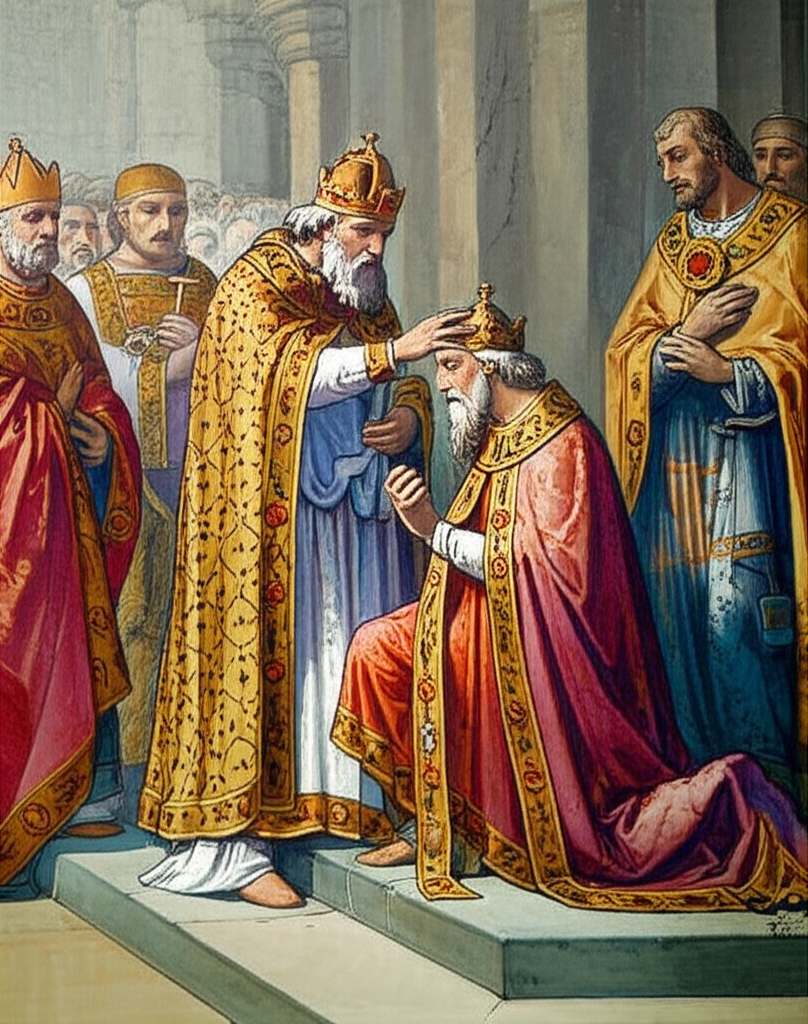
Following the collapse of the Roman Empire, monarchy re-emerged as the dominant form of government in Europe, intertwined with the feudal system and the pervasive influence of the Church. Medieval monarchs often claimed divine right to rule, but their power was rarely absolute.
- Feudalism: Power was decentralized, with monarchs relying on the loyalty of powerful nobles who controlled their own territories and armies. This created a constant tension between the crown and the aristocracy.
- The Church: The Catholic Church, with its own vast hierarchy and spiritual authority, frequently challenged or supported monarchs, acting as a significant check on royal power.
A landmark moment in the history of monarchy was the signing of the Magna Carta in 1215. Forced upon King John of England by his barons, this document established that even the king was subject to the law, placing early limitations on absolute royal authority. This was a crucial change, foreshadowing the eventual evolution towards constitutional monarchies.
The Age of Absolutism: Centralization and Justification
The early modern period, roughly from the 16th to the 18th centuries, witnessed the rise of absolute monarchy, particularly in Europe. Monarchs sought to consolidate power, centralize administration, and assert their authority over both the nobility and the Church.
- France under Louis XIV ("The Sun King"): Louis XIV famously declared "L'état, c'est moi" (I am the state), epitomizing the concept of absolute rule. His reign saw the construction of Versailles, a magnificent symbol of centralized royal power.
- Philosophical Justifications: Thinkers like Jean Bodin and Bishop Jacques-Bénigne Bossuet articulated the theory of divine right of kings with renewed vigor, arguing that monarchs derived their authority directly from God and were accountable only to Him.
However, the most influential philosophical defense of strong, centralized government in this era came from Thomas Hobbes. In his monumental work, Leviathan (1651), Hobbes argued that in a state of nature, human life is "solitary, poor, nasty, brutish, and short." To escape this chaos, individuals willingly surrender some freedoms to an absolute sovereign—a monarch—who can maintain order and prevent societal collapse. For Hobbes, any change that weakened this sovereign risked a return to anarchy.
Enlightenment, Revolution, and the Decline of Absolute Power
The Enlightenment, with its emphasis on reason, individual rights, and the social contract, profoundly challenged the foundations of absolute monarchy. Philosophers began to question the divine right of kings and advocate for governments based on the consent of the governed.
- John Locke: In his Two Treatises of Government, Locke argued that government derives its legitimacy from the consent of the people it governs. He posited that individuals possess inherent natural rights (life, liberty, and property) that no monarch can legitimately infringe upon. If a government violates these rights, the people have the right to revolt.
- Jean-Jacques Rousseau: Rousseau's concept of the "general will" in The Social Contract further undermined absolute rule, suggesting that legitimate government must reflect the collective will of the citizenry.
These ideas fueled revolutionary movements that fundamentally reshaped the political landscape.
- The American Revolution (1775-1783): A rejection of monarchical rule and the establishment of a republic based on popular sovereignty.
- The French Revolution (1789): A violent overthrow of the absolute Bourbon monarchy, leading to the execution of Louis XVI and a dramatic, albeit tumultuous, shift towards republicanism.
These revolutions marked a decisive turning point in the history of monarchy, ushering in an era of radical political change and the ascendancy of democratic ideals.
The Modern Era: Constitutional Monarchy and Symbolic Crowns
In the wake of these revolutionary upheavals, few absolute monarchies survived. The 19th and 20th centuries saw the further decline of royal power, often replaced by republics or evolving into constitutional monarchies.
In a constitutional monarchy, the monarch's power is limited by a constitution and often by a parliamentary system. The monarch typically serves as a ceremonial head of state, embodying national identity and tradition, while actual political power resides with elected officials.
Examples of Modern Constitutional Monarchies:
- United Kingdom: The monarch reigns but does not rule; political power rests with Parliament.
- Japan: The Emperor is a symbol of the state and the unity of the people, with no political power.
- Sweden, Norway, Denmark: Monarchs hold largely ceremonial roles, embodying stability and continuity.
The change from active political rulers to symbolic figureheads represents a profound transformation in the nature of monarchy. While the institution persists, its function within modern government is vastly different from its ancient and absolutist predecessors. It speaks to a human desire for tradition and continuity, even as the mechanisms of power have shifted.
Conclusion: The Enduring Legacy of an Ancient Form
The history of monarchy is a testament to the dynamic interplay between power, philosophy, and societal change. From its origins as a divine institution to its modern role as a symbolic head of state, monarchy has adapted, evolved, and, at times, fiercely resisted the forces of progress. The Great Books of the Western World provide an invaluable lens through which to understand these transformations, offering critical insights from Aristotle's classifications to Locke's theories of consent.
While the age of absolute monarchs may be largely behind us, the philosophical questions they raised about the nature of authority, legitimacy, and the ideal government remain as relevant as ever. The journey of monarchy is a microcosm of human political development, a continuous negotiation between tradition and innovation, stability and freedom.
YouTube Video Suggestions:
-
📹 Related Video: What is Philosophy?
Video by: The School of Life
💡 Want different videos? Search YouTube for: ""Great Books of the Western World political philosophy monarchy""
2. ## 📹 Related Video: ARISTOTLE ON: The Nicomachean Ethics
Video by: The School of Life
💡 Want different videos? Search YouTube for: ""History of Monarchy explained divine right constitutional""