

Unraveling the Fabric of Reality: A Journey Through the History and Philosophy of Mathematics
Mathematics, often seen as a cold, objective discipline, is in fact a vibrant tapestry woven from millennia of human inquiry, a testament to our enduring quest for knowledge. This article embarks on a journey through the history of mathematics, from its ancient practical origins to its profound philosophical implications, exploring how this seemingly abstract field has shaped, and been shaped by, our understanding of the universe and ourselves. We'll delve into the foundational questions that have plagued thinkers for centuries: What is the nature of mathematical truth? Do numbers exist independently, or are they mere human constructs? And how does mathematics provide us with unique insights into reality?
The Ancient Echoes: Where Numbers Met Wisdom
The story of mathematics begins not in ivory towers, but in the fertile crescent, with the practical needs of burgeoning civilizations. Early Egyptians and Babylonians developed sophisticated systems for measurement, accounting, and astronomy, driven by agriculture, trade, and monumental architecture. These were the first steps in harnessing the power of numbers.
The Greek Revolution: From Utility to Philosophy
It was the ancient Greeks, however, who truly elevated mathematics from a tool to a profound intellectual pursuit. Figures like Pythagoras and his followers saw numbers as the fundamental essence of the cosmos, believing that "all is number." This wasn't merely arithmetic; it was a deep philosophical conviction that mathematical relationships underpinned the harmony of the universe.
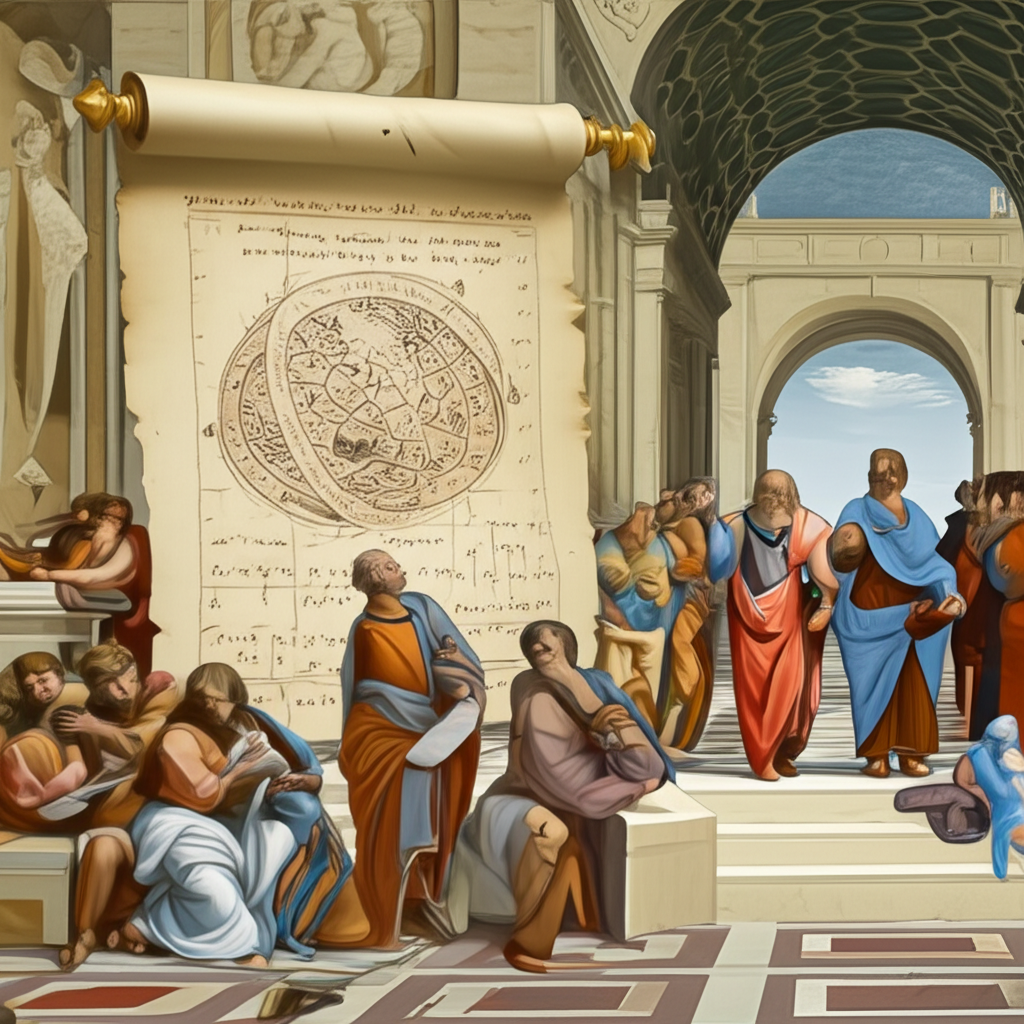
Plato, a titan among the Great Books of the Western World authors, famously inscribed above the entrance to his Academy: "Let no one ignorant of geometry enter here." For Plato, mathematics was the ultimate training for the mind, a necessary stepping stone to apprehending the eternal Forms – perfect, unchanging archetypes that constituted true knowledge. The geometric theorems proven by Euclid in his Elements (another cornerstone of Western thought) were not just practical rules, but demonstrations of immutable truths, derived through rigorous logical deduction from self-evident axioms. This established the deductive method, a hallmark of mathematical inquiry, and a powerful model for acquiring knowledge.
Medieval Bridges and Renaissance Flourishes
Following the decline of the classical world, the flame of mathematical knowledge was kept alight and advanced by Islamic scholars, who translated and built upon Greek and Indian works, introducing concepts like algebra and algorithms to the world. When these ideas returned to Europe during the Renaissance, they sparked a new era of innovation.
Thinkers like René Descartes, whose work graces the pages of the Great Books, revolutionized mathematics by uniting algebra and geometry into analytical geometry. This fusion allowed geometric problems to be solved algebraically and vice versa, demonstrating a profound interconnectedness that opened new avenues for scientific understanding and philosophical inquiry into the nature of space.
The Enlightenment's Quest for Certainty: Calculus and Critique
The 17th and 18th centuries witnessed an explosion of mathematical development, most notably the independent invention of calculus by Isaac Newton and Gottfried Leibniz. This powerful new tool provided the means to understand change and motion, laying the mathematical foundation for modern physics and engineering.
Yet, alongside this progress came deeper philosophical questions. Immanuel Kant, another giant among the Great Books authors, grappled with the nature of mathematical truth in his Critique of Pure Reason. He argued that mathematical judgments, like "7 + 5 = 12" or "a straight line is the shortest distance between two points," were synthetic a priori – meaning they were universally true and necessary (a priori) but also expanded our knowledge (synthetic), not merely defining terms. For Kant, our understanding of space and time itself was inherently structured by these mathematical intuitions, suggesting a profound link between the human mind and the mathematical order of the universe.
The 20th Century: Foundations Shaken and Rebuilt
The early 20th century brought a period of intense self-reflection and crisis within mathematics. As the field grew more abstract, fundamental questions about its very foundations emerged.
The Foundational Debates: What is Mathematical Truth?
- Logicism: Bertrand Russell and Alfred North Whitehead (whose Principia Mathematica aimed to show that all mathematics could be derived from logic) attempted to reduce mathematics entirely to logic.
- Intuitionism: Led by L.E.J. Brouwer, this school argued that mathematical objects only exist if they can be constructively built by the human mind, rejecting concepts like the law of excluded middle in certain contexts.
- Formalism: David Hilbert proposed that mathematics was a formal game played with symbols according to rules, and the task was to prove its consistency.
These debates were not merely technical; they were deeply philosophical, questioning the very source and certainty of mathematical knowledge.
Gödel's Incompleteness Theorems: Limits of Knowledge
Perhaps the most startling development came from Kurt Gödel in the 1930s. His incompleteness theorems, a profound contribution to the philosophy of mathematics, demonstrated that within any consistent axiomatic system rich enough to contain arithmetic, there will always be true statements that cannot be proven within that system. This revelation shattered the dream of a complete, consistent mathematical system and had immense philosophical implications about the limits of formal knowledge and the human intellect.
The Enduring Quest: Mathematics, Philosophy, and the Future of Knowledge
Today, mathematics continues to evolve at an astonishing pace, from the intricate structures of set theory to the practical applications of data science and artificial intelligence. Yet, the philosophical questions remain as pertinent as ever:
- Platonism vs. Nominalism: Do mathematical objects (numbers, sets, functions) exist in an independent, abstract realm, discoverable by us (mathematical Platonism), or are they merely useful fictions, names, or conventions that help us organize our experiences (nominalism)?
- The Unreasonable Effectiveness of Mathematics: As physicist Eugene Wigner famously observed, why is it that mathematics, often developed for purely abstract reasons, so perfectly describes the physical universe? Is this a coincidence, or does it point to an inherent mathematical structure of reality?
The interplay between the history of mathematics and its philosophy reveals not just a progression of concepts and techniques, but a continuous human endeavor to understand the fundamental nature of reality and the limits of our own knowledge. It reminds us that even in the most rigorous of disciplines, the deepest questions remain open, inviting perpetual inquiry.
Further Exploration:
YouTube:
-
📹 Related Video: ARISTOTLE ON: The Nicomachean Ethics
Video by: The School of Life
💡 Want different videos? Search YouTube for: ""Gödel's Incompleteness Theorem explained" for a clear breakdown of its philosophical impact"
-
📹 Related Video: PLATO ON: The Allegory of the Cave
Video by: The School of Life
💡 Want different videos? Search YouTube for: ""Philosophy of Mathematics Platonism vs Nominalism" for a discussion on the ontological status of mathematical objects"