

The Enduring Enigma: A Journey Through the History and Philosophy of Mathematics
Mathematics, often perceived as a collection of abstract rules and numbers, is in fact a profound human endeavor, deeply intertwined with our quest for knowledge about the universe and ourselves. This article delves into the rich history of mathematical thought, exploring how its evolution has consistently sparked fundamental philosophical questions about reality, truth, and the very nature of human understanding. From the geometric marvels of ancient civilizations to the abstract theories of modern algebra, we will trace the lineage of mathematical ideas and examine the enduring philosophical debates they provoke.
The Ancient Roots: Where Numbers Met Wisdom
The story of mathematics begins with humanity's earliest attempts to make sense of the world – counting, measuring, and understanding patterns. While practical needs drove much early development, particularly in ancient Egypt and Babylon for agriculture and construction, it was in ancient Greece that mathematics truly blossomed into a philosophical discipline.
From Practicality to Pure Reason
- Egyptian and Babylonian Contributions: Early civilizations developed sophisticated arithmetic and geometry for practical purposes like taxation, calendar keeping, and monumental architecture. Their understanding, while advanced, was largely empirical.
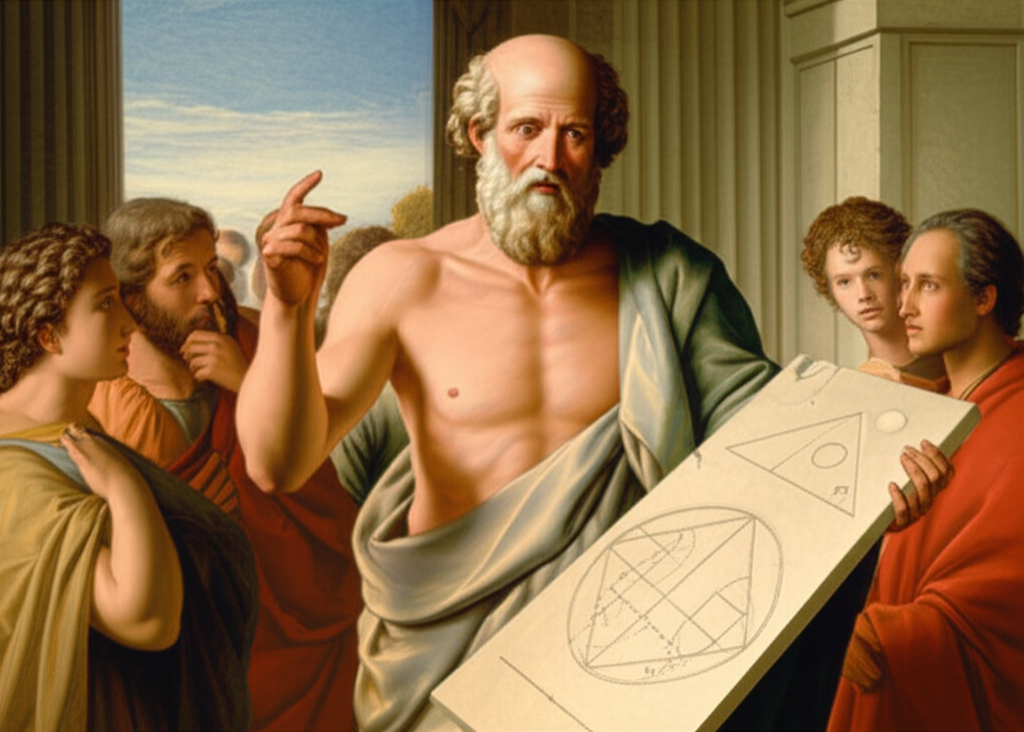
- The Greek Revolution: The Greeks, particularly figures like Pythagoras and Euclid, transformed mathematics from a set of empirical observations into a system of deductive reasoning. They sought not just what worked, but why it worked, establishing the axiomatic method that underpins modern mathematics. Euclid's Elements, a cornerstone text included in the Great Books of the Western World, stands as a monumental achievement, demonstrating how complex geometric truths can be derived from a few self-evident axioms.
It was during this era that the philosophical implications of mathematics first became explicit. Plato, deeply influenced by Pythagorean thought, posited that mathematical objects (like perfect circles or ideal numbers) exist independently of the physical world, in a realm of Forms. For Plato, studying mathematics was a way to train the mind to grasp these eternal, unchanging truths, making it a crucial path to true knowledge.
The Philosophical Crucible: Questions Mathematics Raises
The certainty and universality of mathematical truths have always fascinated philosophers. Unlike empirical sciences, which rely on observation and experimentation, mathematical statements seem to hold true a priori, independent of experience. This unique status provokes a series of profound questions:
What Is a Number? The Ontology of Mathematics
- Platonism/Realism: Do mathematical objects (numbers, sets, functions) exist independently of human thought, waiting to be discovered? If so, where do they reside? This view aligns with Plato's Forms, suggesting mathematics describes an objective reality.
- Formalism: Is mathematics merely a formal system of symbols and rules, a game played according to predefined axioms? Here, mathematical objects don't "exist" in any external sense; they are constructs within our formal systems. David Hilbert was a key proponent of this view.
- Intuitionism: Do mathematical objects exist only as mental constructions, created by the human mind? This perspective, championed by L.E.J. Brouwer, emphasizes the constructive nature of mathematical proof and rejects non-constructive existence proofs.
- Logicism: Can all of mathematics be reduced to logic? Philosophers like Gottlob Frege and Bertrand Russell (whose Principia Mathematica is another key text in the Great Books of the Western World) attempted to show that mathematical truths are ultimately logical truths.
These different schools of thought grapple with the fundamental nature of mathematical entities, directly impacting our understanding of what it means to possess mathematical knowledge.
How Do We Know? The Epistemology of Mathematical Truth
The question of how we acquire mathematical knowledge is central to its philosophy.
- A Priori Knowledge: Mathematical truths are often considered a priori – known independently of experience. We don't need to count every pair of apples in the world to know that 2 + 2 = 4. But how can we gain certain knowledge about the world (or a world of abstract objects) without empirical input?
- The Role of Proof: Mathematical proof is the bedrock of its certainty. It's a chain of deductive reasoning that establishes the truth of a statement from accepted axioms and definitions. But what makes an axiom "true" or "self-evident"?
- Analytic vs. Synthetic Judgments: Immanuel Kant, another giant from the Great Books of the Western World, famously argued that mathematical judgments are "synthetic a priori" – they add new information (synthetic) but are known independently of experience (a priori). This was a revolutionary idea that challenged previous philosophical assumptions about the nature of knowledge.
Mathematics as a Lens for Knowledge
Throughout history, mathematics has served as a powerful tool and a profound subject of philosophy, continually refining our understanding of knowledge itself. Its rigorous methods and the apparent certainty of its truths have inspired philosophers to seek similar foundations for other areas of inquiry. From Descartes' search for indubitable truths, influenced by geometric certainty, to the logical positivists' attempts to ground all meaningful statements in logic and empirical verification, the mathematical paradigm has cast a long shadow over Western thought.
The ongoing dialogue between history, philosophy, and mathematics reveals not just the evolution of numbers and proofs, but the enduring human desire to comprehend the universe in its most fundamental structures. It's a journey that continually asks: What can we truly know, and how can we be sure?
YouTube: "Philosophy of Mathematics Explained"
YouTube: "History of Ancient Greek Mathematics"
📹 Related Video: What is Philosophy?
Video by: The School of Life
💡 Want different videos? Search YouTube for: "The History and Philosophy of Mathematics philosophy"