

The Unseen Architecture: Tracing the History and Philosophy of Mathematics
Mathematics, often perceived as a mere tool for calculation, stands as a monumental pillar in both the History of human thought and the ongoing pursuit of Knowledge. This article delves into the intricate relationship between Mathematics and Philosophy, exploring its evolution from ancient practicalities to the profound foundational questions that continue to challenge our understanding of reality, truth, and the very nature of discovery. From the timeless theorems of antiquity to the existential crises of modern logic, we unravel how Mathematics has consistently shaped, and been shaped by, our deepest philosophical inquiries.
The Enduring Quest: Why Mathematics Matters to Philosophy
At its heart, the Philosophy of Mathematics grapples with fundamental questions: What is Mathematics? Where do its truths come from? And why is it so incredibly effective at describing the universe? For centuries, thinkers have wrestled with whether mathematical concepts are discovered, existing independently in some abstract realm, or invented, products of the human mind. This tension between discovery and invention, between objective truth and subjective construction, lies at the core of understanding Knowledge itself. The journey through the History of Mathematics is not just a chronicle of numbers and theorems, but a testament to humanity's relentless drive to comprehend the cosmos and our place within it.
The Dawn of Mathematical Thought: Ancient Foundations
The earliest stirrings of Mathematics were deeply practical, born from the needs of agriculture, trade, and construction in ancient civilizations. From the precise measurements of the Egyptians to the sophisticated astronomical observations of the Babylonians, mathematics served as a powerful tool for organizing the world.
However, it was with the ancient Greeks that Mathematics truly ascended into the realm of Philosophy. Figures like Pythagoras saw numbers as the fundamental essence of the universe, proclaiming "All is number." This wasn't merely a statement about quantity, but a profound philosophical claim about the underlying structure of reality.
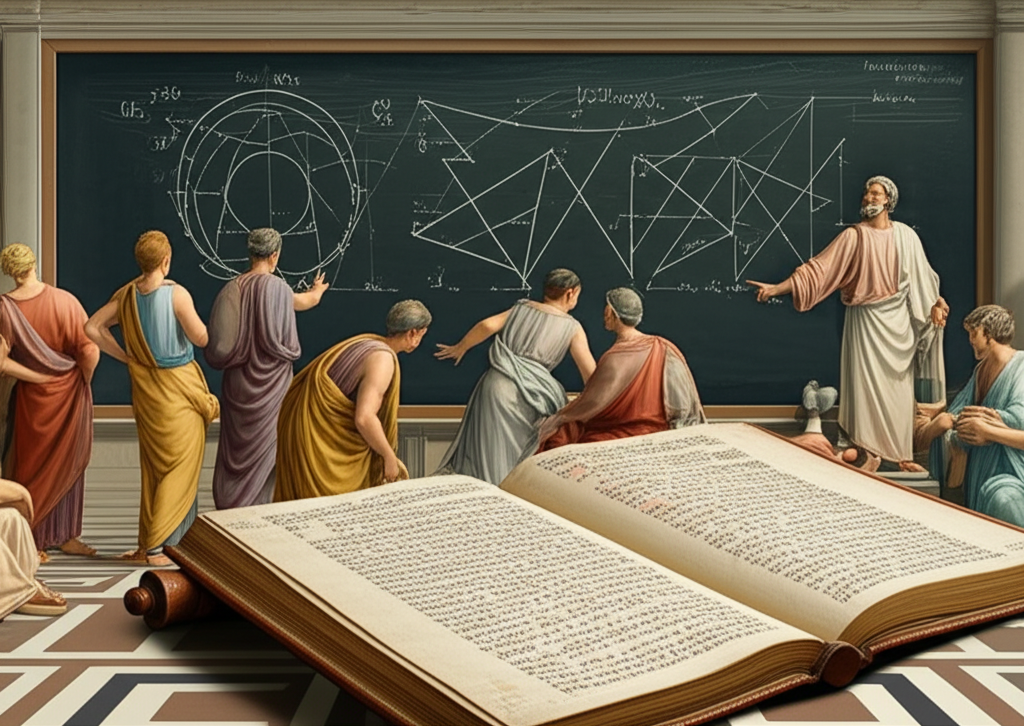
Plato, whose dialogues are cornerstones of the Great Books of the Western World, famously adorned the entrance to his Academy with the inscription, "Let no one ignorant of geometry enter here." For Plato, geometric forms were perfect, eternal, and unchanging, existing in his transcendent Realm of Forms. Studying Mathematics was thus a pathway to higher Knowledge, a means of training the mind to apprehend these ideal truths, distinct from the imperfect sensory world. The theorems of Euclid, meticulously laid out in his Elements, became the paradigm of deductive reasoning, a model for how certain Knowledge could be attained through logical inference from self-evident axioms. This systematic approach deeply influenced Western thought, setting a standard for intellectual rigor that permeated philosophy, science, and law.
Medieval Bridges and Renaissance Resurgence
Following the decline of the classical world, the torch of mathematical inquiry was largely carried by Islamic scholars. They preserved, translated, and expanded upon Greek texts, introducing concepts like algebra and algorithms that would revolutionize calculation. Thinkers like al-Khwarizmi (from whose name "algorithm" derives) were instrumental in bridging the gap between ancient methods and future innovations.
When mathematical Knowledge resurfaced in Europe during the Renaissance, it did so with renewed vigor, intertwined with the burgeoning scientific revolution. Figures like Leonardo da Vinci and Galileo Galilei saw Mathematics as the language of the universe, essential for understanding natural phenomena. Galileo famously declared that the "book of nature is written in the language of mathematics," a profound philosophical statement that cemented mathematics' role as the indispensable tool for scientific inquiry.
The Modern Era: From Calculus to Crises
The 17th century brought a seismic shift with the development of calculus by Isaac Newton and Gottfried Leibniz. This new mathematical language allowed for the description of change and motion with unprecedented precision, fueling advancements in physics and engineering. Philosophers like René Descartes, another titan of the Great Books, sought to build Knowledge on foundations as certain as those of Mathematics, famously employing a method of doubt to arrive at indubitable truths. His analytic geometry unified algebra and geometry, demonstrating the profound interconnectedness of different mathematical domains.
However, as Mathematics grew in complexity, so did its philosophical challenges. The 19th and early 20th centuries witnessed a "foundational crisis." The discovery of paradoxes in set theory (like Russell's Paradox) shook the very bedrock of mathematical certainty. This led to intense philosophical debates about the nature of mathematical objects and proofs, giving rise to distinct schools of thought:
- Logicism: Advocated by Bertrand Russell and Alfred North Whitehead (whose Principia Mathematica is a monumental, if often unread, entry in the Great Books), this school aimed to reduce all Mathematics to logic, thereby establishing its absolute certainty.
- Intuitionism: Championed by L.E.J. Brouwer, this view held that mathematical objects are mental constructions, and mathematical truth is based on our intuitive understanding, not on external reality or formal systems.
- Formalism: Associated with David Hilbert, this perspective treated Mathematics as a formal game with symbols and rules, where consistency was the ultimate goal, rather than reference to any external reality.
These debates highlight the deep philosophical questions that underpin even the most abstract mathematical concepts, probing the very limits of human Knowledge and logical coherence.
Key Philosophical Questions in Mathematics
The History of Mathematics is a continuous dialogue with its Philosophy. Here are some of the enduring questions that continue to fascinate thinkers:
- Ontology of Mathematical Objects: Do numbers, sets, and geometric shapes exist independently of the human mind (Platonism), or are they merely useful fictions or mental constructs (Nominalism, Formalism)?
- Epistemology of Mathematical Knowledge: How do we acquire mathematical Knowledge? Is it purely a priori (known independently of experience), or does empirical observation play a role? What makes a mathematical proof valid?
- The Applicability Problem: Why is Mathematics, a product of abstract thought, so remarkably effective at describing the physical world? Is this a mere coincidence, or does it point to a deeper structural unity between mind and reality?
- The Nature of Mathematical Truth: Is mathematical truth absolute and eternal, or is it relative to the chosen axiomatic system? Can mathematics be consistent and complete? (Gödel's incompleteness theorems cast a long shadow here).
These questions reveal that Mathematics is not just a subject to be learned, but a profound philosophical arena where the very nature of truth, existence, and Knowledge is constantly interrogated.
📹 Related Video: What is Philosophy?
Video by: The School of Life
💡 Want different videos? Search YouTube for: "Philosophy of Mathematics Explained; YouTube: Gödel's Incompleteness Theorem Explained"
The Enduring Quest for Understanding
The journey through the History and Philosophy of Mathematics is a testament to humanity's ongoing intellectual adventure. From the practical needs of ancient civilizations to the abstract foundational crises of the modern era, Mathematics has consistently pushed the boundaries of our understanding. It forces us to confront not only the structure of the universe but also the architecture of our own minds and the very nature of Knowledge. The dialogue between its History and its Philosophy is far from over; it remains a vibrant, evolving field, inviting continuous inquiry into the most fundamental aspects of existence and thought.