

Unraveling the Fabric: The Intertwined History and Philosophy of Mathematics
Summary:
Mathematics, often perceived as a purely objective and unyielding discipline, possesses a rich history deeply intertwined with its philosophy. This article explores how the evolution of mathematical thought, from ancient civilizations to modern foundational crises, has continually challenged and refined our understanding of knowledge itself. We delve into the enduring philosophical questions surrounding the nature of mathematical objects, the source of mathematical truth, and the profound impact mathematics has had on human inquiry.
Introduction: A Dance Between Numbers and Ideas
For centuries, mathematics has stood as a towering edifice of human intellect, a language capable of describing the universe with breathtaking precision and uncovering abstract truths. Yet, beneath its seemingly rigid structure lies a vibrant tapestry woven from history and philosophy. To truly appreciate mathematics is not merely to master its operations but to grapple with the profound questions it poses: What is the nature of mathematical reality? How do we acquire mathematical knowledge? And what does its existence tell us about the universe and our place within it? This journey through the ages reveals that the development of mathematical concepts has always been shadowed by philosophical inquiry, each pushing the boundaries of the other, ultimately shaping our very conception of knowledge.
I. A Historical Odyssey: Milestones in Mathematical Thought
The history of mathematics is a testament to humanity's innate drive to understand, quantify, and model the world around us. From practical necessities to abstract contemplation, each era has left an indelible mark.
-
The Dawn of Calculation: Ancient Roots
- Early Civilizations: Before the Greeks, civilizations in Egypt and Mesopotamia developed sophisticated systems for arithmetic, geometry, and rudimentary algebra. Their mathematics was largely pragmatic, driven by needs like land surveying, calendar keeping, and construction. The Rhind Papyrus and Babylonian clay tablets offer glimpses into these early forms of knowledge.
- Classical Greece: The Birth of Deductive Reasoning: It was in ancient Greece that mathematics transformed from a collection of empirical rules into a rigorous deductive science. Thinkers like Pythagoras explored the numerical relationships in music and the cosmos, while Euclid's Elements, a cornerstone of the Great Books of the Western World, systematized geometry with axioms and proofs, setting a standard for logical rigor that endures to this day. Plato, deeply influenced by Pythagorean thought, saw mathematical forms as ideal, eternal truths existing independently of the physical world, laying the groundwork for mathematical Platonism.
-
Medieval Bridges: East and West
- Islamic Golden Age: While Europe entered the Dark Ages, Islamic scholars preserved and advanced Greek mathematics, translating texts and making significant original contributions. Al-Khwarizmi's work on algebra (from which the term derives) and algorithms, along with the adoption of the Hindu-Arabic numeral system, revolutionized calculation and laid the foundation for modern arithmetic.
- Indian Innovations: In India, concepts like zero, negative numbers, and trigonometric functions were developed, profoundly impacting the global trajectory of mathematics.
-
The Renaissance and Enlightenment: New Frontiers
- The rebirth of classical learning in Europe spurred new mathematical advancements. René Descartes unified geometry and algebra, giving us coordinate geometry. Isaac Newton and Gottfried Leibniz independently developed calculus, a revolutionary tool for understanding change and motion, providing the mathematical backbone for modern physics. This era saw mathematics increasingly applied to the natural sciences, expanding the realm of empirical knowledge.
-
The Modern Era: Foundations and Crises
- The 19th and 20th centuries witnessed an explosion of new mathematical fields (non-Euclidean geometry, abstract algebra, set theory). This expansion, however, led to a "foundational crisis" as paradoxes emerged in set theory (e.g., Russell's Paradox), prompting a deep philosophical introspection into the very nature of mathematics itself. Figures like Georg Cantor, David Hilbert, and Kurt Gödel grappled with the limits and consistency of mathematical systems, profoundly influencing our understanding of formal knowledge.
II. Philosophical Inquiries: The Essence of Mathematics
The history of mathematics is inseparable from its philosophy, which probes the fundamental questions concerning its nature, its objects, and its truth.
-
What Is Mathematics? Ontology and Reality
- Are mathematical objects (numbers, shapes, functions) real? Do they exist independently of human thought, waiting to be discovered, or are they mere human constructions or conventions? This ontological debate lies at the heart of the philosophy of mathematics.
-
How Do We Know Mathematical Truths? Epistemology and Certainty
- Unlike empirical sciences, mathematical truths seem to possess a unique certainty. How do we acquire this knowledge? Is it through intuition, logical deduction, or some other means? What makes a mathematical proof convincing?
-
Major Schools of Thought:
The foundational crisis of the early 20th century spurred the development of distinct philosophical positions:- Platonism/Realism: Adherents, echoing Plato, believe mathematical objects exist objectively and independently of human minds, much like physical objects, though in an abstract realm. Mathematicians discover these truths rather than invent them.
- Formalism: Championed by David Hilbert, formalism views mathematics as a formal game of symbols and rules. Mathematical statements are not "true" in any objective sense but are merely well-formed strings of symbols derived from axioms according to specified rules of inference. The focus is on consistency.
- Intuitionism: Developed by L.E.J. Brouwer, intuitionism asserts that mathematical objects are mental constructions. A mathematical object exists only if it can be constructed by the mind. This leads to a more restrictive mathematics, rejecting, for example, the law of the excluded middle for infinite sets.
- Logicism: Proposed by Bertrand Russell and Alfred North Whitehead in Principia Mathematica (another Great Book), logicism attempts to reduce all mathematics to logic. Mathematical truths are seen as logical truths, derived from purely logical axioms and inference rules.
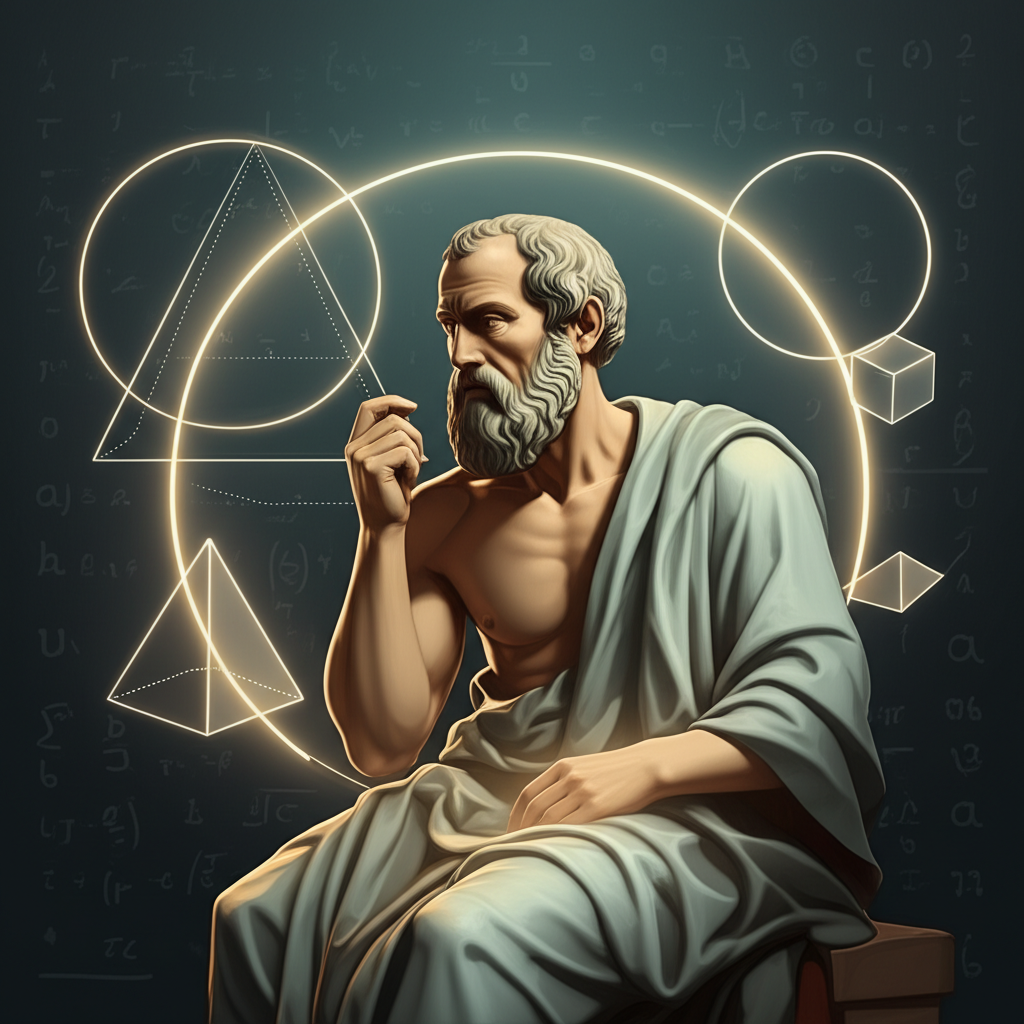 subtly overlay a scroll, symbolizing the historical progression of mathematical thought. The philosopher's expression is one of profound intellectual engagement, emphasizing the link between philosophical inquiry and mathematical discovery.)
III. Mathematics as a Pillar of Knowledge
Beyond its internal debates, mathematics plays an unparalleled role in shaping our broader understanding of knowledge.
- The Language of Science: From physics to economics, mathematics provides the indispensable framework for formulating theories, making predictions, and analyzing data. Its precision allows for a rigorous testing of hypotheses, advancing empirical knowledge.
- A Model for Rationality: The deductive method, perfected in mathematics, has served as an ideal for rational thought in philosophy and other disciplines. The quest for certainty and logical consistency often draws inspiration from mathematical proofs.
- The Unreasonable Effectiveness: As physicist Eugene Wigner famously observed, the "unreasonable effectiveness of mathematics in the natural sciences" is a profound mystery. Why should abstract mathematical structures so perfectly describe the physical universe? This question continues to bridge the gap between science and philosophy, urging us to ponder the fundamental nature of reality itself.
Conclusion: An Endless Dialogue
The history and philosophy of mathematics are not separate fields of study but rather two sides of the same intellectual coin. Each advancement in mathematical technique has provoked new philosophical questions, and each philosophical inquiry has, in turn, refined our approach to mathematical knowledge. From the practical calculations of ancient civilizations to the abstract foundational debates of the modern era, mathematics remains a vibrant, evolving discipline that continually challenges our assumptions and expands the horizons of human understanding. The journey is far from over, and the dialogue between numbers and ideas continues to unfold, promising ever deeper insights into the fabric of reality and the nature of knowledge itself.
📹 Related Video: What is Philosophy?
Video by: The School of Life
💡 Want different videos? Search YouTube for: ""Philosophy of Mathematics Explained" or "Foundations of Mathematics Crisis""
📹 Related Video: PLATO ON: The Allegory of the Cave
Video by: The School of Life
💡 Want different videos? Search YouTube for: ""Plato's Philosophy of Math and Forms""