

The Enduring Enigma: A Journey Through the History and Philosophy of Mathematics
Summary: Mathematics, often perceived as a mere tool for calculation, is in fact a profound and ancient discipline whose history is deeply intertwined with the development of human thought and knowledge. This article embarks on a journey through the evolution of mathematics, from its earliest practical applications to its most abstract theoretical constructs, exploring the enduring philosophical questions it raises about truth, reality, and the very nature of human understanding. We will see how mathematics has not only shaped our world but also continually challenged our perceptions of what it means to know.
Unpacking the Universal Language: Mathematics as History and Philosophy
From the moment early humans began counting, measuring, and observing patterns, mathematics emerged as an indispensable lens through which to comprehend the world. Yet, its story is far more intricate than a simple progression of discoveries. The history of mathematics is a tapestry woven with cultural narratives, technological advancements, and, crucially, a relentless philosophical inquiry into its foundations, its truths, and its relationship to our knowledge. At planksip.org, we believe that to truly understand mathematics is to grapple with its deepest philosophical implications, questioning not just what it is, but why it works and what it reveals about reality itself.
A Historical Odyssey: From Practicality to Pure Abstraction
The journey of mathematics is a testament to human ingenuity, spanning millennia and diverse civilizations.
I. The Dawn of Number: Practical Beginnings
- Ancient Mesopotamia & Egypt: Early mathematics was driven by practical needs – accounting for goods, land measurement, and astronomical observations for calendars. The Babylonians developed sophisticated sexagesimal (base-60) number systems and early forms of algebra, while the Egyptians mastered geometry for constructing pyramids and surveying floodplains. Their innovations laid the groundwork for future civilizations, demonstrating mathematics' initial role as a tool for managing the physical world.
II. The Greek Revolution: Logic, Proof, and Philosophy
- The Birth of Deductive Reasoning: It was the ancient Greeks, whose works feature prominently in the Great Books of the Western World, who transformed mathematics from a collection of empirical techniques into a rigorous, deductive science.
- Pythagoras: Explored the numerical relationships in music and the cosmos, famously attributed with the Pythagorean theorem, infusing mathematics with mystical and philosophical significance.
- Plato: Argued that mathematical objects (like perfect circles or numbers) exist independently of the physical world, in an ideal realm accessible only through reason. This Platonist view profoundly influenced subsequent philosophy and mathematics, positing mathematical truth as eternal and unchanging.
- Euclid: His Elements (c. 300 BCE) became the paradigm for axiomatic-deductive reasoning for over two millennia, demonstrating how complex mathematical knowledge could be built from a few self-evident axioms and logical steps. This work is a cornerstone of Western thought and a prime example of how mathematics became synonymous with rigorous proof and certainty.
III. The Medieval Bridge: Preservation and Innovation
- Islamic Golden Age: While Europe entered the Dark Ages, Islamic scholars preserved, translated, and expanded upon Greek and Indian mathematical traditions. They introduced Arabic numerals (including the concept of zero, vital for positional notation), developed algebra (Al-Khwarizmi), and made significant advances in trigonometry, laying crucial foundations for the Renaissance.
IV. The Modern Era: Calculus, Foundations, and Crisis
- The Renaissance & Enlightenment: The invention of calculus by Newton and Leibniz revolutionized physics and engineering, demonstrating the immense power of mathematics to describe continuous change. This period saw mathematics become the language of science, further solidifying its role in generating empirical knowledge.
- 19th-20th Century: The Foundations Crisis: As mathematics grew more abstract (e.g., non-Euclidean geometries, set theory), philosophers and mathematicians began to question its very foundations. This led to a profound philosophical debate:
- Logicism (Frege, Russell): Attempted to reduce mathematics to logic.
- Intuitionism (Brouwer): Argued mathematics is a construct of the human mind, rejecting non-constructive proofs.
- Formalism (Hilbert): Viewed mathematics as a formal game of symbols, rules, and axioms, independent of any inherent meaning.
- Gödel's Incompleteness Theorems: A monumental philosophical and mathematical discovery demonstrating that any consistent axiomatic system rich enough to contain arithmetic will contain true statements that cannot be proven within the system itself. This challenged the notion of absolute completeness and certainty in mathematical knowledge.
Philosophical Quagmires: What is Mathematical Reality?
The history of mathematics is punctuated by deep philosophical questions that continue to challenge our understanding of knowledge and reality.
- Platonism/Realism: Do mathematical objects (numbers, sets, functions) exist independently of human thought, perhaps in some abstract realm? This view suggests mathematics is discovered, not invented.
- Formalism: Is mathematics merely a consistent system of symbols and rules, a sophisticated game with no inherent meaning beyond its internal logic? Here, mathematical truth is about consistency within the system.
- Intuitionism/Constructivism: Is mathematics a product of human mental construction? This perspective emphasizes the constructive nature of mathematical objects and proofs, rejecting entities that cannot be explicitly built.
- Empiricism: Does mathematical knowledge ultimately derive from our experience of the physical world? This view struggles with the seemingly a priori and universal nature of mathematical truths.
- The Unreasonable Effectiveness: Why does mathematics, an abstract human creation, so perfectly describe the physical universe? This profound question, posed by physicist Eugene Wigner, lies at the heart of the philosophy of mathematics, suggesting a deep, perhaps even mysterious, connection between mind, mathematics, and reality.
Mathematics and the Fabric of Knowledge
Mathematics has long served as the gold standard for certainty and rigorous proof, profoundly influencing our understanding of knowledge itself.
- Epistemological Paradigm: For philosophers like Descartes, the clarity and certainty of mathematical reasoning (e.g., Euclidean geometry) provided a model for all other forms of knowledge. The idea of building knowledge from self-evident truths through logical deduction remains a powerful ideal.
- Limits of Certainty: However, the foundational crises of the 19th and 20th centuries, particularly Gödel's theorems, introduced a humbling perspective. They demonstrated that even within mathematics, absolute completeness and provability are unattainable ideals. This has implications for all domains of knowledge, suggesting inherent limits to what we can definitively know, even within the most rigorous systems.
- Interdisciplinary Bridge: Today, mathematics continues to be a vital language for science, technology, and even the humanities, offering tools for analysis, modeling, and understanding complex systems. Its ongoing evolution reflects a dynamic interplay between human intuition, logical rigor, and the persistent quest for deeper knowledge.
Conclusion: The Unfolding Story of Mathematics
The history and philosophy of mathematics reveal a dynamic and evolving discipline that is far more than a collection of formulas. It is a testament to humanity's relentless pursuit of knowledge, a mirror reflecting our deepest philosophical inquiries into truth, existence, and the very structure of reality. From the practical calculations of ancient civilizations to the abstract debates over its foundations, mathematics remains a cornerstone of human understanding, continually challenging us to refine our ideas about what we know, and how we know it. Its story is far from over, and the questions it poses continue to inspire new generations of thinkers to explore its boundless intellectual landscape.
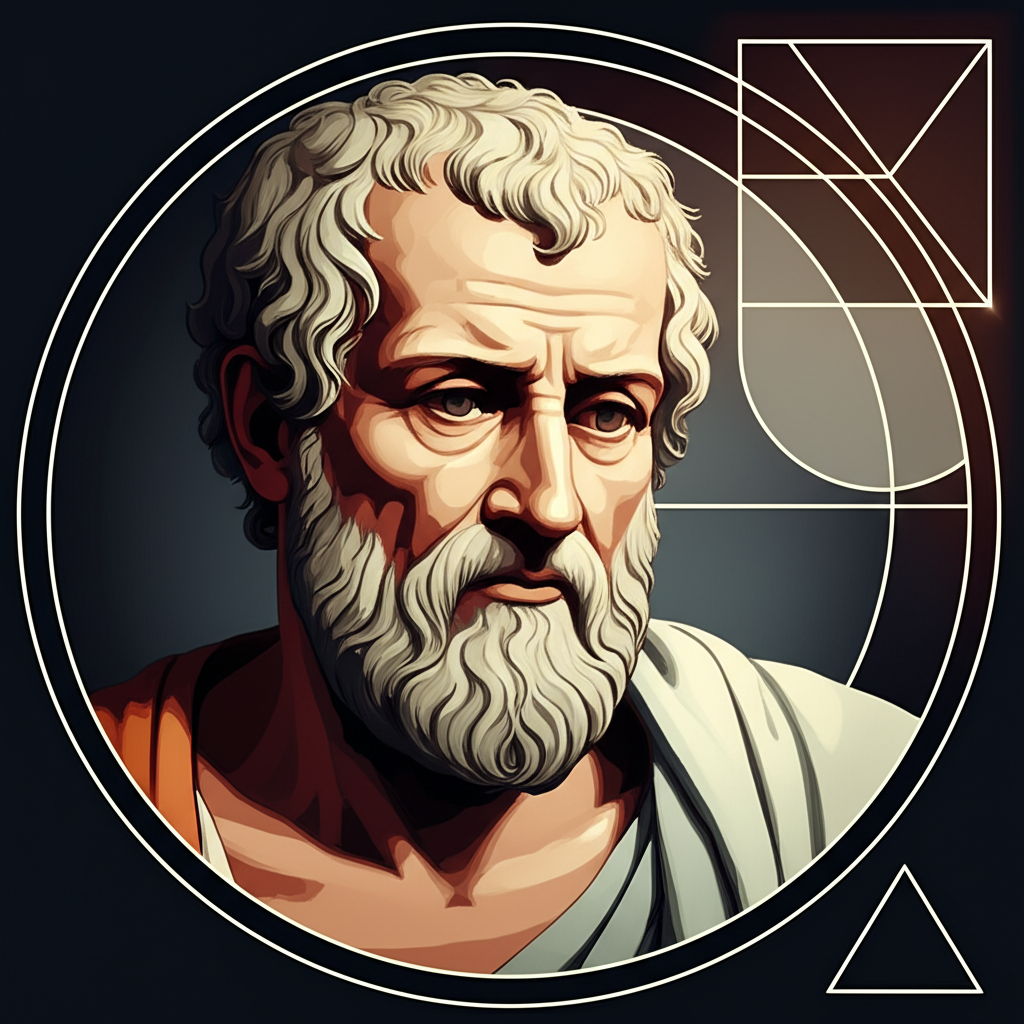 floating abstractly in the foreground. In the background, faint, glowing mathematical symbols from different eras (Babylonian cuneiform, Arabic numerals, modern calculus notations) are subtly integrated into a cosmic or ethereal landscape, symbolizing the timeless and universal nature of mathematics across history.)
📹 Related Video: What is Philosophy?
Video by: The School of Life
💡 Want different videos? Search YouTube for: ""Philosophy of Mathematics introduction" and "History of Math Foundations Crisis""