

The Intertwined Tapestry: History, Philosophy, and the Enduring Quest for Mathematical Knowledge
Summary: Mathematics, often perceived as an immutable realm of objective truth, possesses a rich and complex history deeply interwoven with profound philosophical inquiries. From ancient geometry to modern set theory, the evolution of mathematics has consistently challenged and redefined our understanding of knowledge itself. This article explores how mathematical thought has shaped, and been shaped by, humanity's enduring quest to comprehend reality, certainty, and the very nature of truth.
Ancient Echoes: The Dawn of Mathematical Thought
Long before the abstract proofs we associate with modern mathematics, its origins were deeply practical, rooted in the necessities of ancient civilizations. From the sophisticated accounting systems of Mesopotamia to the architectural marvels of Egypt and the astronomical observations of ancient India and China, early mathematical practices were tools for managing the physical world. However, it was in ancient Greece that a fundamental shift occurred. Thinkers like Pythagoras and Thales began to move beyond mere computation, seeking underlying principles and universal truths. This marked the very beginning of the philosophy of mathematics, questioning why these numerical relationships held true, rather than just how to apply them.
Plato's Ideal: Mathematics as a Window to Reality
One of the most influential figures in the history of philosophy to grapple with mathematics was Plato. Drawing from the Great Books of the Western World, particularly his Republic and Meno, we find the compelling argument that mathematical entities – numbers, perfect circles, ideal triangles – are not merely human constructs but rather eternal, unchanging Forms existing independently of our minds. For Plato, the study of mathematics was the ultimate training for the soul, a way to glimpse these transcendent Forms and access true knowledge.
- The Platonic View of Mathematical Knowledge:
- Mathematical truths are discovered, not invented.
- They are eternal, perfect, and immutable.
- Our minds can access these truths through reason and contemplation, suggesting an innate capacity for mathematical understanding.
- This perspective profoundly influenced subsequent Western thought on the nature of reality and the certainty of knowledge.
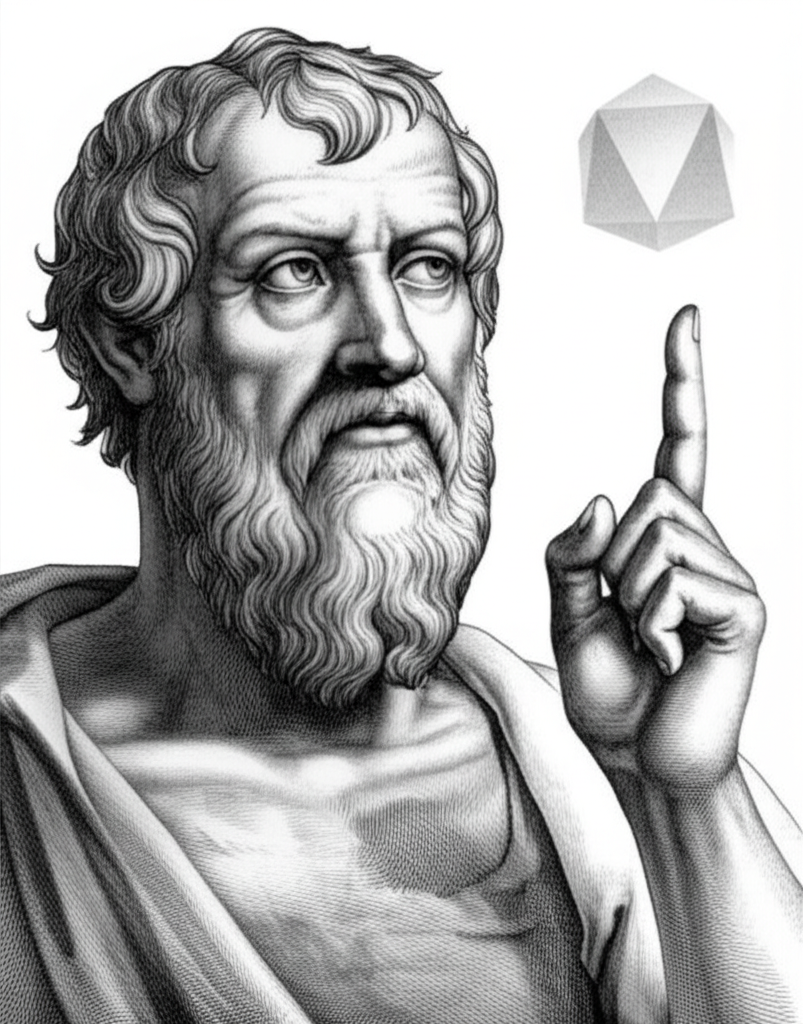 hovering above him, while the other hand gestures towards a scroll with mathematical symbols. The background could subtly suggest the Academy, with students engaged in discussion.)
Euclid's Legacy: The Power of Axiomatic Reasoning
The pinnacle of ancient Greek mathematical achievement, and a cornerstone of the Great Books, is undoubtedly Euclid's Elements. This monumental work, compiled around 300 BCE, wasn't just a collection of geometric theorems; it was a groundbreaking demonstration of the power of axiomatic-deductive reasoning. Euclid began with a few self-evident definitions, postulates (axioms), and common notions, and from these, he logically derived hundreds of complex propositions.
This approach established a gold standard for certainty and rigor that permeated not only mathematics but also philosophy and science for millennia. It provided a model for how indisputable knowledge could be built from foundational truths, influencing thinkers from Aristotle to Descartes. The Elements presented a universe where logical steps led inevitably to truth, a profound assertion about the order of the cosmos and the human mind's capacity to grasp it.
The Enlightenment's Lens: Mathematics as the Language of Nature
The Renaissance and Enlightenment periods witnessed a dramatic resurgence in the application of mathematics to the natural world. Thinkers like René Descartes, another luminary from the Great Books, championed analytical geometry, bridging algebra and geometry and laying the groundwork for calculus. Isaac Newton and Gottfried Leibniz, independently developing calculus, provided the essential tools for describing motion, gravity, and the laws of physics.
This era solidified the view that mathematics was not just an abstract pursuit but the very language in which the universe was written. The success of mathematical models in predicting and explaining natural phenomena led to deep philosophical questions: Was mathematics merely a useful tool, or did its structures inherently reflect the fabric of reality? This period saw the rise of both rationalism, emphasizing reason as the source of knowledge, and empiricism, which grounded knowledge in sensory experience – both grappling with the unique status of mathematical truth.
Modern Quandaries: The Foundations of Mathematical Knowledge
The 19th and early 20th centuries brought revolutionary changes and profound crises to the philosophy of mathematics. The discovery of non-Euclidean geometries challenged the perceived absolute truth of Euclidean space, suggesting that mathematical systems could be consistent without necessarily describing physical reality. Later, paradoxes in set theory, notably Russell's paradox (named after Bertrand Russell, another key figure in the Great Books tradition), exposed unforeseen inconsistencies at the very foundations of mathematics.
This led to a fervent period of foundational research, giving rise to competing schools of thought:
- Logicism: Advocated by Russell and Alfred North Whitehead in their monumental Principia Mathematica, this view sought to reduce mathematics to logic, arguing that mathematical truths were ultimately logical tautologies.
- Formalism: Championed by David Hilbert, this perspective treated mathematics as a formal game played with symbols according to strict rules, with no inherent meaning beyond their consistent manipulation.
- Intuitionism: Proposed by L.E.J. Brouwer, this school insisted that mathematical objects only exist if they can be constructively built or proven by the human mind, rejecting non-constructive proofs.
These debates highlighted the deep philosophical uncertainty regarding the ultimate nature of mathematical objects and the very source of mathematical knowledge. Is mathematics discovered or invented? Is it objective or subjective? These questions remain central to contemporary philosophical discourse.
Mathematics Today: A Human Endeavor, an Enduring Mystery
In the 21st century, the history and philosophy of mathematics continue to evolve. While foundational debates persist, there's a growing appreciation for the human element in mathematical creation. Mathematics is seen as a vibrant, dynamic field driven by curiosity, intuition, and collaboration, not just cold logic. The advent of powerful computing has opened new avenues, from computational mathematics to the mathematics behind artificial intelligence, further blurring the lines between pure theory and practical application.
Yet, the core philosophical questions endure: Why is mathematics so effective in describing the universe? Does its structure pre-exist us, or is it a product of our cognitive architecture? The search for mathematical knowledge remains one of humanity's most profound and beautiful intellectual adventures.
Conclusion: The Ongoing Dialogue
The journey through the history and philosophy of mathematics reveals not a static, unchanging discipline, but a dynamic and deeply human endeavor. From the practical needs of ancient civilizations to Plato's transcendent Forms, Euclid's axiomatic certainty, the Enlightenment's scientific revolution, and the foundational crises of the modern era, mathematics has consistently pushed the boundaries of our understanding. It stands as a testament to humanity's relentless pursuit of knowledge, constantly challenging us to refine our definitions of truth, reality, and the very limits of our intellect. The dialogue between history, philosophy, and mathematics is far from over; it is an ongoing exploration into the very fabric of existence.
**## 📹 Related Video: PLATO ON: The Allegory of the Cave
Video by: The School of Life
💡 Want different videos? Search YouTube for: ""Philosophy of Mathematics explained simply" or "Plato's Theory of Forms and Mathematics""**