

The Language of Existence: An Inquiry into the History and Philosophy of Mathematics
From the simplest tally marks of ancient civilizations to the most abstract theories of modern physics, mathematics has always been more than just a tool for calculation; it is a fundamental mode of human thought, a language through which we attempt to comprehend the universe. This article delves into the intertwined history and philosophy of mathematics, exploring how its development has shaped our understanding of knowledge, reality, and truth, and in turn, how philosophical inquiry has continually challenged and refined its very foundations. We will trace its evolution, examine the profound questions it poses about the nature of existence, and acknowledge its enduring influence on our quest for understanding.
I. Tracing the Arcs of Discovery: A Historical Journey
The story of mathematics is a grand narrative of human ingenuity, stretching back millennia and evolving through diverse cultures. It's a testament to our innate drive to find order in chaos, and to quantify the world around us.
-
From Ancient Roots to the Dawn of Reason:
Long before formal theorems, early humans used mathematics for practical needs: counting livestock, tracking celestial cycles, and building structures. The ancient Egyptians and Babylonians developed sophisticated systems for arithmetic, algebra, and geometry, driven by the demands of agriculture, engineering, and astronomy. Their empirical approaches laid groundwork, but it was the Greeks who transformed mathematics into a deductive science. -
The Hellenic Revelation: Geometry as Truth:
The philosophers and mathematicians of ancient Greece, whose works form a cornerstone of the Great Books of the Western World, revolutionized the field. Figures like Euclid, with his Elements, established the axiomatic method, demonstrating how complex truths could be derived from a few self-evident postulates. This was not just about practical measurement; it was about discovering universal, immutable truths through pure reason. Plato, deeply influenced by Pythagorean thought, saw mathematical forms as perfect, eternal entities existing in a realm beyond sensory experience, making mathematics a pathway to true knowledge. The emphasis shifted from "how to calculate" to "why it must be so." -
The Renaissance and Beyond: New Horizons:
Following centuries of development in Islamic scholarship, Europe saw a resurgence of mathematical innovation during the Renaissance. The invention of algebra, the development of calculus by Isaac Newton and Gottfried Leibniz, and the subsequent explosion of fields like probability, topology, and abstract algebra, pushed the boundaries of what mathematics could describe. This period saw mathematics become the indispensable language of the burgeoning natural sciences, providing the framework for understanding everything from planetary motion to the laws of thermodynamics.
II. The Deep Questions: Philosophy at the Heart of Numbers
The spectacular success and pervasive utility of mathematics naturally lead to profound philosophical questions. What is mathematics? What kind of reality do its objects possess? And how can we be so certain of its truths?
-
What are Mathematical Objects? Realism vs. Anti-Realism:
One of the oldest and most persistent philosophical debates concerns the ontological status of mathematical entities like numbers, sets, and geometric shapes. Do they exist independently of human thought, waiting to be discovered, or are they human constructions or conventions?Philosophical Stance Core Idea Proponents (Examples) Platonism/Realism Mathematical objects exist independently, objectively, and timelessly. Plato, Kurt Gödel Formalism Mathematics is a game of symbols and rules, without inherent meaning. David Hilbert Intuitionism Mathematical objects are mental constructions; existence implies constructibility. L.E.J. Brouwer Nominalism Mathematical objects do not exist; mathematical statements are useful fictions. Hartry Field 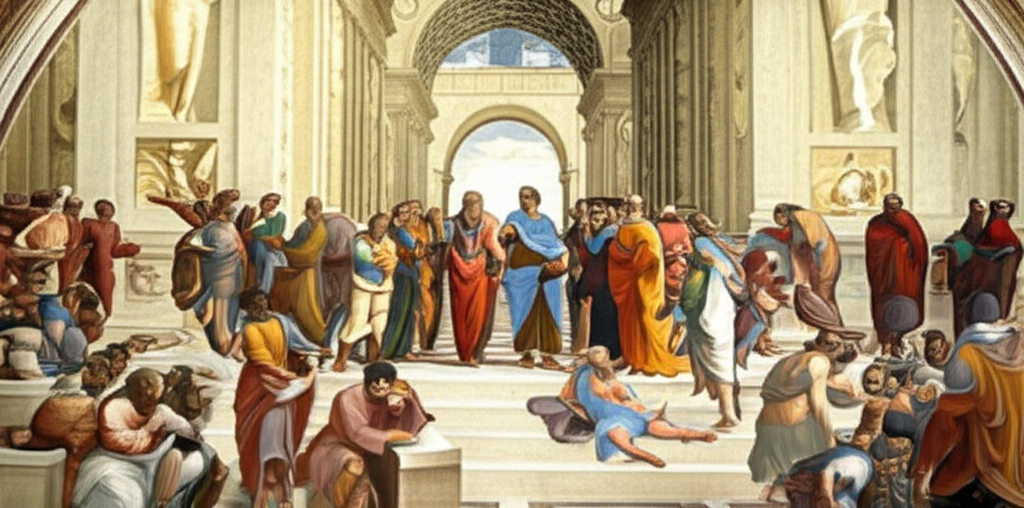
-
The Nature of Mathematical Knowledge: Certainty and Foundations:
Mathematics has long been held as the paradigm of certainty. Its truths seem absolute and undeniable. But what grants this certainty? Is it derived from pure logic, from intuition, or from our empirical experience of the world? The 20th century saw a major foundational crisis, as mathematicians and philosophers grappled with these questions.- Logicism: Advocated by figures like Gottlob Frege and Bertrand Russell (whose Principia Mathematica is a monumental work in the Great Books tradition), this school sought to reduce all mathematics to logic, thereby securing its certainty.
- Intuitionism: Challenged logicism, arguing that mathematical objects are not discovered but constructed by the human mind, and that proof requires constructive methods.
- Formalism: Led by David Hilbert, this view treated mathematics as a formal system of axioms and rules, with emphasis on consistency and completeness, rather than inherent meaning.
These debates profoundly reshaped our understanding of what it means to "know" mathematical truths and the very limits of formal systems, as famously demonstrated by Gödel's incompleteness theorems.
-
Mathematics and Reality: A Peculiar Affinity:
Perhaps the most perplexing philosophical question is why mathematics, an apparently abstract discipline, is so extraordinarily effective at describing the physical universe. From Newton's laws of motion to Einstein's theory of relativity, mathematical equations not only describe but often predict physical phenomena with startling accuracy. Eugene Wigner famously called this the "unreasonable effectiveness of mathematics in the natural sciences." Is this merely a coincidence, or does it suggest a deeper, inherent mathematical structure to reality itself? This question continues to be a fertile ground for philosophical inquiry, bridging the gap between abstract thought and empirical observation.
III. Enduring Threads: Why Mathematics Matters to Philosophy
The history and philosophy of mathematics are not just academic curiosities; they are central to our understanding of the human condition and our place in the cosmos. Mathematics provides a unique lens through which we explore the nature of knowledge, the limits of reason, and the very fabric of reality. It challenges us to think critically about what we mean by truth, existence, and proof. As we continue to push the boundaries of mathematical thought, we simultaneously expand our philosophical horizons, forever seeking to unravel the elegant, intricate patterns that govern both our minds and the universe we inhabit.
📹 Related Video: PLATO ON: The Allegory of the Cave
Video by: The School of Life
💡 Want different videos? Search YouTube for: ""History of Ancient Greek Mathematics Philosophy" for historical context on deductive reasoning and Plato's influence."
📹 Related Video: What is Philosophy?
Video by: The School of Life
💡 Want different videos? Search YouTube for: ""Philosophy of Mathematics Realism Anti-Realism" for contemporary debates on the nature of mathematical objects."