

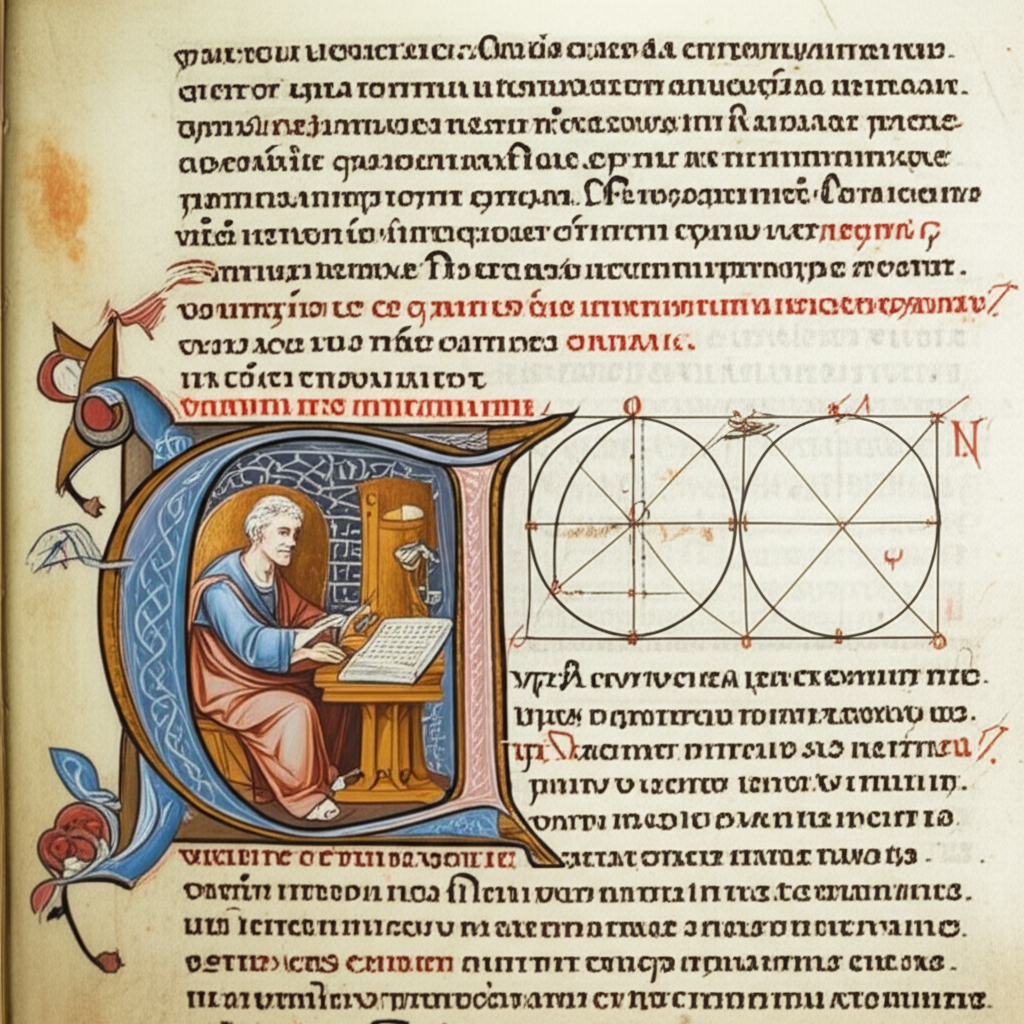
The Enduring Dialogue: History, Philosophy, and the Nature of Mathematics
Mathematics, often perceived as a realm of absolute certainty and objective truth, is far more than just a tool for calculation or a language for science. It possesses a rich history deeply intertwined with the evolution of human knowledge and a profound philosophy that probes its very essence. From the ancient Greeks pondering the perfect forms to modern logicians grappling with its foundations, the story of mathematics is a captivating journey into the heart of reason, abstraction, and our quest to understand reality. This article delves into this fascinating interplay, exploring how historical developments have shaped philosophical inquiries and how philosophical perspectives continue to illuminate the nature of mathematical truth and our very capacity for knowledge.
The Genesis of Mathematical Thought: From Utility to Abstraction
The earliest forms of mathematics emerged from practical needs: counting, measuring, and surveying. Yet, even in antiquity, particularly with the Greeks, mathematics transcended mere utility to become an object of profound philosophical contemplation. This pivotal shift laid the groundwork for centuries of inquiry into the nature of mathematical knowledge.
- Pythagoras and the Harmony of Numbers: The Pythagoreans, an enigmatic brotherhood, believed that numbers were the fundamental essence of the cosmos, dictating everything from musical intervals to planetary motions. Their discovery of incommensurable magnitudes (like the square root of 2) profoundly challenged their worldview, introducing an early philosophical crisis regarding the perfect order of numbers and the limits of rational knowledge.
- Plato and the Realm of Forms: For Plato, as discussed in the Great Books of the Western World, mathematical objects (like the perfect circle or ideal triangle) were not mere human constructs but eternal, unchanging entities residing in a transcendent realm of Forms. Our physical world, in this view, merely offers imperfect copies. Studying mathematics, therefore, was a way to train the mind to apprehend these higher truths, a crucial step in the ascent to true Knowledge. This perspective champions a form of mathematical realism, where mathematical truths are discovered, not invented.
- Euclid and Axiomatic Deduction: Euclid's Elements, another cornerstone of the Great Books, codified geometry into an axiomatic system, starting from self-evident truths (axioms and postulates) and deriving all other theorems through logical deduction. This monumental achievement established a paradigm for rigorous proof and the pursuit of demonstrative knowledge that influenced philosophy and science for millennia. It raised fundamental questions: Are these axioms truly self-evident? Do they describe an objective reality or are they human conventions? The very structure of Euclidean geometry became a model for how all systematic knowledge should be built.
Mathematics as a Model for Knowledge and Certainty
Throughout history, mathematics has often been held up as the gold standard for knowledge—certain, universal, and independent of empirical observation. This ideal has profoundly influenced philosophical endeavors across various eras.
- Descartes and Rationalism: René Descartes, seeking an unshakable foundation for knowledge, turned to the certainty of mathematics. His method of systematic doubt aimed to find truths as clear and distinct as those found in geometry, leading to his famous "Cogito, ergo sum." He believed that genuine knowledge must possess the same undeniable clarity as mathematical proofs.
- Leibniz and Logical Universality: Gottfried Leibniz envisioned a "universal characteristic," a symbolic language based on mathematical principles, that could resolve all disputes through calculation, demonstrating the power of formal systems to organize and validate knowledge. His vision foreshadowed modern logic and the quest for a universal scientific language.
The Philosophical Quagmire: Fundamental Questions in Mathematics
Despite its apparent certainty, mathematics has always posed deep philosophical dilemmas. The 19th and 20th centuries, in particular, saw a "foundational crisis" that brought these questions to the forefront, challenging long-held assumptions about the nature of mathematical truth and our access to it. This period marks a crucial chapter in the history of mathematical philosophy.
Here are some of the enduring questions that define the philosophy of mathematics:
| Philosophical Question | Description
📹 Related Video: What is Philosophy?
Video by: The School of Life
💡 Want different videos? Search YouTube for: "The History and Philosophy of Mathematics philosophy"