

The Unfolding Symphony: A Journey Through the History and Philosophy of Mathematics
The history of mathematics is far more than a mere chronology of discoveries; it is an epic narrative interwoven with humanity's deepest philosophical inquiries. From the earliest counting systems to the most abstract theories, mathematics has consistently served as both a tool for understanding the universe and a profound subject of philosophical contemplation. This journey explores how our ever-evolving comprehension of numbers, shapes, and logical structures has fundamentally shaped our concept of knowledge, truth, and even reality itself. It’s a story of both invention and discovery, reflecting our relentless pursuit of certainty and meaning.
An Ancient Dialogue: Mathematics as the Language of Reality
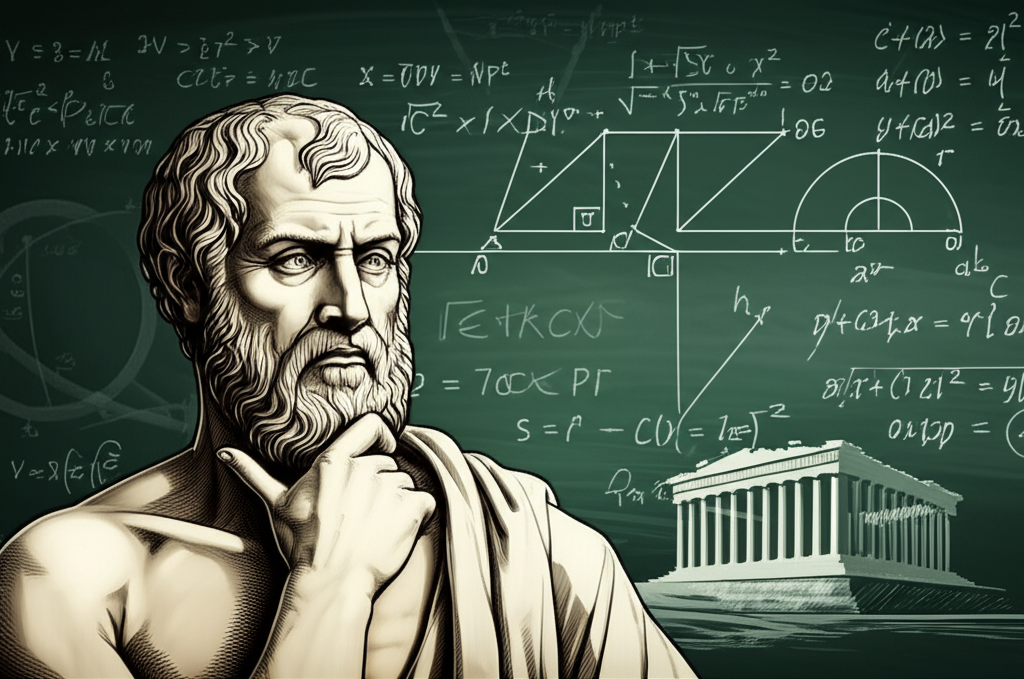
Our exploration begins in antiquity, where the roots of both philosophy and mathematics are inextricably linked. The ancient Greeks, celebrated in the Great Books of the Western World, saw mathematics not merely as a practical discipline but as a gateway to ultimate truth.
- Pythagoras and the Harmony of the Cosmos: For the Pythagoreans, "all is number." They believed that numerical ratios underpinned the harmony of music, the movements of celestial bodies, and the very fabric of existence. This was an early, profound statement on the ontological status of mathematical objects – suggesting they were not just human constructs, but fundamental constituents of reality.
- Plato's Forms and Mathematical Ideals: Plato, a towering figure in
philosophy, posited that mathematical entities (like the perfect circle or the ideal triangle) exist independently in a realm of Forms, accessible only through reason. For Plato, studyingmathematicswas a crucial step in preparing the mind to grasp these eternal, unchanging truths, thus forming the bedrock of trueknowledge. The famous inscription above the Academy, "Let no one ignorant of geometry enter here," underscores this belief. - Euclid's Elements and Axiomatic Deduction: Euclid's Elements, another cornerstone text, established the axiomatic method, demonstrating how vast systems of
knowledgecould be deduced from a few self-evident axioms. This deductive reasoning became the gold standard for certainty, influencing philosophical thought for millennia and providing a powerful model for howknowledgecould be built systematically.
The Shifting Sands of Certainty: From Renaissance to Modernity
As history progressed, mathematics continued its development, often driving scientific revolutions and prompting new philosophical questions.
- Descartes and the Quest for Unshakable Knowledge: René Descartes, seeking absolute certainty in an age of intellectual upheaval, found his foundation in
mathematics. His analytical geometry merged algebra and geometry, demonstrating the power of abstract reasoning. His method, starting from clear and distinct ideas, mirrored the deductive rigor of geometry, aiming to build a secure edifice ofknowledgeimmune to doubt. - Newton, Leibniz, and the Calculus: The independent invention of calculus by Isaac Newton and Gottfried Leibniz revolutionized our ability to understand change and motion. This powerful tool, while incredibly effective, also sparked philosophical debates about the nature of infinitesimals and the limits of human intuition, pushing the boundaries of what
mathematicscould describe and howphilosophycould interpret it.
The Foundations Crisis: When Mathematics Questioned Itself
The late 19th and early 20th centuries witnessed a profound crisis in the foundations of mathematics. Paradoxes emerged (like Russell's Paradox), shaking the once-unshakable certainty of the discipline and forcing mathematicians and philosophers to re-examine its very nature. This era gave rise to distinct schools of thought within the philosophy of mathematics:
| Philosophical School | Core Beliefs | Key Proponents |
|---|---|---|
| Platonism | Mathematical objects exist independently of human thought, in an abstract realm. Mathematics is discovered. | Kurt Gödel, G.H. Hardy |
| Formalism | Mathematics is a formal game played with symbols according to rules; truth is consistency within the system. | David Hilbert |
| Intuitionism | Mathematical objects are mental constructs; proof requires explicit construction. Rejects excluded middle. | L.E.J. Brouwer |
| Logicism | Mathematics is reducible to logic; all mathematical truths are logical truths. | Gottlob Frege, Bertrand Russell, Alfred North Whitehead |
This period represents a critical juncture where the history of mathematics became inseparable from its philosophy, as the very meaning of mathematical existence and proof came under intense scrutiny. The quest was to understand how mathematics provides knowledge and what kind of knowledge it is.
Enduring Questions in the Philosophy of Mathematics
Even today, the philosophy of mathematics grapples with fundamental questions that resonate with ancient inquiries into knowledge and reality:
- Is Mathematics Invented or Discovered? Are mathematical truths inherent features of the universe waiting to be uncovered, or are they products of human ingenuity and convention? This question goes to the heart of mathematical realism.
- The Problem of Applicability: Why is
mathematics, an abstract discipline, so incredibly effective at describing the physical world? Eugene Wigner called this "the unreasonable effectiveness of mathematics in the natural sciences," a mystery that continues to puzzle philosophers. - The Nature of Mathematical Existence: What does it mean for a number or a geometric shape to "exist"? Do they exist in the same way a chair or a tree exists, or in some other, more abstract sense?
- How Do We Acquire Mathematical Knowledge? Is mathematical
knowledgeempirical (derived from experience), or is it a priori (known independently of experience), as suggested by figures like Immanuel Kant?
The Ongoing Symphony of Knowledge
The history and philosophy of mathematics reveal a continuous dialogue between humanity's quest for logical order and its yearning for profound understanding. From the celestial harmonies of Pythagoras to the foundational debates of the 20th century, mathematics has served as a crucible for testing our ideas about truth, certainty, and the very nature of knowledge. It is a testament to the human mind's capacity to create and discover, to build intricate systems of thought that illuminate both the cosmos and our own inner workings. As long as we continue to wonder about the fabric of reality, the symphony of mathematics and philosophy will undoubtedly play on.
📹 Related Video: What is Philosophy?
Video by: The School of Life
💡 Want different videos? Search YouTube for: ""Philosophy of Mathematics: Is Math Discovered or Invented?""
📹 Related Video: KANT ON: What is Enlightenment?
Video by: The School of Life
💡 Want different videos? Search YouTube for: ""The Unreasonable Effectiveness of Mathematics Explained""