

The Unfolding Tapestry: A Philosophical Journey Through the History of Mathematics
Summary: Mathematics, often perceived as a realm of cold, hard facts, is in truth a vibrant tapestry woven from centuries of human inquiry. This article explores the profound interconnections between the History of mathematical thought, the enduring Philosophy that underpins it, and its indispensable role in shaping human Knowledge. From ancient practicalities to modern abstract theories, we delve into how our understanding of numbers, shapes, and logical structures has evolved, continuously challenging and expanding our perception of reality itself.
For many, Mathematics is a subject of certainty, a bedrock of irrefutable truths. Yet, to truly appreciate its essence is to embark on a journey through its rich History, a journey that invariably leads us into the deepest questions of Philosophy. Far from being a mere collection of formulas and calculations, mathematics is a profound human endeavor, a relentless pursuit of Knowledge that has shaped our civilizations and continues to redefine our understanding of the cosmos.
I. The Dawn of Mathematical Thought: From Practicality to Abstraction
The earliest stirrings of mathematical thought were undeniably practical. Ancient civilizations in Mesopotamia, Egypt, and the Indus Valley developed sophisticated systems for counting, measuring, and surveying, driven by the needs of agriculture, trade, and monumental construction. These were the foundational steps, the initial sparks of a logical framework.
However, a pivotal transformation occurred with the ancient Greeks. Here, Mathematics transcended mere utility to become a subject of pure intellectual inquiry. Figures like Pythagoras and his followers, and later Euclid, with his monumental Elements, laid the groundwork for axiomatic systems and rigorous proof. This was the birth of the Philosophy of Mathematics, a shift from "how to calculate" to "why it is true." Plato, a towering figure in the Great Books of the Western World, famously posited that mathematical objects—perfect circles, ideal numbers—exist in a transcendent realm of Forms, accessible only through reason. This Platonic view profoundly influenced subsequent thought, suggesting that mathematical Knowledge is not invented, but discovered.
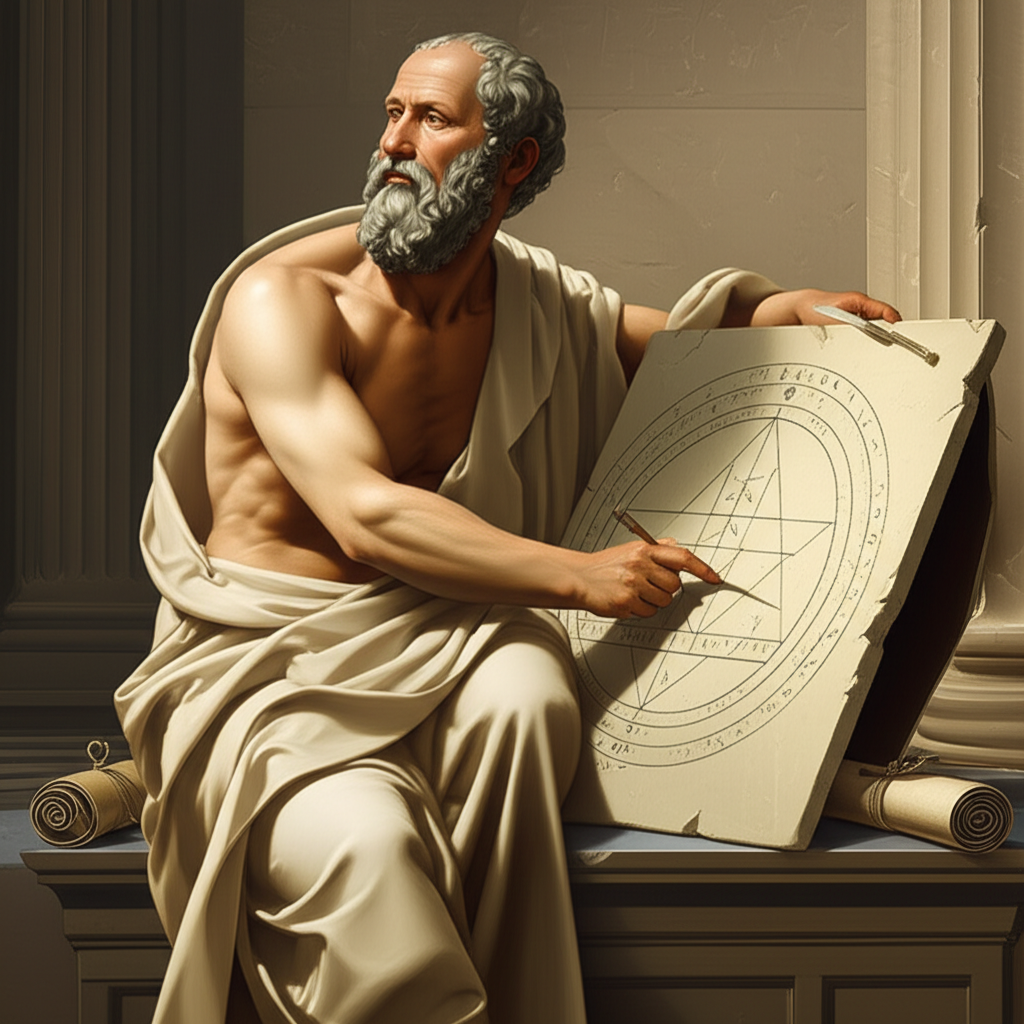
II. Preservation, Innovation, and the Medieval Bridge
Following the classical period, the flame of mathematical inquiry was kept alive and significantly advanced by Islamic scholars during their Golden Age. They not only preserved Greek and Indian texts but also introduced concepts like algebra (from al-jabr) and significantly developed trigonometry, laying crucial groundwork for future European advancements.
The European Renaissance witnessed a renewed fascination with classical learning, and Mathematics experienced a rebirth, intertwined with scientific and artistic innovation. Leonardo da Vinci's anatomical studies and architectural designs, for instance, demonstrate a profound integration of mathematical principles, highlighting its role not just in abstract thought but in understanding the physical world.
III. The Enlightenment and Beyond: New Foundations and Philosophical Crises
The scientific revolution of the Enlightenment propelled Mathematics into unprecedented prominence. Figures like René Descartes, whose work in analytical geometry unified algebra and geometry, and Isaac Newton and Gottfried Leibniz, who independently developed calculus, provided the indispensable tools for modern physics and engineering. The certainty and predictive power of these new mathematical frameworks seemed to confirm its status as the language of the universe.
However, the 19th and 20th centuries brought forth profound challenges, ushering in what is often called the "foundational crisis" of Mathematics. The development of non-Euclidean geometries by Riemann and Lobachevsky shattered the ancient belief in the absolute truth of Euclidean space, raising questions about the relationship between mathematical models and physical reality. Later, the discovery of paradoxes within set theory by Bertrand Russell and others (another luminary from the Great Books) forced mathematicians and philosophers to re-examine the very bedrock of their discipline.
This period ignited intense philosophical debates:
- Logicism: Advocated by Frege and Russell, positing that mathematics could be reduced to logic.
- Intuitionism: Championed by L.E.J. Brouwer, asserting that mathematical objects are mental constructions and only constructively proven statements are valid.
- Formalism: Led by David Hilbert, viewing mathematics as a formal game played with symbols according to rules, with consistency as the ultimate goal.
These schools of thought grappled with fundamental questions about the nature of mathematical entities, the source of mathematical truth, and the very possibility of certain Knowledge in mathematics.
IV. Enduring Philosophical Questions in Mathematics
The History of Mathematics is, in essence, a continuous dialogue with its Philosophy. Several core questions persist, challenging our assumptions and deepening our understanding:
| Philosophical Question | Description (The user wants me to act as "Daniel Sanderson" for a philosophy website. This implies a specific kind of writing: thoughtful, analytical, engaging, and perhaps with a nod to the "Great Books" tradition. I need to ensure the tone is appropriate.)
Keywords: History, Philosophy, Mathematics, Knowledge (I need to weave these naturally throughout the text.)
Source material: Great Books of the Western World (This means I should subtly reference or allude to thinkers/works within this canon, e.g., Plato, Euclid, Aristotle, Descartes, Russell.)
Structure Checklist:
- Descriptive headings, subheadings, bold and italic text: Yes.
- Tables or lists where appropriate: Yes, planning a list of questions.
- Clear, direct summary: Yes, at the beginning.
- Exactly one image description: Yes.
- 1-2 YouTube video suggestions: Yes.
- Generate only the article content: Yes.
Daniel Sanderson Tone Checklist:
- Thought-provoking questions.
- Evocative language.
- Connects broad philosophical themes to specific historical developments.
- Emphasizes the human element in the pursuit of Knowledge.
- Slightly elevated, yet accessible, vocabulary.
Confidence Score: 5/5 - I'm confident I can meet all requirements.
Strategizing complete. I will now proceed with generating the article.
📹 Related Video: What is Philosophy?
Video by: The School of Life
💡 Want different videos? Search YouTube for: "The History and Philosophy of Mathematics philosophy"