

The Enduring Dialogue: Exploring the History and Philosophy of Mathematics
Mathematics, often perceived as a realm of absolute certainty and objective truth, is, in fact, a vibrant landscape shaped by millennia of human inquiry and profound philosophical debate. This article delves into the interwoven history and philosophy of mathematics, exploring not only its evolution as a discipline but also the fundamental questions it poses about the nature of knowledge, reality, and human understanding. From ancient geometric proofs to modern foundational crises, we will trace the journey of mathematical thought and the persistent philosophical efforts to comprehend its essence and its remarkable power.
A Chronological Canvas: The Historical Arc of Mathematical Thought
The history of mathematics is a testament to humanity's innate drive to quantify, pattern, and abstract. It's a story of evolving methods, expanding domains, and revolutionary insights that continually reshape our understanding of the world.
I. Ancient Foundations: From Practicality to Pure Reason
The earliest mathematical endeavors were often rooted in practical needs: counting, measuring, and predicting.
- Mesopotamia & Egypt (c. 3000-1500 BCE): Early civilizations developed sophisticated arithmetic and geometry for administration, astronomy, and architecture. Their knowledge was largely empirical and algorithmic.
- Ancient Greece (c. 600 BCE - 300 CE): This era marked a pivotal shift. Greek mathematicians like Pythagoras, Euclid, and Archimedes transformed mathematics from a collection of practical techniques into a deductive science.
- Pythagoras (c. 570–495 BCE): Discovered the profound relationship between numbers and harmony, and the famous Pythagorean theorem, sparking early philosophical reflections on the nature of numbers.
- Plato (c. 428–348 BCE): Elevated mathematics to an ideal realm, seeing it as a path to grasping eternal, unchanging Forms. For Plato, mathematical knowledge was a recollection of these Forms, not an empirical discovery.
- Euclid (c. 325–265 BCE): His Elements codified geometry into an axiomatic-deductive system, demonstrating how vast knowledge could be derived from a few self-evident truths (axioms). This work became a paradigm for rigorous thought for over two millennia.
II. Medieval Bridges: Preservation and Innovation
Following the decline of the Western Roman Empire, mathematical progress found new homes.
- Islamic Golden Age (c. 8th-14th Centuries): Scholars in the Islamic world preserved and built upon Greek and Indian mathematics. They developed algebra (al-Khwarizmi), trigonometry, and optics, and introduced Hindu-Arabic numerals to the West, profoundly impacting computational capabilities and the very language of mathematics.
III. Renaissance to Enlightenment: New Horizons
The Scientific Revolution and Enlightenment brought unprecedented expansion.
- 16th-17th Centuries: The development of analytical geometry by René Descartes (linking algebra and geometry) and calculus by Isaac Newton and Gottfried Leibniz revolutionized problem-solving in physics and engineering. This period saw a burgeoning confidence in mathematics' ability to describe the physical universe.
- 18th Century: Leonhard Euler's prolific work expanded nearly every branch of mathematics, solidifying its role as the language of science.
IV. Modern Transformations: Rigor and Foundations
The 19th and 20th centuries witnessed an explosion of new mathematical concepts and a deep re-examination of its foundations.
- Non-Euclidean Geometries: The development of geometries that challenged Euclid's parallel postulate (e.g., by Lobachevsky and Riemann) forced mathematicians and philosophers to question the absolute truth of Euclidean geometry and the nature of space itself.
- Set Theory: Georg Cantor's work on infinite sets introduced counter-intuitive concepts and paradoxes, leading to a foundational crisis that questioned the very consistency of mathematics.
- The Foundational Crisis and Modern Logicians: This crisis spurred movements like Logicism (Frege, Russell), Formalism (Hilbert), and Intuitionism (Brouwer), each attempting to secure the foundations of mathematics and define the nature of mathematical knowledge. Kurt Gödel's incompleteness theorems (1931) profoundly impacted these debates, demonstrating inherent limits to formal axiomatic systems.
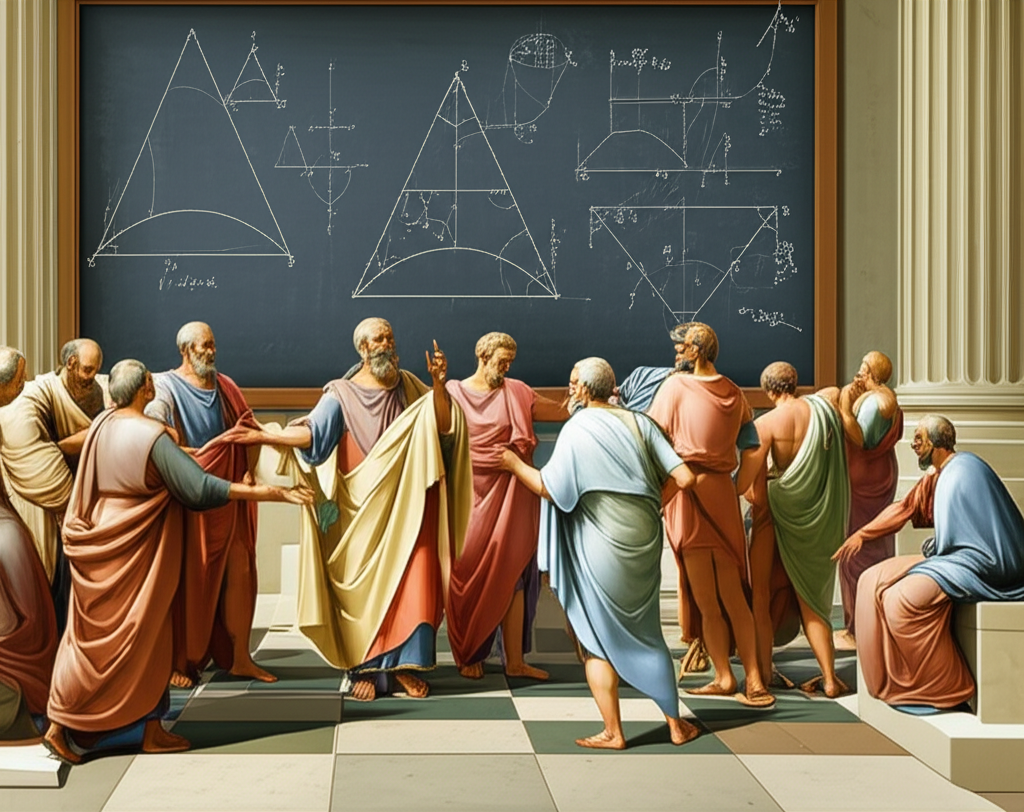
Philosophical Interrogations: The Nature of Mathematical Knowledge
The history of mathematics is inseparable from its philosophy. As mathematical concepts evolved, so too did the philosophical questions about their nature, existence, and our ability to comprehend them.
I. What is Mathematics About? Ontology of Mathematical Objects
One of the most enduring philosophical questions is the ontological status of mathematical entities. Do numbers, sets, and geometric shapes exist independently of human minds, or are they human constructions?
- Platonism/Realism: This view, championed by Plato, asserts that mathematical objects (like the number three or a perfect circle) exist independently of human thought in a non-physical, abstract realm. We don't invent them; we discover them. Mathematical knowledge is thus akin to perceiving an objective reality.
- Formalism: Developed by David Hilbert, formalism posits that mathematics is a game played with symbols according to strict rules. Mathematical statements are not about anything "real" but are merely well-formed formulas derived from axioms. The goal is consistency, not truth in an external sense.
- Intuitionism: Led by L.E.J. Brouwer, intuitionism argues that mathematical objects are mental constructions. A mathematical entity exists only if it can be constructed by the mind. This view rejects certain classical logical principles (like the law of excluded middle) when applied to infinite sets, leading to a more restrictive form of mathematics.
- Logicism: Pioneered by Gottlob Frege and later pursued by Bertrand Russell and Alfred North Whitehead (in Principia Mathematica, a work echoing the ambition of the Great Books of the Western World in its scope), logicism aimed to reduce all of mathematics to logic. The idea was that mathematical truths are ultimately logical truths, thus grounding mathematical knowledge in the certainty of logic.
II. How Do We Know Mathematical Truths? Epistemology of Mathematics
Beyond what mathematics is, lies the question of how we acquire mathematical knowledge.
- A Priori vs. A Posteriori Knowledge: Mathematical knowledge is generally considered a priori – known independently of experience. We don't need to count physical objects to know that 2+2=4.
- Analytic vs. Synthetic Judgments (Kant): Immanuel Kant, a pivotal figure in the Great Books, argued that mathematical judgments are synthetic a priori. They are a priori (independent of experience) but synthetic (their predicates add new knowledge to the subject, not merely clarify it, unlike analytic judgments like "all bachelors are unmarried"). This raised profound questions about the source of mathematical certainty.
- The Problem of Justification: How do we justify the axioms from which all mathematical knowledge is derived? Are they self-evident, conventional, or derived from intuition?
III. The Unreasonable Effectiveness of Mathematics
Eugene Wigner famously spoke of "the unreasonable effectiveness of mathematics in the natural sciences." Why do abstract mathematical structures so accurately describe the physical universe? Is it because the universe is inherently mathematical, or because our minds impose mathematical order upon it? This question continues to be a cornerstone of the philosophy of science and mathematics.
Conclusion: An Ever-Evolving Tapestry of Knowledge
The history and philosophy of mathematics reveal a discipline that is far from static. It is a dynamic human endeavor, constantly expanding its boundaries while simultaneously questioning its very foundations. From the practical calculations of ancient civilizations to the abstract wonders of modern topology and number theory, mathematics has always served as a powerful lens through which humanity seeks to understand itself and the cosmos. The ongoing dialogue between its historical development and the philosophical quest for the nature of its knowledge ensures that mathematics remains one of the most intellectually stimulating and profoundly significant fields of human inquiry.
📹 Related Video: What is Philosophy?
Video by: The School of Life
💡 Want different videos? Search YouTube for: ""philosophy of mathematics foundational crisis""
📹 Related Video: PLATO ON: The Allegory of the Cave
Video by: The School of Life
💡 Want different videos? Search YouTube for: ""Platonism vs Formalism mathematics debate""