

The Unfolding Tapestry: A Historical Journey Through the Progress of Liberty
Summary: The historical trajectory of liberty is not a smooth, linear ascent but a complex, often arduous, and perpetually unfolding process. From the nascent stirrings of self-governance in ancient city-states to the expansive declarations of individual rights in modern constitutional democracies, the concept of liberty has been continually refined, challenged, and expanded. This article will explore how our understanding and embodiment of liberty have evolved through the ages, inextricably linked with the development of law and the persistent human drive for self-determination, drawing insights from the foundational texts of Western thought.
The Ancient Echoes: Seeds of Freedom and the Rule of Law
To speak of the History of Liberty is to embark on a journey that begins not with a bang, but with a whisper in the ancient world. The notion of freedom, distinct from mere survival, first took recognizable shape within the confines of the Greek polis. Here, citizens (though a limited segment of the population) participated directly in their governance, experiencing a form of political liberty unknown to many empires of the time. Thinkers like Plato and Aristotle grappled with the ideal state, the nature of justice, and the role of the individual within the collective, laying philosophical groundwork for future discussions of freedom.
The Romans, in turn, contributed significantly through their sophisticated development of Law. Their legal codes, concepts of citizenship, and the idea of Lex Publica (public law) provided a framework that, while often hierarchical, nevertheless established principles of order, rights, and responsibilities. The Stoics, with their emphasis on universal reason and natural law, further broadened the intellectual landscape, suggesting an inherent human dignity that transcended societal constructs—a crucial precursor to later declarations of inalienable rights.
It is here, in the interplay between political participation and formalized jurisprudence, that the earliest threads of our understanding of liberty begin to weave together.
Medieval Shadows and the Glimmer of Individual Rights
The fall of Rome ushered in an era often characterized by feudal structures and the dominance of monarchical and ecclesiastical power. Yet, even within these seemingly restrictive confines, the Progress of Liberty found new avenues. The concept of natural law, inherited from the Stoics and Christian theology, asserted that certain moral principles were inherent and discoverable by reason, placing limits even on the authority of kings.
Perhaps the most iconic document from this period is the Magna Carta (1215). Though initially a compact between a king and his barons, it enshrined principles like due process and the idea that the ruler himself was subject to Law. This was a monumental step, shifting the paradigm from absolute monarchical will to a nascent constitutionalism, asserting that even the most powerful could not operate above the established legal framework. These were not yet universal liberties, but they were crucial precedents for the future assertion of individual rights against arbitrary power.
The Enlightenment's Clarion Call: Reason, Rights, and Revolution
The true blossoming of modern Liberty occurred during the Enlightenment. Philosophers like John Locke articulated the concept of natural rights—life, liberty, and property—as inherent to human beings, not granted by the state. He proposed a social contract where governments derived their legitimacy from the consent of the governed, fundamentally altering the relationship between rulers and the ruled. Jean-Jacques Rousseau explored the idea of popular sovereignty and the general will, further cementing the notion of a free people governing themselves.
This intellectual ferment directly fueled the great revolutions of the 18th century, particularly the American and French Revolutions. Their declarations—the American Declaration of Independence and the French Declaration of the Rights of Man and of the Citizen—were not merely political manifestos but profound philosophical statements asserting universal human rights and the right of a people to self-determination. They codified into Law principles that had been debated for centuries, marking a significant leap in the Progress of Liberty.
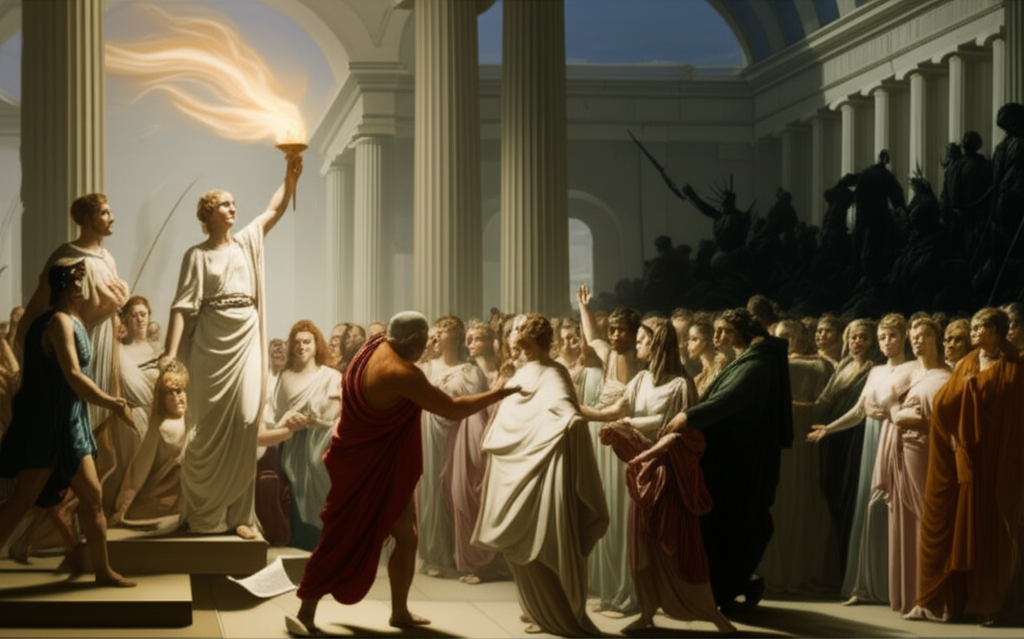
Expanding the Sphere: The Ongoing Struggle for Inclusive Liberty
The 19th and 20th centuries witnessed the continuous, often violent, struggle to extend the reach of Liberty to all. The abolitionist movements challenged the very notion of human ownership, arguing for the inherent freedom of every individual. The suffrage movements fought for political equality, demanding that women, too, be recognized as full citizens with the right to vote. The civil rights movements of the 20th century, particularly in the United States, confronted systemic discrimination and fought for equal protection under the Law for marginalized communities.
This period demonstrates that the Progress of Liberty is rarely a finished project. It requires constant vigilance, re-evaluation, and the willingness to challenge existing structures that limit freedom. The evolution of Law during these eras reflects this ongoing expansion, with new legislation and constitutional interpretations striving to align societal practices with the ideal of universal liberty.
Key Milestones in the Progress of Liberty
| Era/Event | Key Contribution to Liberty | Connection to Law |
|---|---|---|
| Ancient Greece | Concept of citizenship, direct democracy (for some) | Early forms of constitutional practice, juries |
| Roman Republic | Lex Publica, rights for citizens, Stoic natural law | Codified law, legal precedents |
| Magna Carta (1215) | Limits on monarchical power, due process | Foundation of constitutional Law |
| Enlightenment Era | Natural rights, social contract, popular sovereignty | Constitutions, bills of rights, codified Law |
| 19th/20th Century | Abolition of slavery, women's suffrage, civil rights | Legislative reform, international Law, constitutional amendments |
The Unfinished Symphony: Liberty in the Modern Age
Today, the discussion around Liberty continues to evolve. We grapple with questions of digital freedom, privacy in an interconnected world, economic liberty, and the balance between individual rights and collective security. The lessons of History teach us that Progress is not inevitable; it is the result of persistent effort, critical thought, and the courage to challenge injustice.
The Great Books of the Western World serve as a profound testament to this enduring human quest. From the dialogues of Plato to the treatises of Locke and Mill, they offer a rich tapestry of ideas, debates, and struggles that have shaped our understanding of what it means to be free. The relationship between Liberty and Law remains central: Law can be an instrument of oppression, but it is also the indispensable framework through which liberty is defined, protected, and expanded. The historical Progress of Liberty is, in essence, the story of humanity's ongoing endeavor to create societies where individual flourishing is not just an ideal, but a lived reality, secured by just laws.
YouTube Suggestions:
-
📹 Related Video: ARISTOTLE ON: The Nicomachean Ethics
Video by: The School of Life
💡 Want different videos? Search YouTube for: ""John Locke Two Treatises of Government Explained""
2. ## 📹 Related Video: ARISTOTLE ON: The Nicomachean Ethics
Video by: The School of Life
💡 Want different videos? Search YouTube for: ""History of Civil Rights Movement Documentary""