

The Historical Progress of Human Knowledge
From the earliest attempts to make sense of the cosmos to the intricate scientific theories of today, the history of human knowledge is a testament to an unyielding drive for understanding. This article explores the evolution of our collective knowledge, tracing its progress through pivotal intellectual epochs, highlighting how each era built upon the last, leading to an ever-expanding comprehension of ourselves and the universe.
The very act of being human seems inextricably linked to the pursuit of knowledge. We are, after all, creatures who question, who observe, who seek patterns and meaning. To reflect on the historical progress of human understanding is to embark on a journey through the intellectual landscapes of millennia, witnessing the remarkable evolution of thought that has shaped civilizations and continues to redefine our place in the cosmos. It is a narrative woven with threads of curiosity, discovery, and the relentless refinement of ideas, a story beautifully encapsulated within the volumes of the Great Books of the Western World.
From Mythos to Logos: The Dawn of Inquiry
For much of early human history, explanations for the world around us were rooted in myth, divine intervention, and oral traditions. These narratives, while rich in cultural significance, often served to explain the inexplicable rather than to systematically understand it.
The true progress towards what we recognize as systematic knowledge began with the ancient Greeks. Here, thinkers like Thales, Anaximander, and Heraclitus started to seek naturalistic explanations for phenomena, moving away from purely mythological accounts. This intellectual shift culminated in the profound philosophical inquiries of Socrates, Plato, and Aristotle, whose works form the bedrock of Western thought.
- The birth of systematic inquiry: Instead of simply accepting divine explanations, these philosophers began to apply reason and observation.
- Socrates' enduring challenge: "The unexamined life is not worth living," spurred generations to critical self-reflection.
- Key shifts in knowledge acquisition:
- Transition from supernatural explanations to naturalistic observation.
- Development of formal logic and rhetorical argumentation.
- Laying the foundational categories for ethics, politics, metaphysics, and epistemology.
The Medieval Crucible: Preservation and Scholasticism
Following the decline of the Roman Empire, much of the classical knowledge of antiquity was preserved, painstakingly copied, and studied within monastic institutions. This period, often mischaracterized as intellectually stagnant, was in fact a crucial era of synthesis and preservation.
Scholasticism, a dominant intellectual tradition of the Middle Ages, sought to reconcile classical philosophy, particularly Aristotelian thought, with Christian theology. Figures like Augustine of Hippo and Thomas Aquinas undertook monumental efforts to demonstrate the compatibility of faith and reason, enriching both domains.
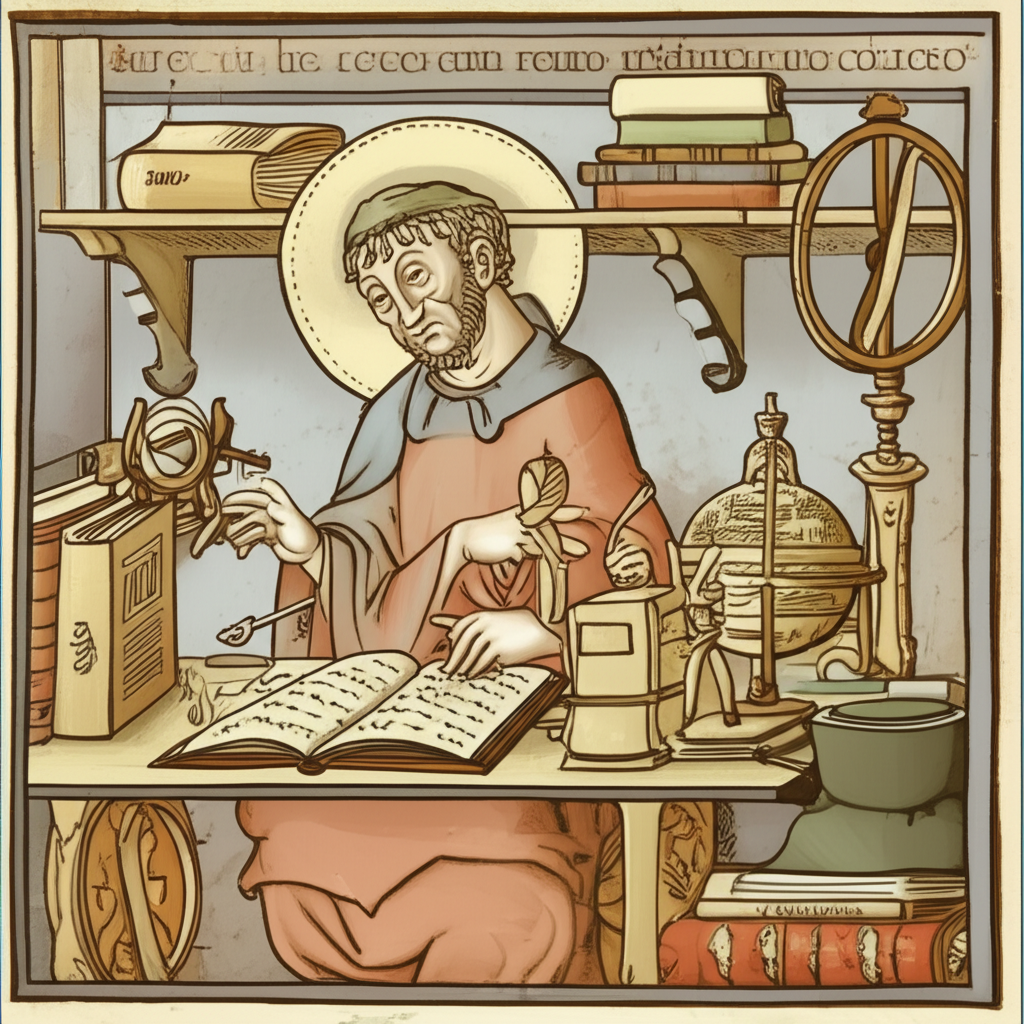
- The synthesis of faith and reason: Scholastic thinkers believed that true knowledge could not contradict divine revelation and that reason could illuminate theological truths.
- Universities emerged as centers of learning, fostering rigorous debate and intellectual progress.
- Despite theological constraints, this era saw significant advancements in logic and systematic argumentation, ensuring the evolution of intellectual tools.
The Renaissance and the Scientific Revolution: A Paradigm Shift
The Renaissance marked a "rebirth" of classical learning and an increasing focus on human potential and achievement. This cultural awakening laid the groundwork for one of the most transformative periods in the history of knowledge: the Scientific Revolution.
Beginning in the 16th century, thinkers like Nicolaus Copernicus, Galileo Galilei, Johannes Kepler, and Isaac Newton revolutionized our understanding of the natural world. They emphasized empirical observation, experimentation, and mathematical reasoning, moving away from purely deductive or authority-based knowledge.
- The empirical turn and the rise of the scientific method: This period saw a fundamental shift in how knowledge was acquired and validated.
- Newton's universal law: "To every action there is always an equal and opposite reaction" exemplified the power of mathematical laws to describe the cosmos.
| Era | Primary Mode of Knowledge Acquisition | Key Figures/Concepts |
|---|---|---|
| Ancient Greece | Rational argument, observation | Plato, Aristotle, Logic |
| Medieval Period | Revelation, Scholastic reasoning | Aquinas, Augustine, Theology |
| Scientific Rev. | Experimentation, Mathematical proof | Galileo, Newton, Empiricism |
This era fundamentally reshaped the landscape of knowledge, leading to unprecedented progress in astronomy, physics, and medicine.
The Enlightenment and Beyond: Reason, Progress, and Specialization
The success of the Scientific Revolution fueled the Enlightenment, an intellectual and philosophical movement that championed reason, individualism, and skepticism. Philosophers like John Locke, Immanuel Kant, and Voltaire advocated for human rights, democratic governance, and the pursuit of universal truths through rational inquiry.
The progress of knowledge during this period led to significant societal changes, including the Industrial Revolution, and a growing belief in humanity's capacity for self-improvement. As scientific disciplines matured, they began to specialize, leading to deeper, more focused investigations into specific domains. This evolution of inquiry, however, also presented new philosophical challenges, explored by later movements like existentialism and postmodernism, which questioned the very foundations of objective knowledge and grand narratives of progress.
- The democratization of knowledge and the pursuit of universal truths: Reason was seen as accessible to all, not just an elite few.
- The evolution of scientific disciplines led to the development of specialized fields like chemistry, biology, and geology.
The Contemporary Landscape: Interconnectedness and the Digital Age
The 20th and 21st centuries have witnessed an exponential acceleration in the progress of human knowledge. From breakthroughs in genetics and quantum physics to the advent of artificial intelligence and global communication networks, our capacity to understand and manipulate the world has expanded dramatically.
The digital age has fundamentally altered how knowledge is created, disseminated, and accessed. Global collaboration, open-source initiatives, and vast digital libraries have made information more readily available than ever before, fostering new forms of intellectual evolution. Yet, this abundance also brings challenges, including the need for critical evaluation and the philosophical questions surrounding data, privacy, and the nature of consciousness in an increasingly technological world.
- The exponential growth and interconnectedness of knowledge: Information now flows globally, fostering unprecedented interdisciplinary research.
- New frontiers in knowledge continually emerge, pushing the boundaries of human understanding in ethics, technology, and our place in the universe.
Conclusion
The historical progress of human knowledge is not a linear march but a dynamic, often circuitous evolution, marked by periods of profound insight, challenging revision, and continuous expansion. From the rudimentary observations of ancient stargazers to the complex models of quantum mechanics, our collective understanding has grown exponentially. Yet, as we stand at the precipice of new discoveries, one thing remains clear: the quest for knowledge is an inherently human endeavor, a perpetual journey that promises ever more profound insights into the mysteries that surround us and lie within.
Further Exploration:
-
📹 Related Video: What is Philosophy?
Video by: The School of Life
💡 Want different videos? Search YouTube for: ""History of Western Philosophy animated summary""
-
📹 Related Video: PLATO ON: The Allegory of the Cave
Video by: The School of Life
💡 Want different videos? Search YouTube for: ""The Scientific Revolution explained in 5 minutes""