

The Unfolding Tapestry: A Philosophical Journey Through the Historical Progress of Human Knowledge
The journey of human understanding is a magnificent, complex narrative, a testament to our insatiable curiosity and our relentless drive to make sense of the cosmos and our place within it. This article embarks on a philosophical exploration of the historical progress of human knowledge, tracing its evolution from rudimentary observations to the intricate scientific and philosophical frameworks we possess today. Far from a linear march, this progress has been a winding path, marked by profound insights, paradigm shifts, and often, the rediscovery of forgotten wisdom. We will delve into how different eras have shaped our collective understanding, demonstrating that knowledge is not a static entity, but a vibrant, ever-evolving process woven into the very fabric of human history.
Echoes from Antiquity: Laying the Cornerstone of Inquiry
Our quest for knowledge finds its earliest systematic expressions in the ancient world, particularly with the foundational thinkers whose works are immortalized in collections like the Great Books of the Western World. Here, we encounter the very genesis of philosophical inquiry. The pre-Socratics grappled with the fundamental nature of reality, while Socrates, through his relentless questioning, laid the groundwork for critical self-examination and ethical reasoning.
Plato, with his theory of Forms, posited an ideal realm of perfect, unchanging knowledge, accessible through reason rather than sensory experience. His student, Aristotle, took a different path, emphasizing empirical observation and logical deduction. His vast contributions to logic, ethics, politics, biology, and metaphysics demonstrated an early, systematic approach to categorizing and understanding the world. These ancient Greek efforts represent a profound leap, moving beyond myth to establish rational frameworks for acquiring and organizing knowledge, setting the stage for millennia of intellectual progress.
The Medieval Crucible: Faith, Reason, and Scholastic Synthesis
Following the classical era, the medieval period, often mischaracterized as a "dark age," was in fact a crucial crucible for the evolution of knowledge. While deeply intertwined with theological concerns, scholars of this era meticulously preserved, translated, and commented upon ancient texts, including those of Aristotle, ensuring their survival. The rise of scholasticism, particularly in the burgeoning universities, saw thinkers like Thomas Aquinas striving to synthesize faith and reason.
This period witnessed significant progress in logic, metaphysics, and natural philosophy. The scholastic method, with its rigorous disputations and systematic argumentation, honed intellectual tools that would prove indispensable for future advancements. It was a time of consolidation and deep reflection, laying the groundwork for the intellectual explosions that would follow.
A New Dawn: Renaissance, Revolution, and the Birth of Modern Science
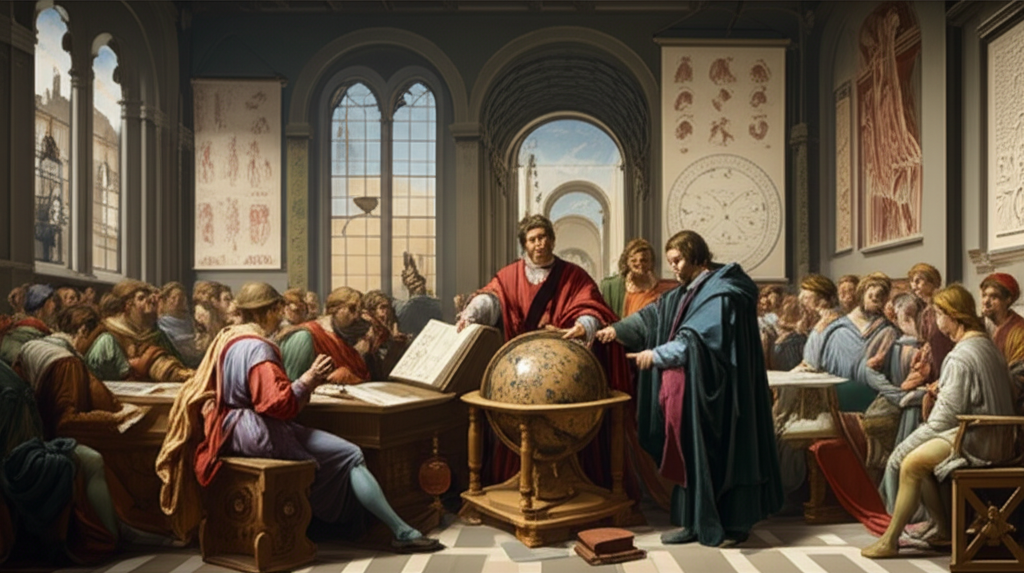
The Renaissance marked a profound shift, a "rebirth" of classical learning that rekindled a spirit of humanism and individual inquiry. This intellectual ferment paved the way for the Scientific Revolution, a period of unprecedented progress that fundamentally altered how we acquire knowledge. Figures like Nicolaus Copernicus challenged geocentric dogma, while Galileo Galilei's telescopic observations provided empirical evidence that shook the foundations of established cosmology.
Francis Bacon championed the inductive method, emphasizing observation and experimentation over pure deduction, a cornerstone of modern scientific inquiry. René Descartes, with his radical skepticism and "I think, therefore I am," sought to establish a new foundation for certainty in knowledge. Isaac Newton's laws of motion and universal gravitation provided a comprehensive, mechanistic understanding of the physical world, epitomizing the era's ambition to discover universal laws through reason and empirical data. This period represents a dramatic evolution in the methodology and scope of human knowledge.
The Enlightenment's Illumination: Reason, Rights, and the Pursuit of Truth
The 18th century, known as the Enlightenment, was an age profoundly dedicated to the progress of reason and individual liberty. Philosophers like John Locke, Jean-Jacques Rousseau, and Montesquieu critically examined political structures, advocating for natural rights, social contracts, and separation of powers, significantly advancing our knowledge of governance and human society. Immanuel Kant's critical philosophy explored the limits and structures of human understanding itself, profoundly influencing epistemology and metaphysics.
The Enlightenment belief in the power of human reason to solve societal problems and unveil natural laws fueled an optimistic view of progress. Encyclopedists like Diderot aimed to compile all human knowledge, reflecting a profound faith in the systematic accumulation and dissemination of information. This era solidified the idea that knowledge was a tool for human emancipation and societal betterment.
The Modern Labyrinth: Specialization, Skepticism, and the Ever-Evolving Frontier
The 19th and 20th centuries witnessed an explosion in the specialization of knowledge. Fields previously intertwined began to diverge, leading to deeper insights within specific domains. Darwin's theory of evolution revolutionized biology, Freud unveiled the complexities of the unconscious mind, and Einstein's theories of relativity fundamentally reshaped our understanding of space, time, and gravity.
However, this period also brought challenges to the notion of objective truth and unilinear progress. Philosophers like Nietzsche questioned traditional values, while postmodern thinkers highlighted the subjective and culturally constructed nature of knowledge. Despite these critical self-examinations, the evolution of knowledge continued unabated, driven by technological advancements and global interconnectedness. The digital age has accelerated the pace of information exchange, leading to unprecedented opportunities and challenges in managing and validating knowledge.
The Nature of Progress: A Winding Path, Not a Straight Line
The history of human knowledge is not a simple ascent up a ladder of ever-increasing certainty. Instead, it resembles a complex, branching tree, with periods of rapid growth, pruning, and even the occasional dead end.
Key Aspects of Knowledge Progress:
- Cumulative Growth: Often, new knowledge builds upon previous discoveries, refining or expanding existing theories.
- Paradigm Shifts: Sometimes, entirely new frameworks emerge that fundamentally alter our understanding, rendering old theories obsolete (e.g., the shift from Newtonian to relativistic physics).
- Rediscovery and Reinterpretation: Lost knowledge can be rediscovered, or old ideas can be reinterpreted in new contexts, gaining fresh relevance.
- Dialectical Advance: Philosophical progress often occurs through a dialectical process of thesis, antithesis, and synthesis, where opposing ideas clash and lead to a more nuanced understanding.
- Technological Enablement: New tools and technologies (telescopes, microscopes, computers) have consistently expanded our capacity to observe, measure, and analyze, thereby accelerating knowledge acquisition.
While we can point to undeniable advancements in our understanding of the natural world and human society, the concept of progress in philosophy itself remains a topic of debate. Are we "better" philosophers than the ancients, or merely engaged in an ongoing conversation with different tools and perspectives? This question underscores the enduring, dynamic nature of the philosophical quest.
Conclusion: The Enduring Quest for Understanding
The historical progress of human knowledge is a magnificent testament to the enduring human spirit of inquiry. From the earliest philosophical ponderings to the intricate scientific models of today, our collective understanding has undergone a continuous evolution. It is a journey marked by both brilliant insights and humbling setbacks, a testament to the fact that knowledge is never truly complete, but always in a state of becoming. As Emily Fletcher, I find profound beauty in this unfolding tapestry, reminding us that the pursuit of wisdom is not a destination, but an eternal, exhilarating voyage. The history of our knowledge is, in essence, the history of what it means to be human—a creature forever reaching beyond the known, driven by the profound desire to understand.
YouTube Suggestions:
-
📹 Related Video: What is Philosophy?
Video by: The School of Life
💡 Want different videos? Search YouTube for: "The School of Life History of Philosophy"
2. ## 📹 Related Video: What is Philosophy?
Video by: The School of Life
💡 Want different videos? Search YouTube for: "CrashCourse Philosophy Epistemology"