

The Unfolding Tapestry: A Philosophical Journey Through the Historical Progress of Human Knowledge
The story of humanity is inextricably linked to the evolution of its understanding. From the earliest whispers of curiosity to the complex algorithms of the modern age, the historical progress of human knowledge stands as our most enduring testament to the boundless capacity for inquiry. This article embarks on a philosophical journey through the ages, tracing how our collective comprehension of the cosmos, ourselves, and our societies has not merely accumulated but fundamentally transformed, building upon the insights of preceding generations. It is a narrative of continuous intellectual progress, marked by paradigm shifts, revolutionary discoveries, and the persistent human drive to illuminate the unknown.
The Ancient Seeds of Inquiry: Laying the Foundations of Reason
Our journey into the history of knowledge begins not with definitive answers, but with profound questions. The earliest civilizations, while rich in practical skills and mythic narratives, laid crucial groundwork for systematic thought.
From Mythos to Logos: Early Philosophical Stirrings
The true turning point, often highlighted in the Great Books of the Western World, emerged with the ancient Greeks. Thinkers like Thales, Anaximander, and Heraclitus dared to seek natural explanations for natural phenomena, moving beyond purely supernatural accounts. This shift from mythos to logos—from storytelling to rational discourse—was revolutionary. Plato, with his theory of Forms, challenged us to distinguish between appearance and reality, while his student Aristotle meticulously categorized and analyzed the natural world, laying the groundwork for logic, biology, and ethics. Their contributions underscore that progress in knowledge isn't just about collecting facts, but about developing robust methods of inquiry.
Medieval Bridges and Scholastic Consolidation: Preserving and Reinterpreting
Following the classical era, the medieval period, often mischaracterized as a "dark age," played a vital role in the preservation and reinterpretation of ancient knowledge.
The Monastic Scribes and Islamic Scholars
While much of Europe grappled with political fragmentation, monastic institutions painstakingly copied and preserved classical texts. Simultaneously, Islamic scholars in centers like Baghdad and Cordoba not only safeguarded Greek and Roman works but also enriched them with their own advancements in mathematics, astronomy, medicine, and optics. Figures like Avicenna and Averroes, whose works found their way back into European thought, were instrumental in bridging the gap and ensuring the continuity of intellectual evolution. This cross-cultural exchange was crucial for the eventual resurgence of learning.
Scholasticism: A Synthesis of Faith and Reason
The later medieval period saw the rise of Scholasticism, exemplified by Thomas Aquinas. Drawing heavily from Aristotle, Aquinas sought to reconcile faith with reason, demonstrating that theological truths and philosophical inquiry could coexist and even complement each other. This intellectual endeavor, though often confined to theological frameworks, refined logical argumentation and systematic thought, further contributing to the progress of structured knowledge.
The Renaissance and the Dawn of Modern Science: A Rebirth of Curiosity and Empirical Methods
The Renaissance marked a profound shift, rekindling an intense interest in classical learning while simultaneously fostering a new spirit of humanism and empirical observation.
Breaking Free: Observation, Experimentation, and the Scientific Method
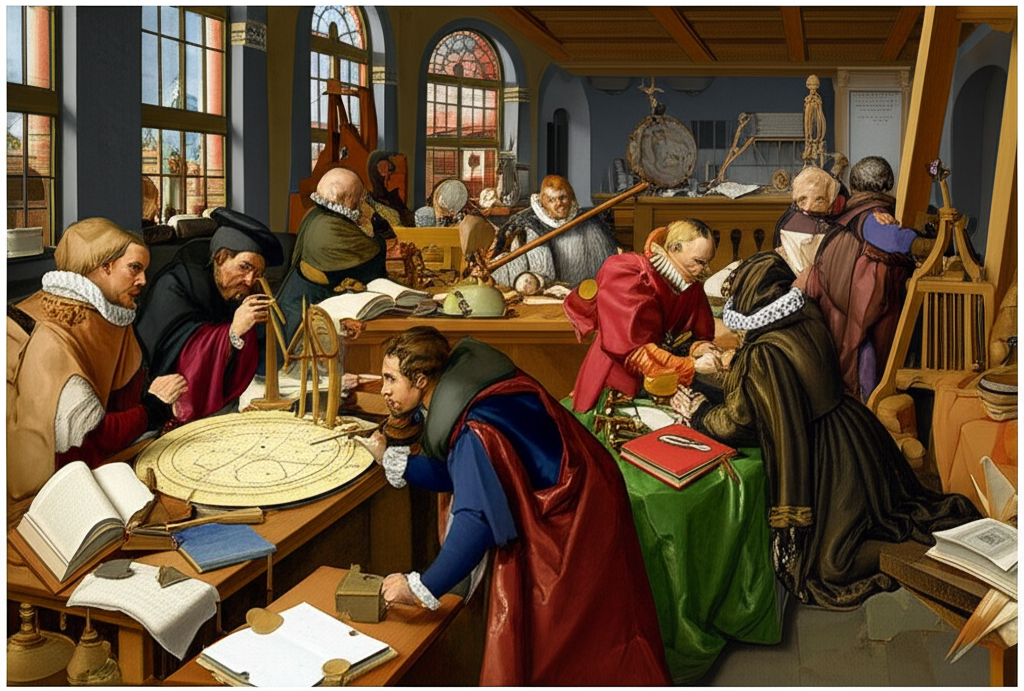
This era witnessed a fundamental reorientation in how knowledge was acquired. Figures like Francis Bacon championed inductive reasoning and the systematic collection of data, advocating for an empirical approach that would become the bedrock of modern science. Nicolaus Copernicus, Galileo Galilei, and Johannes Kepler challenged geocentric dogma with heliocentric models, demonstrating the power of observation and mathematical reasoning to overturn long-held beliefs. René Descartes, another pillar of the Great Books, sought to build knowledge on an unshakeable foundation of rational doubt, emphasizing the power of human reason. This period firmly established that genuine progress in understanding the natural world depended on testable hypotheses and verifiable evidence.
Enlightenment's Illumination: Systematization and Social Impact
The Enlightenment built upon the scientific revolution, extending the principles of reason and empirical inquiry to human society, politics, and ethics.
Reason, Revolution, and the Expansion of Human Understanding
Isaac Newton's monumental work, providing a unified theory of gravity and motion, became a symbol of reason's power to unravel the universe's mysteries. Philosophers like John Locke and Jean-Jacques Rousseau applied rational thought to governance, articulating ideas of natural rights and social contracts that fueled political revolutions and fundamentally altered the evolution of political knowledge. Immanuel Kant, another giant from the Great Books, critically examined the limits and scope of human reason itself, forever changing epistemology. The French Encyclopédistes, led by Diderot and d'Alembert, sought to compile all human knowledge into a single, accessible work, underscoring the era's belief in the power of disseminated information for societal progress.
The Ever-Evolving Landscape of Contemporary Knowledge: From Specialization to Interconnectedness
The 19th and 20th centuries witnessed an unprecedented explosion of knowledge, leading to specialization across countless scientific and academic disciplines. The 21st century continues this trend, amplified by digital technologies and global interconnectedness.
Accelerated Discovery and the Global Brain
From Einstein's theories of relativity to the mapping of the human genome, from the development of quantum mechanics to the rise of artificial intelligence, the pace of discovery has accelerated exponentially. The internet and digital information have democratized access to knowledge, creating a global "brain" where information flows almost instantaneously. This constant evolution presents new challenges, such as information overload and the need for critical discernment, but it also offers unparalleled opportunities for collaborative progress and interdisciplinary insights.
Here's a brief overview of key shifts in the acquisition and dissemination of knowledge:
- Oral Tradition: Early human societies primarily transmitted knowledge through storytelling, proverbs, and direct instruction, relying heavily on memory.
- Written Script: The invention of writing systems (cuneiform, hieroglyphs, alphabets) allowed for knowledge to be recorded, preserved, and disseminated across time and space, independent of individual memory.
- Manuscript Culture: Scribes meticulously copied texts, making knowledge rare and often confined to elites, monasteries, and scholarly centers.
- Printing Press: Gutenberg's invention revolutionized knowledge dissemination, enabling mass production of books, democratizing access, and fueling literacy and scientific exchange.
- Scientific Method: The formalization of empirical observation, experimentation, and peer review established a rigorous framework for generating reliable knowledge.
- Digital Information & Internet: The advent of computers and the internet has created an unprecedented global repository of information, enabling instant access, rapid collaboration, and new forms of data analysis.
The historical progress of human knowledge is not a linear march but a dynamic, often circuitous, and always awe-inspiring journey. It is a testament to our enduring curiosity, our capacity for reason, and our collective commitment to understanding the world and our place within it. As we continue to push the boundaries of what is known, we stand on the shoulders of countless thinkers, forever engaged in the grand project of intellectual evolution.
📹 Related Video: What is Philosophy?
Video by: The School of Life
💡 Want different videos? Search YouTube for: ""History of Philosophy from Thales to Foucault""
📹 Related Video: KANT ON: What is Enlightenment?
Video by: The School of Life
💡 Want different videos? Search YouTube for: ""The Scientific Revolution: Crash Course History of Science #13""