

The Unfolding Tapestry: Tracing the Historical Progress of Human Knowledge
The journey of human knowledge is not a simple, linear ascent but a complex, winding path, marked by profound insights, periods of stagnation, and revolutionary leaps. This article explores the historical progress of human knowledge, examining how our understanding of the world has undergone a continuous evolution from ancient inquiries to the present day. We will see that this progress is less about a steady march forward and more about a dynamic process of questioning, re-evaluating, and building upon the intellectual foundations laid by countless thinkers throughout history, often drawing from the very core texts compiled in the Great Books of the Western World.
Ancient Seeds of Inquiry: The Birth of Philosophy and Science
The earliest stirrings of systematic knowledge in the Western tradition can be traced to the ancient Greeks. Before them, understanding was often mythological or practical, but with figures like Thales, Anaximander, and later, the titans of classical thought—Socrates, Plato, and Aristotle—a new mode of inquiry emerged. This period saw the birth of philosophy as a distinct discipline, dedicated to reasoned argumentation and the pursuit of truth.
- Plato's Forms: Through dialogues like The Republic, Plato introduced the concept of eternal, unchanging Forms, suggesting a reality beyond sensory perception. His academy was a crucible for intellectual debate, setting a precedent for systematic philosophical schooling.
- Aristotle's Empiricism: Aristotle, a student of Plato, diverged significantly by emphasizing observation and classification. His works, spanning logic, ethics, politics, metaphysics, and natural science, provided the foundational categories and methods that would dominate Western thought for nearly two millennia. His meticulous approach to categorizing phenomena, from species to forms of government, represents an early, profound step in the evolution of systematic knowledge.
This era laid the essential groundwork, establishing the very questions and methodologies that would shape subsequent progress. The commitment to rational inquiry, evident in these early philosophers, was a monumental shift in human intellectual history.
Medieval Preservation and Scholastic Synthesis
Following the decline of the Roman Empire, much of classical knowledge was preserved and reinterpreted within the framework of Christian theology. The medieval period, often mischaracterized as a "dark age," was in fact a crucial era for the consolidation and transmission of learning.
Key Contributions:
- Monastic Scribes: Monasteries became centers of learning, diligently copying and preserving ancient texts. Without their painstaking efforts, much of the classical heritage, including the Great Books, might have been lost forever.
- Scholasticism: Thinkers like Thomas Aquinas, drawing heavily on Aristotle, sought to synthesize faith and reason. In his Summa Theologica, Aquinas demonstrated a rigorous logical approach to theological and philosophical questions, pushing the boundaries of systematic thought and showing how existing knowledge could be integrated into new frameworks.
- University System: The establishment of universities across Europe provided structured environments for the pursuit of knowledge, fostering intellectual communities and debates that would eventually lead to new forms of inquiry.
This era, while not always marked by radical new discoveries in the modern sense, was vital for the history of knowledge as it ensured continuity and prepared the ground for future intellectual explosions.
The Renaissance and the Great Unveiling: A New Dawn for Understanding
The Renaissance marked a profound shift, rekindling interest in classical antiquity and placing renewed emphasis on human potential and achievement. This period, roughly from the 14th to the 17th century, ignited a rapid acceleration in the progress of knowledge.
| Era | Primary Mode of Inquiry | Key Philosophical Shift | Impact on Knowledge |
|---|---|---|---|
| Ancient Greece | Rational Speculation, Observation | From Mythos to Logos; Birth of Systematic Philosophy | Foundation of Logic, Ethics, Metaphysics, Early Science |
| Medieval Period | Theological Reasoning, Commentary | Synthesis of Faith and Reason; Preservation of Classics | Development of Scholasticism, University System |
| Renaissance | Humanism, Artistic Expression | Re-evaluation of Human Role; Revival of Classical Texts | Artistic Innovation, Early Scientific Inquiry, Exploration |
| Scientific Rev. | Empirical Observation, Experiment | Challenge to Authority; Rise of Modern Scientific Method | Breakthroughs in Astronomy, Physics, Medicine; New Epistemology |
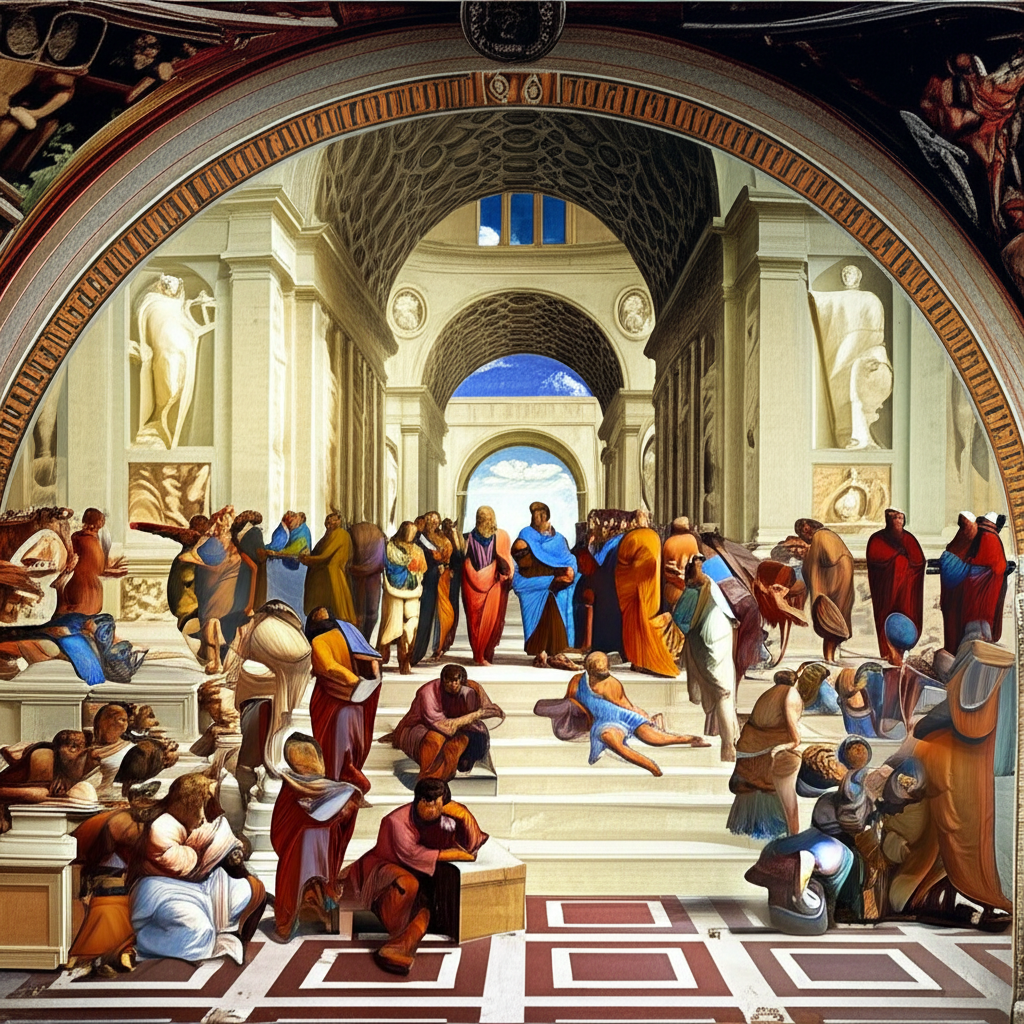
The Scientific Revolution, an integral part of this broader awakening, fundamentally altered humanity's approach to understanding the natural world. Figures like Nicolaus Copernicus, Galileo Galilei, Johannes Kepler, and Isaac Newton revolutionized astronomy and physics. Francis Bacon advocated for empirical methods, emphasizing observation and experimentation over pure deduction, thereby charting a new course for the evolution of scientific knowledge. Descartes, with his famous "Cogito, ergo sum," laid the groundwork for modern rationalism, questioning all prior assumptions and building knowledge from a foundation of certainty.
Enlightenment's Torch: Reason, Rights, and Revolution in Thought
The 18th century, known as the Enlightenment, saw the principles of reason and empiricism applied to human society itself. Philosophers like John Locke, Jean-Jacques Rousseau, and Immanuel Kant profoundly influenced political theory, ethics, and epistemology.
- Political Philosophy: Locke's ideas on natural rights and social contract theory (found in his Two Treatises of Government) were foundational to modern democracy and revolutions in America and France, representing a significant progress in understanding governance.
- Epistemology: Kant, in his Critique of Pure Reason, wrestled with the limits and scope of human knowledge, attempting to reconcile rationalism and empiricism. His work profoundly shaped subsequent philosophical inquiry.
- Dissemination of Knowledge: The Enlightenment also saw an explosion in literacy and the publication of encyclopedias, democratizing access to knowledge and fostering a critical, informed public. This period truly accelerated the evolution of public discourse and collective understanding.
The Modern Epoch: Accelerating Specialization and the Digital Age
The 19th and 20th centuries witnessed an unprecedented acceleration in the progress of knowledge, driven by industrialization, technological innovation, and scientific specialization. From Darwin's theory of evolution to Einstein's relativity, from quantum mechanics to the decoding of the human genome, the sheer volume and depth of new knowledge have been astounding.
The digital age, characterized by the internet and vast computing power, has further transformed how knowledge is created, stored, and accessed. Information is now globally interconnected, leading to collaborative research on an unprecedented scale. However, this rapid expansion also presents challenges, such as information overload and the need for critical evaluation of sources. The evolution of knowledge is now inextricably linked to our technological capabilities.
Navigating the Labyrinth: The Nuances of Progress and Evolution
While we speak of the "progress" of knowledge, it's important to acknowledge its complex and often non-linear nature.
- Cyclical Nature: Sometimes, old ideas are revisited and reinterpreted with new tools or perspectives, demonstrating that history is not always a clean break.
- Forgotten Knowledge: Entire bodies of knowledge have been lost or suppressed, only to be rediscovered centuries later.
- Subjectivity and Bias: The pursuit of knowledge is always influenced by the cultural, social, and political contexts of its time. What is considered "progress" can be subjective.
The evolution of human knowledge is a continuous, iterative process. It's about building, questioning, and rebuilding, always striving for a more comprehensive and accurate understanding of ourselves and the cosmos. The Great Books of the Western World stand as a testament to this enduring human endeavor, offering a dialogue across centuries that continues to inform our present and inspire our future progress.
📹 Related Video: What is Philosophy?
Video by: The School of Life
💡 Want different videos? Search YouTube for: ""History of Philosophy Explained" or "Key Concepts in Epistemology""