

The Unfolding Tapestry: A Historical Evolution of Government Forms
The history of human societies is inextricably linked to the evolution of their governing structures. From the rudimentary organization of early tribes to the complex systems of modern nation-states, the form of government has been in a constant state of flux, reflecting humanity's perpetual quest for order, justice, and effective collective action. This article delves into the profound change witnessed across millennia, exploring how different political frameworks have emerged, transformed, and often collapsed, leaving behind a rich legacy of philosophical inquiry and practical experimentation.
The Enduring Question of Governance: A Philosophical Journey
Since the dawn of organized communities, humanity has grappled with fundamental questions: Who should rule? How should decisions be made? What constitutes legitimate authority? These inquiries, central to philosophical thought throughout the ages, have driven the diverse evolution of government forms. Far from being static entities, these structures are living organisms, adapting, mutating, and often dramatically transforming under the pressures of social, economic, and technological change. Our journey through this history reveals not a linear progression, but a cyclical and often unpredictable unfolding of political possibilities, as eloquently explored by the great thinkers whose works comprise the Great Books of the Western World.
From Kinship to Kingship: The Earliest Forms
The earliest forms of human organization were likely based on kinship, with leadership emerging from elders or powerful individuals within families or tribes. This initial stage, characterized by informal rules and customary law, laid the groundwork for more formalized structures.
- Tribal Councils: Decisions made by consensus or the authority of respected elders.
- Chiefdoms: The consolidation of power into a single individual, often based on charisma, military prowess, or spiritual authority.
- Emergence of Monarchy: As societies grew in complexity and scale, the hereditary transmission of power became a common mechanism for maintaining order, leading to the establishment of kingships and empires. This marked a significant change from decentralized power to centralized rule, often justified by divine right.
The Classical Age: Plato, Aristotle, and the Cycles of Change
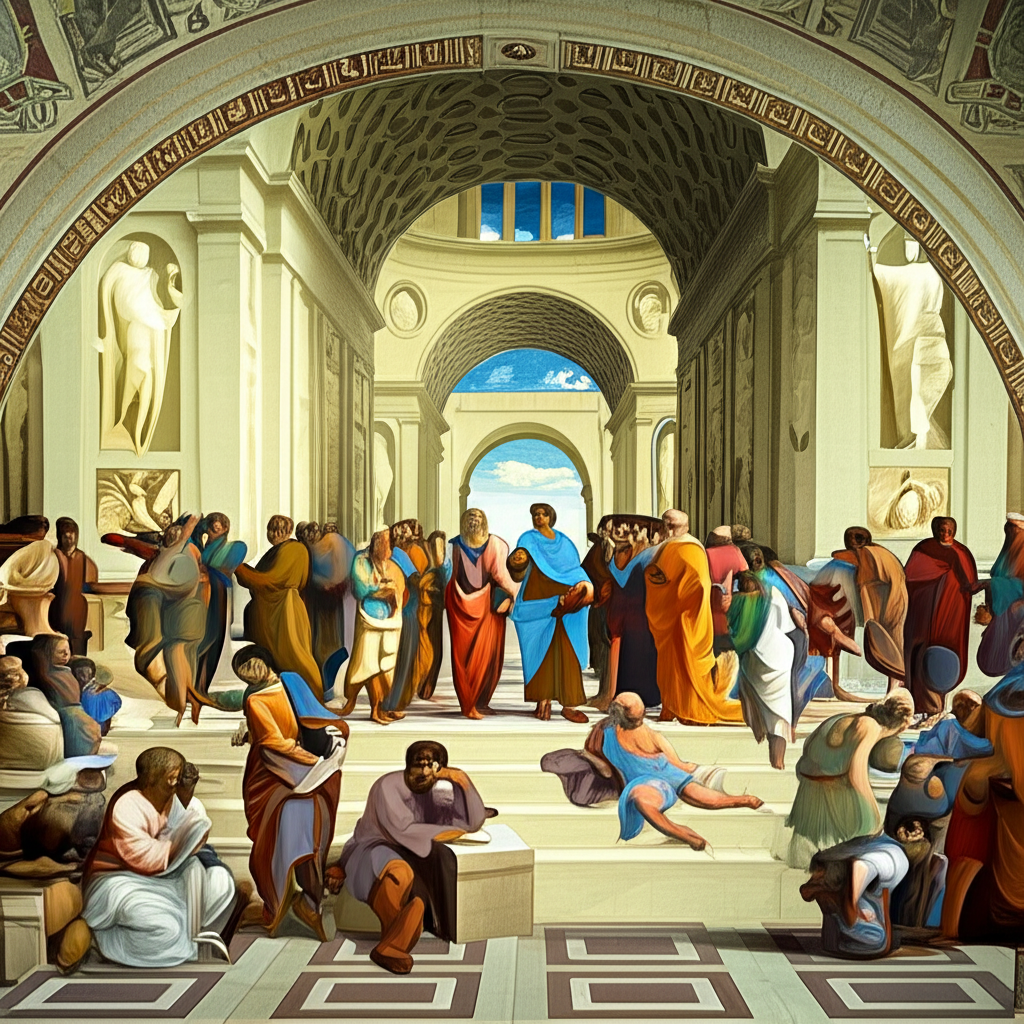
The ancient Greek city-states provided fertile ground for both political experimentation and philosophical reflection on government. Thinkers like Plato and Aristotle, whose insights are cornerstones of the Great Books, meticulously analyzed existing forms and theorized about ideal ones, recognizing the inherent dynamism and potential for change within each system.
Plato's Ideal States and Their Degeneration
In his Republic, Plato envisioned an ideal aristocracy ruled by philosopher-kings, guided by reason and justice. However, he also theorized a natural cycle of degeneration:
- Aristocracy: Rule by the best, based on wisdom.
- Timocracy: Rule by honor, driven by ambition (e.g., Sparta).
- Oligarchy: Rule by wealth, leading to inequality.
- Democracy: Rule by the people, often leading to excessive freedom and anarchy.
- Tyranny: Rule by a single, oppressive individual, emerging from the chaos of democracy.
Aristotle's Taxonomy of Governments
Aristotle, in his Politics, provided a more empirical classification, distinguishing between "correct" forms (aiming for the common good) and "deviant" forms (aiming for the ruler's self-interest). He also emphasized the inevitability of evolution and change between these forms.
| Number of Rulers | Correct Form (Common Good) | Deviant Form (Self-Interest) |
|---|---|---|
| One | Monarchy | Tyranny |
| Few | Aristocracy | Oligarchy |
| Many | Polity (Constitutional Republic) | Democracy (Mob Rule) |
Aristotle's "polity" represented a mixed government, balancing elements of oligarchy and democracy, which he considered the most stable and practical form, capable of resisting radical change.
Medieval Transformations: Feudalism and Early Republics
Following the collapse of the Roman Empire, Europe entered the Medieval period, characterized by fragmented authority and the rise of feudalism. This was a significant change from the centralized Roman state.
- Feudalism: A decentralized system where land was exchanged for service, creating a hierarchy of lords, vassals, and serfs. Power was localized, and the concept of a unified "state" was largely absent.
- The Church's Influence: The Roman Catholic Church emerged as a powerful transnational institution, often challenging or collaborating with secular rulers, adding another layer of complexity to governance.
- Emergence of Republics and City-States: In pockets like Northern Italy, independent city-states (e.g., Venice, Florence) developed republican forms of government, often ruled by wealthy merchant oligarchies, showcasing a different path of evolution from monarchical systems.
The Enlightenment and Modernity: New Social Contracts
The Enlightenment period brought about a profound intellectual change, challenging traditional notions of authority and paving the way for modern democratic thought. Philosophers of the social contract, whose ideas are central to the Great Books, fundamentally reshaped our understanding of government.
- Thomas Hobbes (Leviathan): Argued for a strong, absolute sovereign to prevent the chaos of the "state of nature," where life is "solitary, poor, nasty, brutish, and short." His work justified a powerful, centralized government.
- John Locke (Two Treatises of Government): Posited that individuals possess natural rights (life, liberty, property) and that government is formed through a social contract to protect these rights. If the government fails, the people have a right to revolt, laying the groundwork for constitutionalism and limited government.
- Jean-Jacques Rousseau (The Social Contract): Advocated for popular sovereignty and the "general will," where citizens collectively determine the laws. His ideas heavily influenced revolutionary movements and the concept of direct democracy.
- Baron de Montesquieu (The Spirit of the Laws): Championed the separation of powers (legislative, executive, judicial) as a safeguard against tyranny, a principle foundational to many modern democratic governments.
These thinkers provided the philosophical underpinnings for the American and French Revolutions, ushering in an era dominated by democratic and republican ideals, a monumental change in the history of governance.
📹 Related Video: PLATO ON: The Allegory of the Cave
Video by: The School of Life
💡 Want different videos? Search YouTube for: ""Plato Aristotle government forms explained," "Social contract theory Hobbes Locke Rousseau""
Contemporary Challenges and Continuous Evolution
The 20th and 21st centuries have witnessed further dramatic shifts in government forms. While liberal democracies became prominent, authoritarian regimes, communist states, and various hybrid models also emerged. The evolution continues, driven by globalization, technological advancements, environmental crises, and persistent social inequalities.
- Democratic Consolidation and Retreat: The spread of democracy has been met with periods of democratic backsliding and the rise of illiberal democracies.
- Rise of Technocracy: The increasing influence of expert knowledge in policy-making, sometimes challenging traditional democratic processes.
- Global Governance: The evolution of international organizations and treaties to address shared global challenges, hinting at new forms of collective government beyond nation-states.
The history of government is a testament to humanity's ongoing struggle to organize itself effectively. Each era brings new challenges and new solutions, ensuring that the evolution of governance remains a dynamic and vital field of study.
The Unfolding Tapestry of Governance
The historical evolution of government forms is not a simple narrative but a complex tapestry woven from countless threads of ambition, philosophy, conflict, and cooperation. From ancient monarchies to modern democracies, the fundamental questions of power, authority, and justice have driven a continuous process of change and adaptation. As we look to the future, understanding this rich history and the philosophical underpinnings of different governments is crucial for navigating the ongoing evolution of human societies. The lessons from the Great Books of the Western World remind us that the quest for effective and just governance is an eternal human endeavor.