

The Ever-Turning Wheel: Unpacking the Historical Cycles of Revolution
Revolutions, those tumultuous periods of profound societal change, often appear as singular, cataclysmic events, born of unique circumstances and driven by immediate grievances. Yet, a deeper examination, guided by the wisdom gleaned from the Great Books of the Western World, reveals a more enduring truth: revolutions frequently follow discernible patterns, echoing across epochs and cultures. From ancient city-states to modern nation-states, the forces that ignite, propel, and conclude these upheavals demonstrate a cyclical rhythm, an ever-turning wheel of discontent, transformation, and often, the re-establishment of familiar struggles within a new guise of government. Understanding these historical cycles is not merely an academic exercise; it is crucial for comprehending the enduring human quest for justice, order, and self-governance.
The Anatomy of Discontent: Seeds of Revolution
Every great revolution begins not with a bang, but with a whisper of discontent, growing into a roar as the fabric of the existing government begins to fray. Philosophers from Plato to Locke have meticulously dissected the preconditions for such societal ruptures. Aristotle, in his Politics, observed that seditions, or revolutions, arise fundamentally from inequality, whether perceived or real, and from the desire for equality or superiority. When the ruling class becomes too exclusive, too corrupt, or too detached from the common good, its legitimacy erodes.
- Erosion of Trust: A government that consistently fails to uphold its end of the social contract – whether that contract is implicit, as for Hobbes, or explicit, as for Locke – loses the consent of the governed. When basic rights are trampled, economic disparities become unbearable, or political representation becomes a farce, the ground is fertile for radical change.
- Ideological Ferment: Revolutionary ideas rarely spring from a vacuum. They are often cultivated by intellectuals who articulate the grievances of the populace, providing a coherent philosophical framework for the desired change. Think of the Enlightenment thinkers preceding the French Revolution, or the foundational texts of Marxism preceding socialist uprisings.
- When the social contract frays, the populace begins to question not just the leaders, but the very system of government itself.
The Eruption: The Moment of Upheaval
Once the seeds of discontent have taken root, a spark can ignite the conflagration. This is the active phase of revolution, characterized by popular mobilization, civil unrest, and the often-violent overthrow of the established order. Machiavelli, ever the pragmatist, understood the brutal realities of acquiring and maintaining power during such tumultuous times, noting that new princes must be prepared to act decisively.
Stages of Revolutionary Action:
- Grievance Articulation: Specific injustices become focal points for widespread anger.
- Mobilization: Leaders emerge, galvanizing popular support through rhetoric and organization.
- Confrontation: Direct challenges to state authority, often leading to clashes.
- Overthrow: The collapse of the old government apparatus.
- Consolidation: The attempt to establish a new order and legitimate the new power.
The Aftermath and the New Order: A Cycle Continues
The euphoria of overthrowing an oppressive government is often short-lived. The period immediately following a successful revolution is fraught with peril and presents immense challenges for establishing a stable new order. As Hobbes argued in Leviathan, without a strong, acknowledged authority, society risks descending into a "war of all against all." The ideals that fueled the revolution frequently clash with the practicalities of governance, leading to internal power struggles, purges, and the potential for a new form of tyranny.
Revolutionary Ideals vs. Realities:
| Ideal | Common Reality Post-Revolution |
|---|---|
| Liberty & Freedom | Often curtailed by new authorities seeking to consolidate power or suppress dissent; "enemies of the revolution" frequently targeted. |
| Equality & Justice | New hierarchies can emerge; economic disparities may persist or shift, not disappear; new forms of injustice may arise under the banner of the new order. |
| Popular Sovereignty | Power often concentrates in the hands of a small elite or a charismatic leader, rather than truly residing with the people; the "general will" can be interpreted and enforced by a select few. |
| Democratic Governance | Fragile institutions; susceptibility to coups or strongman rule; difficulty in transitioning from revolutionary fervor to stable, pluralistic democracy. |
| Peace & Stability | Often followed by civil war, external conflicts, or prolonged periods of instability as internal factions vie for control and external powers react to the change. |
This often grim reality reminds us that change itself does not guarantee progress; it merely rearranges the pieces on the chessboard of power.
The Cyclical Nature of History: From Anarchy to Oligarchy and Back
The most profound insight from the Great Books regarding revolution is the notion of historical cycles. Plato, in The Republic, described a degeneration of states from aristocracy to timocracy, oligarchy, democracy, and finally, tyranny. Aristotle elaborated on this in Politics, detailing how various forms of government – monarchy, aristocracy, polity – can decay into their corrupt counterparts – tyranny, oligarchy, democracy (which he saw as mob rule) – and how these often lead back to new forms of rule, completing a cycle.
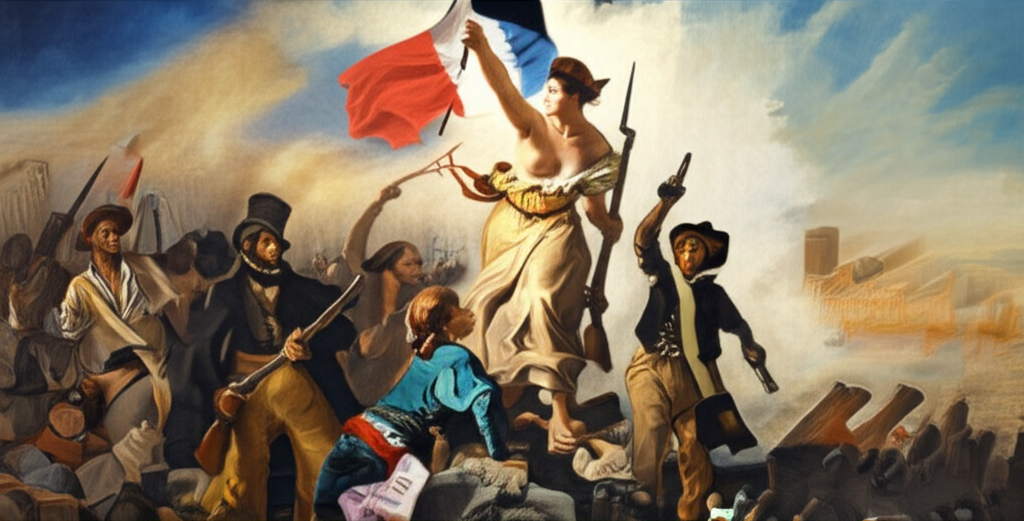
The French Revolution, beginning with the overthrow of monarchy, passing through radical democracy and the Reign of Terror, and culminating in Napoleon's empire, serves as a stark modern example of these ancient observations. The relentless pendulum of power swings, driven by human ambition, the pursuit of justice, and the inherent instability of any system that fails to adapt or address fundamental human needs. While the specific actors and technologies change, the underlying patterns of discontent, eruption, and the struggle to establish a lasting, just government remain remarkably consistent throughout history.
Philosophical Reflections on Enduring Change
What, then, do these historical cycles of revolution teach us? They suggest that while the pursuit of an ideal government is a noble endeavor, it is one perpetually challenged by the complexities of human nature and the shifting tides of societal circumstance. History demonstrates that no political system is immune to decay or immune to the pressures for change. The challenge for any government is not to prevent all change, but to manage it, to adapt, and to continually strive for a just order that minimizes the conditions ripe for violent upheaval. The great thinkers offer not prescriptive formulas, but profound insights into the enduring human condition and the eternal dance between order and liberty, stability and transformation.
Understanding these cycles arms us with a more nuanced perspective, enabling us to see beyond the immediate drama of a revolution and grasp its deeper, recurring philosophical underpinnings. It is a reminder that the work of building and maintaining a good government is an ongoing, intergenerational task, always susceptible to the ever-turning wheel of history.
📹 Related Video: ARISTOTLE ON: The Nicomachean Ethics
Video by: The School of Life
💡 Want different videos? Search YouTube for: ""Aristotle Politics forms of government cycle""
📹 Related Video: PLATO ON: The Allegory of the Cave
Video by: The School of Life
💡 Want different videos? Search YouTube for: ""John Locke Social Contract Theory Revolution""