

The Enduring Metamorphosis of Self-Governance: A Philosophical Journey Through Democracy's History
Summary
Democracy, far from being a static ideal, is a concept and practice that has undergone profound historical change since its inception. This pillar page embarks on a philosophical journey, tracing the evolution of democracy from its ancient Athenian roots to its contemporary forms. We will explore how different thinkers, from the Great Books of the Western World, grappled with questions of popular rule, the nature of government, and the rights of citizens, revealing a continuous dialogue that shapes our understanding of this most debated form of government. This exploration highlights not only the enduring appeal but also the persistent challenges inherent in the aspiration for self-governance.
The Enduring Question of Rule: An Introduction to Democracy's Shifting Sands
From the earliest city-states to the sprawling nations of today, humanity has wrestled with a fundamental question: who should rule, and how? The answer, "the people," seems simple enough, yet the practical and philosophical implications of democracy have been anything but. What one era lauded as enlightened governance, another critiqued as mob rule. The history of democracy is a testament to constant adaptation, redefinition, and often, fierce struggle. It is a story not of a fixed blueprint, but of an evolving ideal, shaped by change in social structures, economic realities, and, crucially, the philosophical insights of the ages.
I. The Genesis of Democracy: Athens and Its Legacy
Our journey begins in ancient Greece, the birthplace of the term demokratia – rule by the people.
A. Athenian Experiment: Direct Participation and Its Limits
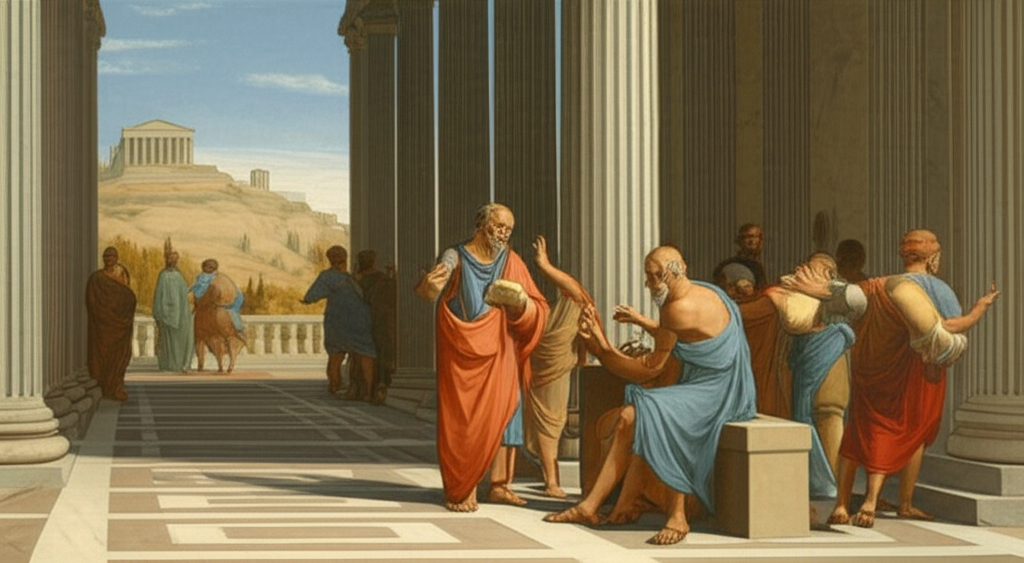
The Athenian model, flourishing in the 5th century BCE, was a radical departure from the monarchies and oligarchies prevalent at the time. It was a system of direct democracy, where eligible male citizens participated directly in the assembly (the Ekklesia), debated laws, and served on juries.
Key Features of Athenian Democracy:
- Direct Participation: Citizens directly voted on legislation and policy.
- Lottery Selection: Many public offices were filled by lot, emphasizing civic duty over professional politics.
- Accountability: Officials were subject to scrutiny and potential recall.
Yet, this revolutionary form of government was not without its limitations and critics. Slavery was widespread, women and foreign residents were excluded, and the sheer logistics of direct rule for a large population were daunting.
B. The Philosophical Foundations Laid: Early Critiques and Classifications
The Greek philosophers, observing the Athenian experiment, provided the first profound analyses of democracy.
- Plato, in his Republic, viewed democracy as a step towards tyranny, fearing its susceptibility to the whims of the uneducated masses and its tendency to descend into anarchy. He advocated for rule by philosopher-kings, an aristocracy of intellect.
- Aristotle, in his Politics, offered a more nuanced classification of government forms. He saw democracy (or polity, as he preferred for a mixed form) as a potentially stable system when the middle class held sway, but warned of its degeneration into ochlocracy (mob rule) when the poor dominated purely for their own interests. His work provided a foundational framework for understanding the strengths and weaknesses of popular rule.
II. The Interregnum: Republicanism and the Medieval Turn
Following the decline of Athenian direct democracy, the idea of popular rule underwent significant transformations, particularly through the Roman Republic and later, medieval European thought.
A. Roman Republic: Representation and the Rule of Law
The Roman Republic (c. 509–27 BCE) introduced a crucial innovation: representation. While not a democracy in the Athenian sense, it featured elected magistrates, a Senate, and assemblies that allowed for a degree of popular input, albeit heavily weighted towards the aristocratic classes. The Roman emphasis on law and institutions provided a powerful counterpoint to the Athenian focus on direct assembly, highlighting the importance of a structured framework for government.
B. Medieval Thought: Divine Right vs. Early Seeds of Consent
During the European Middle Ages, the dominant form of government was monarchy, often justified by the doctrine of divine right. However, even within this framework, seeds of democratic thought were sown. Thinkers like Thomas Aquinas, drawing on Aristotle, discussed the concept of natural law and the idea that rulers had obligations to their subjects. Early forms of representative bodies, such as parliaments and councils, began to emerge, primarily to advise monarchs and consent to taxation, hinting at a nascent principle of popular consent, however limited.
III. The Enlightenment's Democratic Revolution: From Subjects to Citizens
The Enlightenment period (17th-18th centuries) marked a pivotal change in the history of democracy, shifting the philosophical ground from divine right to popular sovereignty and individual rights.
A. The Social Contract Theorists: Justifying Popular Sovereignty
This era saw the rise of social contract theory, which fundamentally altered how government legitimacy was understood.
- Thomas Hobbes, in Leviathan, argued that people consent to an absolute sovereign to escape the "war of all against all," prioritizing order over individual liberty. While not democratic, his idea of a contract laid conceptual groundwork.
- John Locke, in his Two Treatises of Government, provided a powerful philosophical justification for liberal democracy. He posited that individuals possess inherent natural rights (life, liberty, property) and that government derives its legitimacy from the consent of the governed. If the government breaches this trust, the people have a right to revolt. Locke's ideas became the bedrock of modern constitutional democracy.
- Jean-Jacques Rousseau, in The Social Contract, argued for the concept of the "General Will," where citizens collectively determine laws that serve the common good. He favored a form of direct democracy for small states, where citizens could directly participate in expressing the General Will, viewing representation with suspicion.
B. The American and French Revolutions: Putting Theory into Practice
The philosophical currents of the Enlightenment ignited actual political revolutions.
- The American Revolution (1776) resulted in the establishment of a republican government based on popular sovereignty, a written constitution, and a system of checks and balances. The Federalist Papers articulated the rationale for a large, representative republic designed to guard against factionalism and the tyranny of the majority.
- The French Revolution (1789) further propagated the ideals of liberty, equality, and fraternity, though its path to democracy was far more turbulent, demonstrating the inherent difficulties in translating abstract ideals into stable political realities.
IV. The Nineteenth Century: Expansion, Critique, and the Rise of Mass Democracy
The 19th century witnessed the gradual expansion of democratic participation and profound intellectual engagement with its implications.
A. Universal Suffrage and the Problem of "The Many"
The focus shifted from merely establishing republics to broadening the base of political participation. The struggle for universal male suffrage, and later women's suffrage, became central. This expansion raised new questions about the quality of public opinion and the potential for a "tyranny of the majority."
- Alexis de Tocqueville, in Democracy in America, provided an unparalleled analysis of American democracy. He marveled at its egalitarian spirit and the vibrancy of its civil society, but also warned of the dangers of individualism, the potential for a "tyranny of the majority," and the soft despotism that could arise from an overly powerful central government providing for every need.
- John Stuart Mill, in On Liberty and Considerations on Representative Government, championed individual freedom and thought. He advocated for representative government as the best form, but emphasized the need for an educated electorate, protection of minority rights, and the importance of intellectual discourse to prevent democracy from succumbing to mediocrity or the suppression of dissenting views.
B. Industrialization and Social Demands
The Industrial Revolution brought rapid urbanization, new social classes, and immense economic disparities, placing new pressures on democratic systems to address issues of welfare, labor rights, and social justice. This led to the emergence of new political ideologies and movements demanding greater inclusion and economic equality within the democratic framework.
V. Twentieth and Twenty-First Centuries: Challenges, Adaptations, and the Digital Age
The 20th century tested democracy like no other, and the 21st century continues to present unprecedented challenges and opportunities.
A. Totalitarianism and the Defense of Liberal Democracy
The rise of totalitarian regimes (fascism, communism) in the 20th century forced a fierce ideological struggle, pitting liberal democracy against authoritarian alternatives. World Wars and the Cold War underscored the fragility of democratic institutions and the constant need for their defense, both externally and internally. The post-war era saw a significant spread of democratic government, often linked to economic development and international cooperation.
B. Global Spread and Democratic Backsliding
The late 20th century brought a wave of democratization, particularly after the collapse of the Soviet Union. However, the early 21st century has seen concerning trends of "democratic backsliding," where established democracies weaken, and newly established ones falter. Factors contributing to this include:
- Economic Inequality: Growing gaps between rich and poor can erode faith in democratic institutions.
- Populism: The rise of populist leaders who often challenge established norms and institutions.
- Disinformation: The spread of false information, often amplified by digital media, can undermine informed public discourse.
- Polarization: Deepening political divisions make consensus and compromise difficult.
C. The Future of Democracy: Deliberation, Inclusion, and Resilience
Today, the debate continues regarding the optimal form of democracy.
| Aspect of Democracy | Historical Evolution | Contemporary Challenges/Debates |
|---|---|---|
| Participation | Direct (Athens) -> Representative (Rome/Modern) -> Universal Suffrage | Low voter turnout, digital engagement, deliberative models |
| Scope of Gov't | Limited (Locke) -> Expanding (Welfare State) -> Debates on intervention | State size, public services, market regulation |
| Decision-Making | Assembly (Athens) -> Legislature (Modern) -> Referenda, Expert Panels | Gridlock, speed of decision-making, technocracy |
| Inclusion | Elite males (Athens) -> Property owners (early modern) -> All citizens | Minority rights, identity politics, digital divides |
The digital age presents both promise and peril. While social media can foster citizen engagement and protest movements, it also facilitates the spread of misinformation and the formation of echo chambers. The future of democracy hinges on our ability to foster genuine deliberation, ensure equitable inclusion, strengthen civic education, and build resilient institutions capable of adapting to rapid change.
Conclusion: The Unfolding Narrative of Self-Governance
The historical change in democracy is not merely a chronicle of political systems; it is a profound philosophical narrative about human agency, the quest for justice, and the perennial struggle to balance liberty with order. From the Agora of Athens to the digital forums of the 21st century, the concept of government by the people has been continuously challenged, refined, and redefined. The Great Books of the Western World offer a rich tapestry of thought that reminds us that democracy is not a destination but an ongoing, often arduous, journey – a dynamic process that demands constant vigilance, critical engagement, and a renewed commitment to its founding principles. As Daniel Fletcher, I believe the greatest lesson from this history is that democracy is less a fixed structure and more a living organism, constantly evolving, always requiring our active participation and thoughtful stewardship.
**## 📹 Related Video: PLATO ON: The Allegory of the Cave
Video by: The School of Life
💡 Want different videos? Search YouTube for: ""Plato's Republic democracy critique" OR "John Locke social contract democracy""**
**## 📹 Related Video: PLATO ON: The Allegory of the Cave
Video by: The School of Life
💡 Want different videos? Search YouTube for: ""Alexis de Tocqueville Democracy in America explained" OR "The Future of Democracy philosophical debate""**