

The Ever-Evolving Polis: A Philosophical Journey Through the Historical Change in Democracy
Democracy, as a form of government, is often heralded as the pinnacle of human political organization, a system where the people hold the power. Yet, to view it as a monolithic, unchanging ideal is to misunderstand its profound history and relentless change. From its nascent stirrings in ancient city-states to its complex, often fragile manifestations across the globe today, democracy has been a crucible of human aspiration and societal struggle, constantly redefined by philosophical inquiry, social pressures, technological advancements, and the enduring quest for justice and order. This pillar page embarks on a philosophical exploration of this dynamic evolution, tracing the significant transformations that have shaped, challenged, and reshaped the very essence of self-governance.
The Genesis of Self-Rule: Ancient Roots of Democracy
Our journey into the history of democracy inevitably begins in the classical world, where the very concept of popular government first took discernible form. This was not, however, a democracy as we understand it today, but a unique political experiment fraught with its own limitations and philosophical critiques.
Athens: The Cradle and Its Contradictions
The Athenian polis of the 5th century BCE stands as the quintessential example of early democracy. Here, direct participation was the norm, with male citizens gathering in the Ecclesia to debate and vote on laws, and serving by lot on juries and councils. It was a radical departure from monarchical or oligarchic rule, embodying the ideal of isonomia (equality before the law) and isegoria (equality of speech).
However, this vibrant system was profoundly limited. A significant portion of the population – women, slaves, and resident foreigners – were excluded from citizenship, highlighting a fundamental tension between the ideal of popular rule and the realities of social hierarchy. Philosophers like Plato, in his Republic, viewed democracy with suspicion, arguing that it could easily devolve into mob rule or tyranny due to the ignorance and emotional sway of the masses. Aristotle, in his Politics, offered a more nuanced classification, seeing democracy (rule by the poor) as a deviation from polity (a mixed constitution), yet acknowledging its potential for stability if properly balanced.
Rome: Republic to Empire – A Different Path
While not a direct democracy, the Roman Republic (509 BCE – 27 BCE) offered another significant model of self-governance, emphasizing representative institutions and the rule of law. Its system of elected magistrates, a powerful Senate, and popular assemblies (though often dominated by the elite) showcased a different approach to balancing popular will with aristocratic influence. The Roman experience, chronicled by figures like Polybius and Livy, illustrated the struggles inherent in maintaining republican virtues against the corrupting forces of ambition and expansion, ultimately succumbing to the centralized power of empire.
| Feature | Athenian Democracy (c. 5th BCE) | Roman Republic (c. 3rd-1st BCE) |
|---|---|---|
| Form of Gov. | Direct Democracy | Representative Republic |
| Citizenship | Free-born adult males | Free-born males (with varying rights) |
| Key Institutions | Ecclesia (Assembly), Boule (Council), Dikasteria (Courts) | Senate, Consuls, Popular Assemblies (Comitia) |
| Philosophical View | Praised by Pericles, critiqued by Plato, analyzed by Aristotle | Idealized by Cicero, analyzed by Polybius |
| Limitations | Excluded women, slaves, foreigners | Class divisions, expansion's strain, eventual collapse into Empire |
The Long Interregnum: Medieval Monarchy and Emerging Ideas
Following the fall of Rome, Europe entered a period dominated by feudalism, monarchy, and ecclesiastical authority. The concept of popular government largely receded, replaced by systems based on inherited power, divine right, and hierarchical social structures.
Feudalism and the Absence of Popular Government
In the medieval era, power was highly decentralized yet fundamentally undemocratic. Loyalty was owed upwards through a chain of fealty, from serf to lord, lord to king. The idea of citizens participating in governance was alien to this structure, where rights were largely tied to status and land ownership, not universal personhood.
Seeds of Dissent: Magna Carta and Early Representative Forms
Despite the prevailing monarchical systems, the seeds of future change were being sown. The Magna Carta (1215) in England, though initially a charter for barons, established the principle that even the king was subject to the law and laid groundwork for future constitutionalism. The emergence of parliamentary bodies, such as the English Parliament or the French Estates-General, while far from democratic, represented nascent forms of consultation and limited representation, where various estates (clergy, nobility, commoners) could voice concerns, albeit with vastly unequal power. These were crucial steps in the history of limiting absolute government.
Rebirth and Revolution: The Enlightenment's Democratic Impulse
The intellectual ferment of the Renaissance and Reformation, coupled with burgeoning scientific inquiry, paved the way for the Enlightenment – a period that fundamentally reshaped political thought and reignited the flame of democracy.
Philosophical Foundations: Locke, Rousseau, Montesquieu
The 17th and 18th centuries saw a radical rethinking of the relationship between the individual and the state. John Locke, in his Two Treatises of Government, posited that government derives its legitimacy from the consent of the governed and that individuals possess inherent natural rights (life, liberty, property) that no state can legitimately infringe upon. Jean-Jacques Rousseau's The Social Contract championed popular sovereignty and the "general will," arguing for a form of participatory government where citizens directly express their collective desires. Montesquieu, in The Spirit of the Laws, advocated for the separation of powers (legislative, executive, judicial) as a crucial safeguard against tyranny, a principle that would profoundly influence future constitutional design. These thinkers provided the intellectual arsenal for revolutionary change.
The American Experiment: A New Republic
Inspired by Enlightenment ideals, the American Revolution (1775-1783) led to the establishment of a new kind of government – a representative republic. The U.S. Constitution, a landmark document, enshrined principles like popular sovereignty, federalism, and the separation of powers. However, this nascent democracy was also deeply flawed. The institution of slavery contradicted its foundational claims of liberty and equality, and suffrage was initially limited to white, propertied men. The debates among the Founders, as captured in The Federalist Papers, reveal the ongoing philosophical tension between ensuring popular rule and guarding against its potential excesses.
The French Revolution: Ideals and Excesses
Almost immediately following the American Revolution, France erupted in 1789, unleashing a torrent of revolutionary change that sought to dismantle the old order and establish government based on liberty, equality, and fraternity. While it championed universal rights and popular sovereignty more explicitly than its American predecessor, the French Revolution also descended into the "Reign of Terror," demonstrating the perilous path of radical democracy when unmoored from stable institutions and tempered reason. The history of this period underscores the fragile balance between revolutionary fervor and the need for enduring political stability.
Expanding Horizons: Modern Democracy and Its Challenges
The 19th and 20th centuries witnessed the gradual, often tumultuous, expansion of democratic principles and practices across the globe, alongside new challenges to the very nature of government.
The Age of Suffrage: Expanding the Franchise
A defining characteristic of modern democracy's change has been the relentless expansion of suffrage. The fight for universal male suffrage in the 19th century was followed by the crucial struggle for women's voting rights in the early 20th century, and the civil rights movements that dismantled racial barriers to voting. These movements fundamentally altered who constituted "the people" in popular government, moving closer to the ideal of inclusive representation.
Representative vs. Participatory: Debates on Government's Form
As democracy spread, so too did debates about its optimal form. The prevalence of large, complex nation-states made direct democracy impractical, cementing the role of representative government. However, contemporary thinkers continue to explore models of deliberative and participatory democracy, seeking ways to enhance citizen engagement beyond periodic elections and counter the perceived alienation of modern political life.
Global Spread and Retreat: The 20th and 21st Centuries
The 20th century saw waves of democratization, particularly after the two World Wars and the collapse of the Soviet Union. Yet, the 21st century has brought new anxieties, with the rise of illiberal democracy, populist movements, and authoritarian resurgence challenging the very foundations of democratic government. The history of democracy is not a linear march of progress but a constant oscillation between expansion and contraction, progress and peril.
Enduring Challenges to Modern Democracy
- Political Polarization: The fragmentation of public discourse and the rise of partisan animosity.
- Misinformation and Disinformation: The erosion of shared facts and the manipulation of public opinion, particularly via digital platforms.
- Economic Inequality: The tension between democratic ideals of equality and widening wealth gaps.
- Erosion of Trust in Institutions: Declining confidence in government, media, and other pillars of society.
- Technological Disruption: The impact of AI, automation, and surveillance on civic life and individual liberty.
- Global Authoritarianism: The resurgence of non-democratic regimes and their influence on international norms.
The Philosophical Pulse: Why Democracy Changes
The constant change in democracy is not merely a historical accident but a reflection of deep philosophical tensions and the evolving nature of human society.
The Dialectic of Ideals and Realities
Plato's cyclical theory of government – from aristocracy to timocracy, oligarchy, democracy, and finally tyranny – suggests an inherent instability in political forms. While perhaps overly deterministic, it highlights the constant interplay between an ideal (e.g., pure democracy) and the practical realities that shape and often distort it. Aristotle's concept of the "mixed constitution" was an attempt to mitigate these inherent instabilities by blending elements of different forms of rule, acknowledging that no single form of government is perfect or immune to change.
Technology, Information, and the Digital Polis
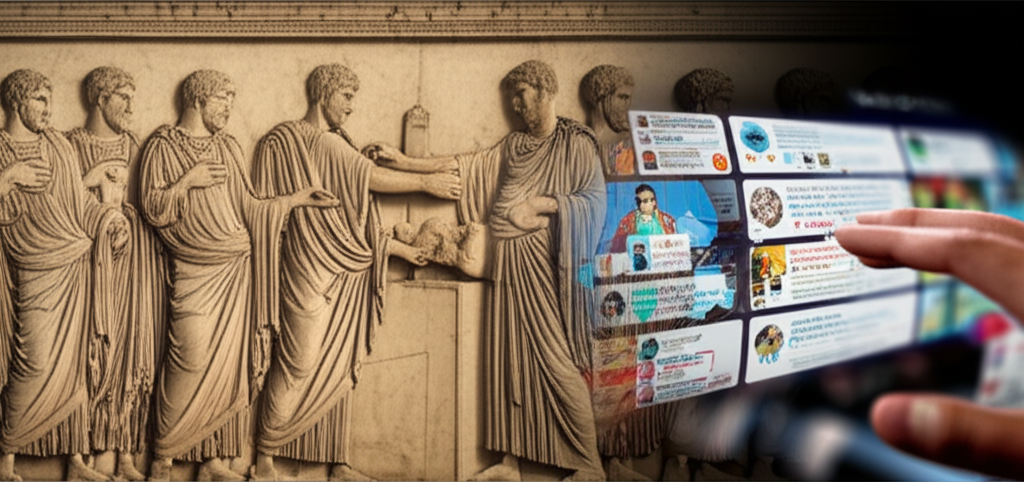
The information age has introduced unprecedented factors into the democratic equation. Social media platforms, while offering new avenues for political participation and mobilization, also present challenges like echo chambers, the rapid spread of misinformation, and the potential for foreign interference in elections. The very nature of public discourse and civic engagement is undergoing a profound change, compelling us to reconsider the mechanisms of a healthy democracy.
The Eternal Struggle: Liberty, Equality, and Order
At its core, the history of democracy is a continuous negotiation of fundamental philosophical values: liberty (individual freedom), equality (equal rights and opportunities), and order (stability and security). Different eras and societies have prioritized these values differently, leading to diverse democratic forms and persistent debates about the proper role of government. The change in democracy is, in essence, the ongoing human attempt to reconcile these often-competing ideals within the constraints of real-world politics.
The Unfinished Symphony of Self-Governance
The history of democracy is not a static text but a living, breathing narrative of continuous change. From the limited direct participation of ancient Athens to the complex representative systems of today, the concept and practice of popular government have been in a perpetual state of evolution. This journey underscores that democracy is not a destination but an ongoing process, a constant striving to balance the ideals of liberty and equality with the practical demands of order and effective governance. As we navigate the complexities of the 21st century, understanding this rich history of change is not merely an academic exercise but a critical imperative for safeguarding and reimagining the future of self-rule. The philosophical questions that have always underpinned democracy remain as vital and urgent as ever.
📹 Related Video: PLATO ON: The Allegory of the Cave
Video by: The School of Life
💡 Want different videos? Search YouTube for: ""Plato's Republic democracy critique explained""
📹 Related Video: KANT ON: What is Enlightenment?
Video by: The School of Life
💡 Want different videos? Search YouTube for: ""The Enlightenment and modern democratic thought""