

The Subjective Fabric of Reality: Exploring the Experience of Time and Space
The objective measurements of time and space, as dictated by clocks and rulers, offer a stark contrast to their profound and often enigmatic experience within human consciousness. This article delves into how we, as sentient beings, sense and interpret these fundamental dimensions, moving beyond their scientific definitions to explore their subjective, lived reality. We will uncover how our minds actively shape our perception of duration and extension, drawing on philosophical insights that have pondered these mysteries for millennia. From the fleeting moment to the boundless expanse, our experience of time and space is a rich tapestry woven by perception, memory, and anticipation, profoundly influencing our understanding of existence itself.
The Elusive Sense of Time
Time, for all its universality, is perhaps the most personal of our dimensions. It is not merely a succession of moments measured by an external clock, but a deeply felt current that flows, ebbs, and occasionally stands still within our consciousness.
- Duration and Succession: Our primary experience of time is as duration – the persistence of an event – and succession – one event following another. This inherent sense of order allows us to construct narratives, learn from the past, and plan for the future. Aristotle, in his Physics, grappled with time as the "number of motion with respect to 'before' and 'after'," tying it intrinsically to change and our perception of it.
- The Elasticity of Moments: Who hasn't felt time accelerate during joy or drag interminably during boredom? This elasticity highlights the subjective nature of our temporal experience. A minute spent in anticipation can feel like an hour, while an hour lost in flow state can vanish in a blink. This phenomenon underscores that our emotional and cognitive states profoundly modulate our internal clock.
- Memory and Anticipation: Our experience of time is not confined to the present moment. Memory binds us to the past, allowing us to revisit previous durations, while anticipation projects us into the future, shaping our present actions. This constant interplay between past, present, and future forms the continuous stream of our conscious experience of time.
Navigating the Landscape of Space
Just as time is more than clock ticks, space is more than mere coordinates on a map. It is the arena of our existence, perceived through our senses and interpreted by our minds, giving rise to a personal geography of meaning.
- Spatial Awareness and Embodiment: Our sense of space begins with our own bodies. We are inherently spatial beings, occupying a volume, moving through an environment, and perceiving objects in relation to ourselves. This embodied experience forms the bedrock of our understanding of distance, direction, and dimension.
- The A Priori Intuition: Immanuel Kant, in his Critique of Pure Reason (a cornerstone of the Great Books), argued that space is not an empirical concept derived from outer experience, but rather an a priori intuition, a fundamental framework through which our minds organize sensory data. We don't perceive space in the world; rather, we perceive the world through the lens of space. This suggests that our experience of space is a condition for our perception of objects, not a consequence of it.
- Meaningful Spaces: Beyond its geometric properties, space acquires meaning through our interactions. A home is not just a structure of walls; it's a sanctuary imbued with memories. A vast, open landscape can evoke feelings of freedom or insignificance. Our experience of space is thus deeply intertwined with our emotional and psychological states, transforming objective dimensions into subjective realms.
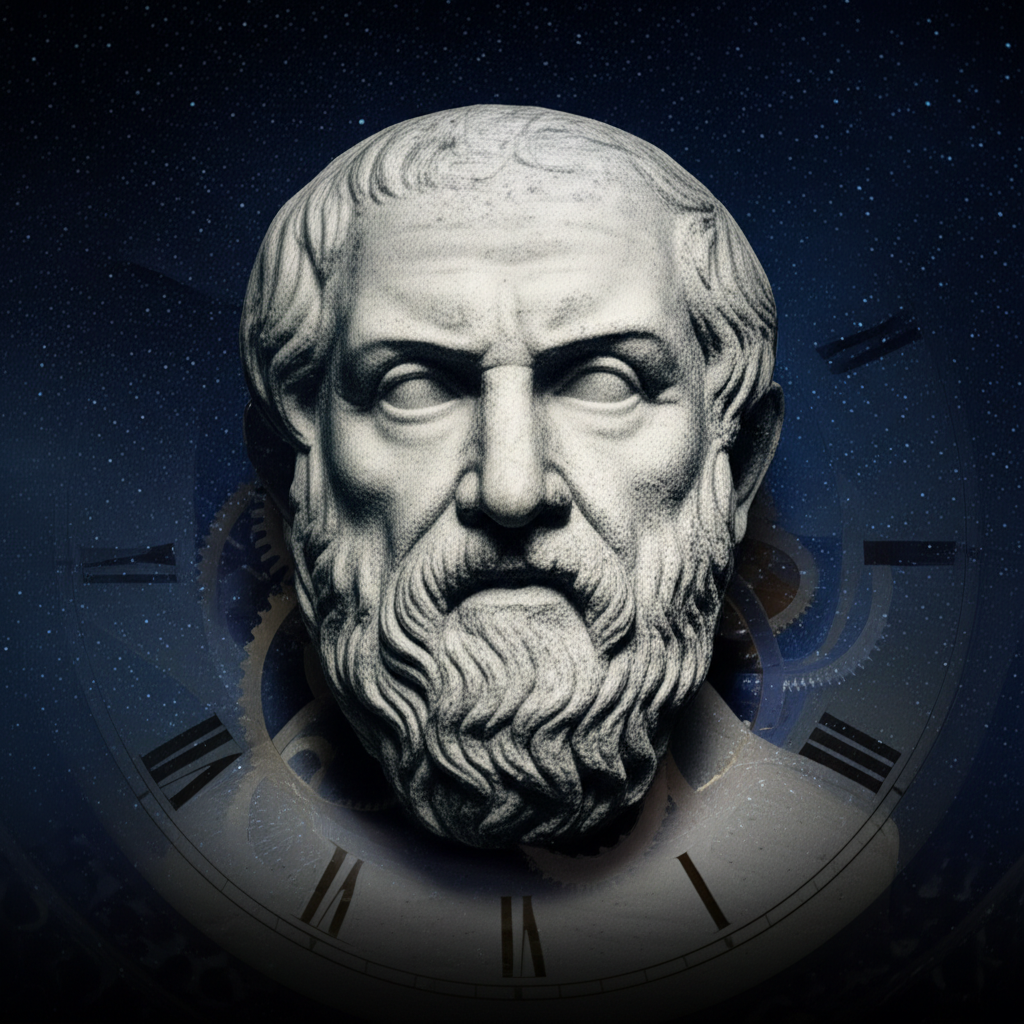
The Indivisible Unity: Time and Space Intertwined
While we discuss them separately for clarity, our experience of time and space is, in reality, inextricably linked. We do not experience one without the other.
Consider the following aspects of their interwoven nature:
- Movement: Any movement through space inherently takes time. Walking from one room to another involves both a change in spatial coordinates and the passage of a certain duration. Our sense of distance is often gauged by the time it takes to traverse it.
- Perception of Change: We perceive changes in space over time. A tree grows taller, a building ages, a river carves a new path. These temporal processes are observed through their spatial manifestations.
- Memory's Spatial-Temporal Maps: Our memories are often stored with both a temporal tag ("when it happened") and a spatial context ("where it happened"). Recalling an event often involves reconstructing the space in which it occurred and the time at which it unfolded.
| Aspect of Experience | Time Focus | Space Focus | Interconnection |
|---|---|---|---|
| Perception | Succession of events, duration, rhythm | Relative position, distance, volume, orientation | Observing an object's movement (spatial change over time) |
| Subjectivity | Time "flies" or "drags," emotional significance | Personal comfort in a room, feeling "lost" or "found" | A journey (spatial traversal) feels long or short (temporal experience) |
| Cognition | Memory of past events, anticipation of future | Mental maps, understanding of environment | Recalling an event's setting and sequence |
Conclusion: The Human Canvas of Reality
The experience of time and space is not a passive reception of external data but an active construction by consciousness. From the ancient Greek philosophers pondering the nature of being and becoming, to the Enlightenment thinkers dissecting the mechanisms of perception, the Great Books of the Western World consistently return to these fundamental questions. Our sense of these dimensions is deeply personal, influencing not just how we navigate the world, but how we understand our place within it. To truly grasp the world, we must first understand how our own minds shape the very fabric of our reality, transforming objective measurements into a rich, subjective experience.
📹 Related Video: KANT ON: What is Enlightenment?
Video by: The School of Life
💡 Want different videos? Search YouTube for: ""Kant's Philosophy of Space and Time Explained""
📹 Related Video: ARISTOTLE ON: The Nicomachean Ethics
Video by: The School of Life
💡 Want different videos? Search YouTube for: ""Bergson on Time and Duration: A Philosophical Exploration""