

The Fabric of Our Reality: Navigating the Experience of Time and Space
Summary: Our understanding of time and space extends far beyond mere physical dimensions; it delves into the profound philosophical question of how we experience these fundamental categories. This article explores the intricate ways human consciousness shapes our sense of temporal flow and spatial extension, drawing on insights from the Great Books of the Western World to reveal that time and space are not just objective realities, but deeply personal and subjective experiences. We will investigate how philosophers have grappled with the nature of these concepts, moving from their objective measurement to their subjective apprehension, ultimately revealing the mind's central role in constituting our reality.
Introduction: Beyond the Clock and the Map
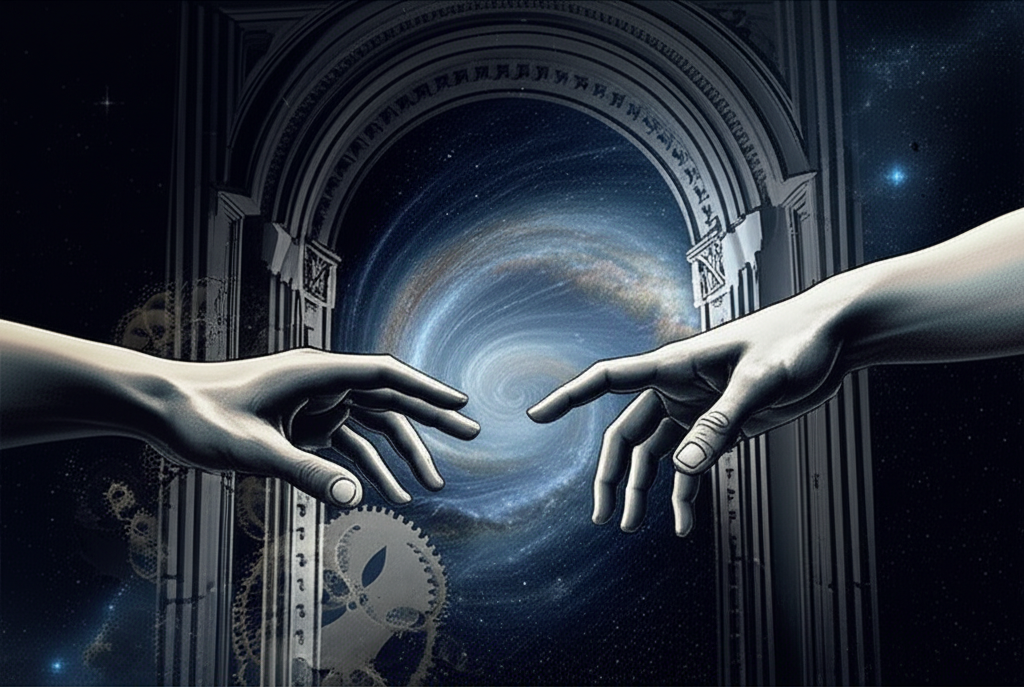
We live, move, and have our being within the twin frameworks of time and space. Yet, how often do we truly pause to consider the experience of them? Is time an unyielding, linear progression, or a malleable sense shaped by our internal states? Is space an absolute, empty container, or a relational construct defined by the objects within it and our perception of them? For centuries, philosophers have wrestled with these questions, moving beyond the scientific measurement of time and space to probe their subjective, phenomenal dimensions. This exploration, deeply rooted in the Western philosophical tradition, reveals that our most basic experience of reality is far more complex and fascinating than it first appears.
The Subjective Lens: How We Sense Time and Space
The journey into the experience of time and space inevitably leads us to the doorstep of human consciousness. It's here that the objective, measurable aspects of these concepts begin to warp and bend, shaped by our individual minds.
-
Augustine's Inner Time: In his Confessions, St. Augustine famously pondered the nature of time, concluding that it is a "distension of the soul." He grappled with how we measure time when the past is no more and the future is not yet, suggesting that time exists primarily in our present apprehension of memory and anticipation. Our experience of time is thus not external, but an internal stretching of our minds. This profound insight highlights how our sense of time is intrinsically linked to our psychological state – moments of joy fly by, while periods of boredom drag on.
-
Kant's A Priori Intuitions: Immanuel Kant, in his Critique of Pure Reason, posited that time and space are not empirical concepts derived from experience, but rather a priori forms of intuition inherent in the structure of our minds. They are the necessary preconditions for any experience at all. We sense objects in space and events in time because our minds are pre-wired to perceive them this way. Without these innate frameworks, the raw data of sensation would be an unintelligible chaos. For Kant, the experience of time and space is fundamental to how we organize and understand the world.
Time: A River, a Measure, or a Mental Construct?
The experience of time is perhaps one of the most enigmatic aspects of our existence. Is it a universal river flowing steadily, or a personal current we navigate?
Philosophical Perspectives on the Nature of Time
| Philosopher | Core Idea of Time | Emphasis on Experience/Sense |
|---|---|---|
| Aristotle | The "number of motion" with respect to "before" and "after". | Measured by change, requiring a soul to count or perceive. |
| St. Augustine | A "distension of the soul," existing in the present of things. | Deeply subjective; rooted in memory, attention, and expectation. |
| Isaac Newton | Absolute, true, and mathematical time; flows uniformly. | Objective, independent of any external referent or observer. |
| Immanuel Kant | An a priori form of intuition; the way the mind structures phenomena. | Necessary condition for all experience; not a concept, but a form. |
While Newton conceived of an absolute time flowing independently of all things, a concept that underpins much of classical physics, the philosophical experience of time often diverges. Our sense of time's passage can accelerate or decelerate based on our emotional state, attention, or engagement. A thrilling adventure compresses hours into minutes, while waiting for news stretches minutes into hours. This discrepancy highlights the chasm between objective measurement and subjective experience.
Space: Absolute Container or Relational Tapestry?
Just as time holds different meanings, so too does space. Our experience of space defines our sense of place, distance, and proximity.
The Debate on Spatial Reality
The philosophical debate concerning space largely crystallized around two opposing views:
-
Absolute Space (Newton): Isaac Newton argued for an absolute space that exists independently of any objects within it. It is an unmoving, infinite container, providing the stage upon which all events unfold. Our sense of motion and location is relative to this absolute, invisible framework. The experience of moving "through" space implies this underlying, independent reality.
-
Relational Space (Leibniz): Gottfried Wilhelm Leibniz countered that space is not an independent entity but merely a system of relations between objects. Remove all objects, and space itself vanishes. Our experience of space is always an experience of the arrangement and distance between things. There is no empty space; there are only relations. Therefore, our sense of "here" versus "there" is always contingent on what else is present.
The experience of navigating a crowded city street versus an open desert profoundly illustrates these concepts. In the city, our sense of space is highly relational, defined by buildings, people, and pathways. In the desert, the vastness might evoke a feeling closer to absolute space, yet even there, our perception of distance is relative to the few landmarks available.
The Intertwined Experience: Spacetime and Consciousness
While historically treated as distinct, the experience of time and space is often intrinsically linked. We rarely sense one without the other. A journey (movement through space) takes a certain duration (time). A memory (an event in time) often has a specific location (in space).
Modern physics, particularly Einstein's theory of relativity, formalized this connection with the concept of spacetime, where time and space are not separate but interwoven into a single continuum. While this is a scientific model, it resonates with our intuitive experience: our lives are a sequence of events unfolding in specific places. The sense of "being there then" is a holistic experience of spacetime.
Ultimately, the profound philosophical inquiry into the experience of time and space reveals the power of consciousness. Whether they are a priori forms of intuition, "distensions of the soul," or systems of relations, our minds are not passive receivers but active constructors of these fundamental aspects of reality. To understand time and space is, in essence, to understand the very nature of our own experience.
YouTube Video Suggestions:
-
📹 Related Video: What is Philosophy?
Video by: The School of Life
💡 Want different videos? Search YouTube for: ""Augustine on Time Philosophy Explained""
2. ## 📹 Related Video: KANT ON: What is Enlightenment?
Video by: The School of Life
💡 Want different videos? Search YouTube for: ""Kant's Philosophy of Space and Time Explained""